
We read your photo as:
A circuit consists of a 5V source, a 100 ohm resistor R, and two diodes D1 and D2 in series. Calculate the voltage drops and current for two scenarios: a) The circuit is serviceable. b) D2 is shorted
Physics
ScanSolve AI Answer
Answers
2 partsStep-by-step solution
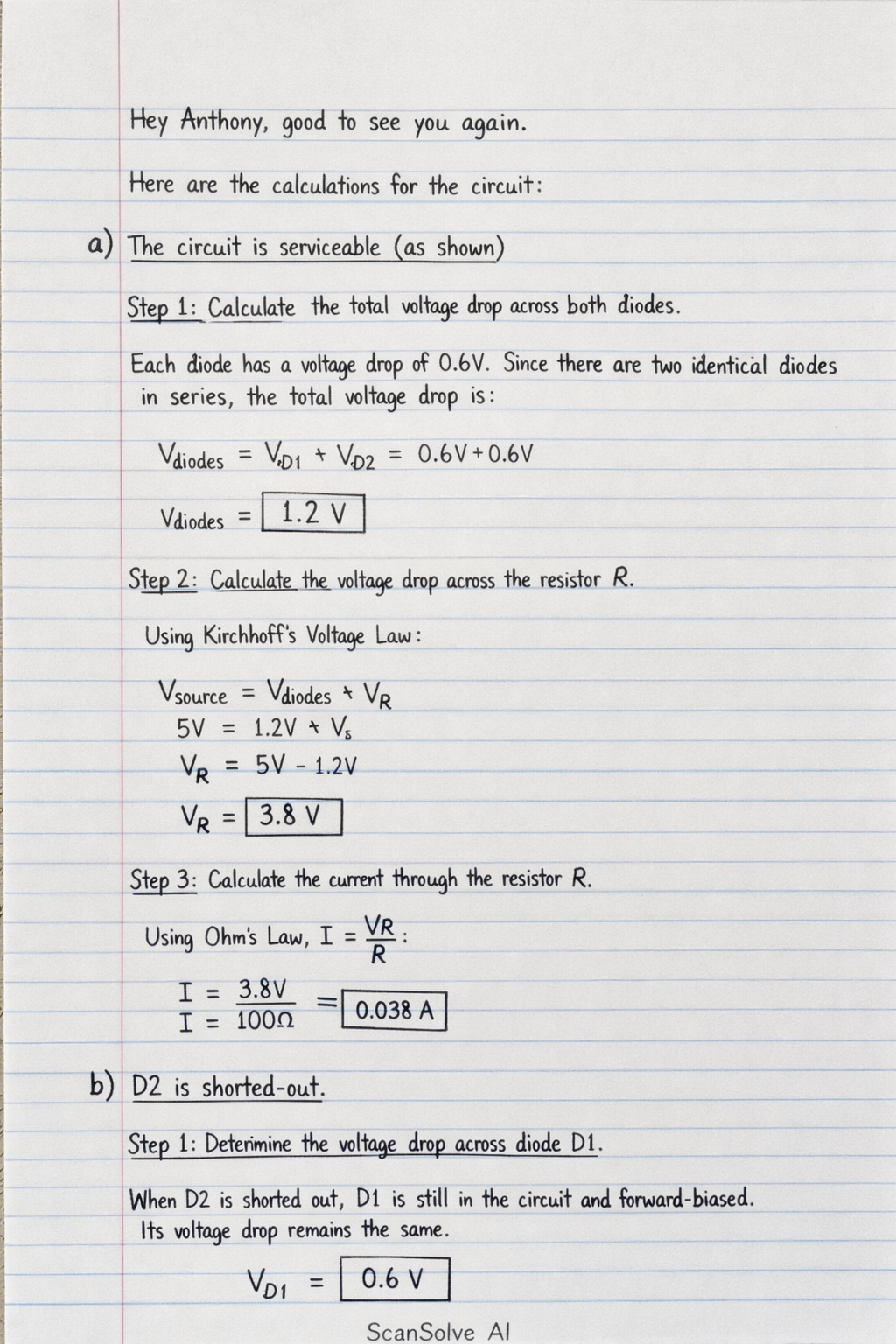
6 stepsHere are the calculations for the circuit:
Part a· 3 steps
The circuit is serviceable (as shown)
Calculate the total voltage drop across both diodes.
Each diode has a voltage drop of . Since there are two identical diodes in series, the total voltage drop is:
Calculate the voltage drop across the resistor R.
Using Kirchhoff's Voltage Law, the sum of voltage drops in a series circuit equals the supply voltage.
Calculate the current through the resistor R.
Using Ohm's Law, :
Part b
D2 is shorted-out
Determine the voltage drop across diode D1.
When D2 is shorted out, D1 is still in the circuit and forward-biased. Its voltage drop remains the same.
Calculate the voltage drop across resistor R.
Since D2 is shorted out, its voltage drop is . Using Kirchhoff's Voltage Law:
Calculate the current through resistor R.
Using Ohm's Law, :
Was this helpful?
Still stuck on this one?
Ask a follow-up, and the answer starts from this question.
Got a different question?Ask your own question
More Physics Questions
QCalculate the following when D2 is shorted-out: (i) Current through the resistor R, (ii) Voltage…QFor the circuit, calculate: i. The total circuit resistance ii. The voltage-drop across the 50…QA circuit has two resistors in parallel, R1 = 4 ohms and R2 = 12 ohms, connected to a 9 V battery…QThe circuit in Fig 4 has a 60V voltage source, a 10Ω resistor, a 30Ω resistor, a 20Ω resistor, and a…QA circuit has a 3 Ohm and a 6 Ohm resistor in series with a parallel combination of a 4.5 Ohm and a…
Browse by topic:Electrical Engineering
Handwritten Step-by-Step Solution
Get this as a handwritten image on WhatsApp — like a tutor wrote it for you.
Try on WhatsApp