
We read your photo as:
Name the THREE basic gas processes..
ScanSolve AI Answer
Step-by-step solution
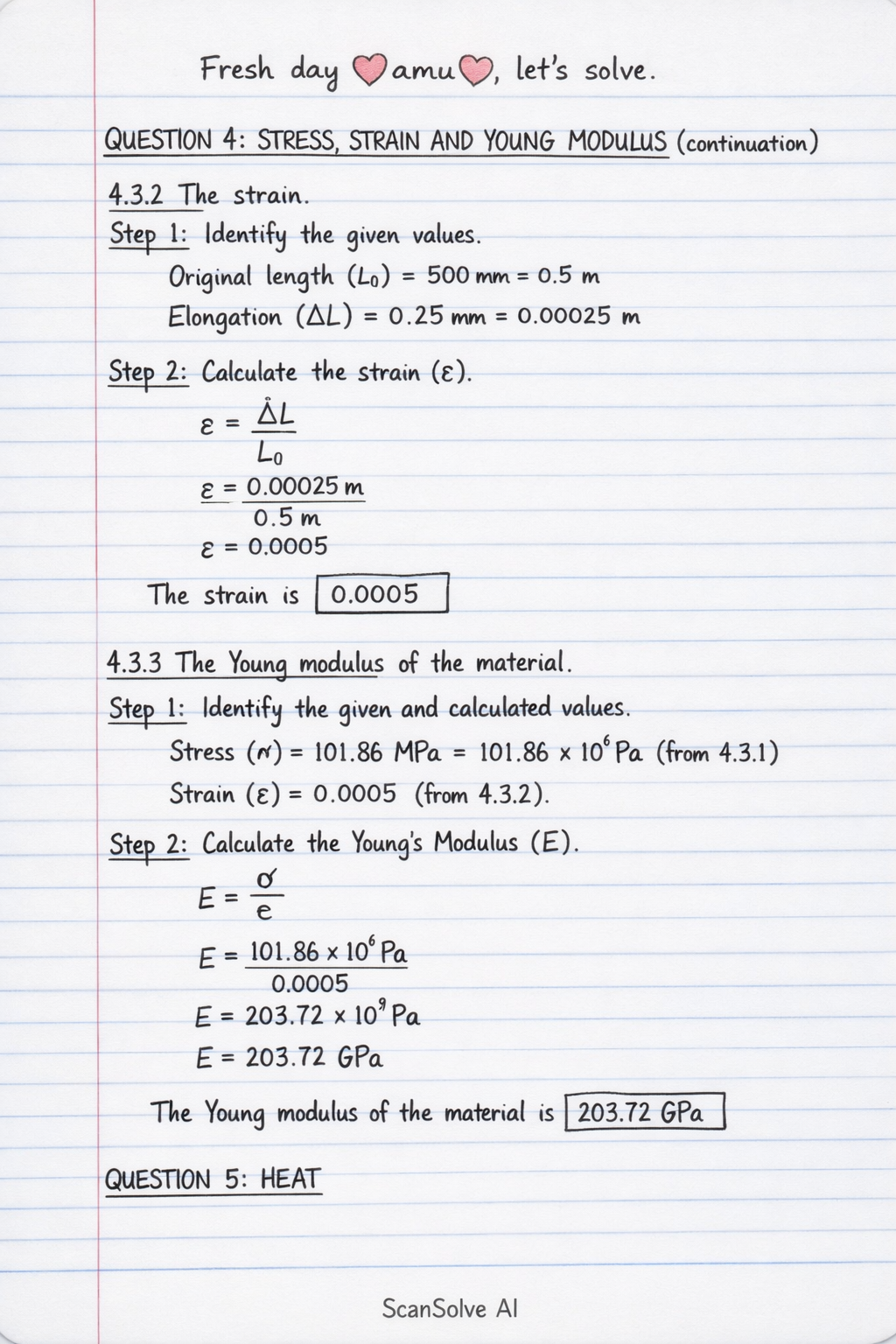
11 stepsQUESTION 4: STRESS, STRAIN AND YOUNG MODULUS (continuation)
4.3.2 The strain.
Identify the given values.
Original length () = 500 mm = 0.5 m
Elongation () = 0.25 mm = 0.00025 mCalculate the strain ().
The strain is .
4.3.3 The Young modulus of the material.
Identify the given and calculated values.
Stress () = 101.86 MPa = Pa (from 4.3.1)
Strain () = 0.0005 (from 4.3.2)Calculate the Young's Modulus ().
The Young modulus of the material is .
QUESTION 5: HEAT
5.1 Name the THREE basic gas processes.
- Isobaric process (constant pressure)
- Isochoric process (constant volume)
- Isothermal process (constant temperature)
5.2 A square metal plate with sides 1 m long is at a temperature of 31 °C. There is a hole of 600 mm in diameter in the centre. The linear coefficient of expansion of the metal is /K.
5.2.1 Calculate: The temperature of the metal plate in if it is heated until the sides are 1,005 m long.
Identify the given values.
Initial length () = 1 m
Final length () = 1.005 m
Initial temperature () = 31 °C
Linear coefficient of expansion () = /KCalculate the change in temperature ().
The formula for linear expansion is .
Calculate the final temperature ().
The final temperature of the metal plate is .
5.2.2 The diameter of the hole at this temperature.
Identify the given and calculated values.
Initial hole diameter () = 600 mm = 0.6 m
Linear coefficient of expansion () = /K
Change in temperature () = 400 K (from 5.2.1)Calculate the final diameter ().
The hole expands by the same linear expansion formula.
The diameter of the hole at this temperature is .
5.3 A cylinder has a capacity of 0,075 m and is filled with oxygen at a pressure of 380 kPa and a temperature of 50 °C. Later it is found that owing to a leak, the pressure has dropped to 280 kPa and the temperature has decreased to 25 °C.
5.3.1 Calculate the mass of the oxygen that was initially in the cylinder if the gas constant is 265 J/kg.K.
Identify the initial conditions and convert units.
Volume () = 0.075 m
Initial pressure () = 380 kPa = Pa
Initial temperature () = 50 °C = K
Gas constant () = 265 J/kg.KUse the ideal gas law to calculate the initial mass ().
The ideal gas law is .
The mass of the oxygen initially in the cylinder is .
Still stuck on this one?
Ask a follow-up, and the answer starts from this question.
More Physics Questions
Handwritten Step-by-Step Solution
Get this as a handwritten image on WhatsApp — like a tutor wrote it for you.
Try on WhatsApp