This physics problem tests your understanding of fundamental physical laws and their applications. The step-by-step solution below breaks down the problem using relevant equations and physical reasoning.
ScanSolve AI Answer
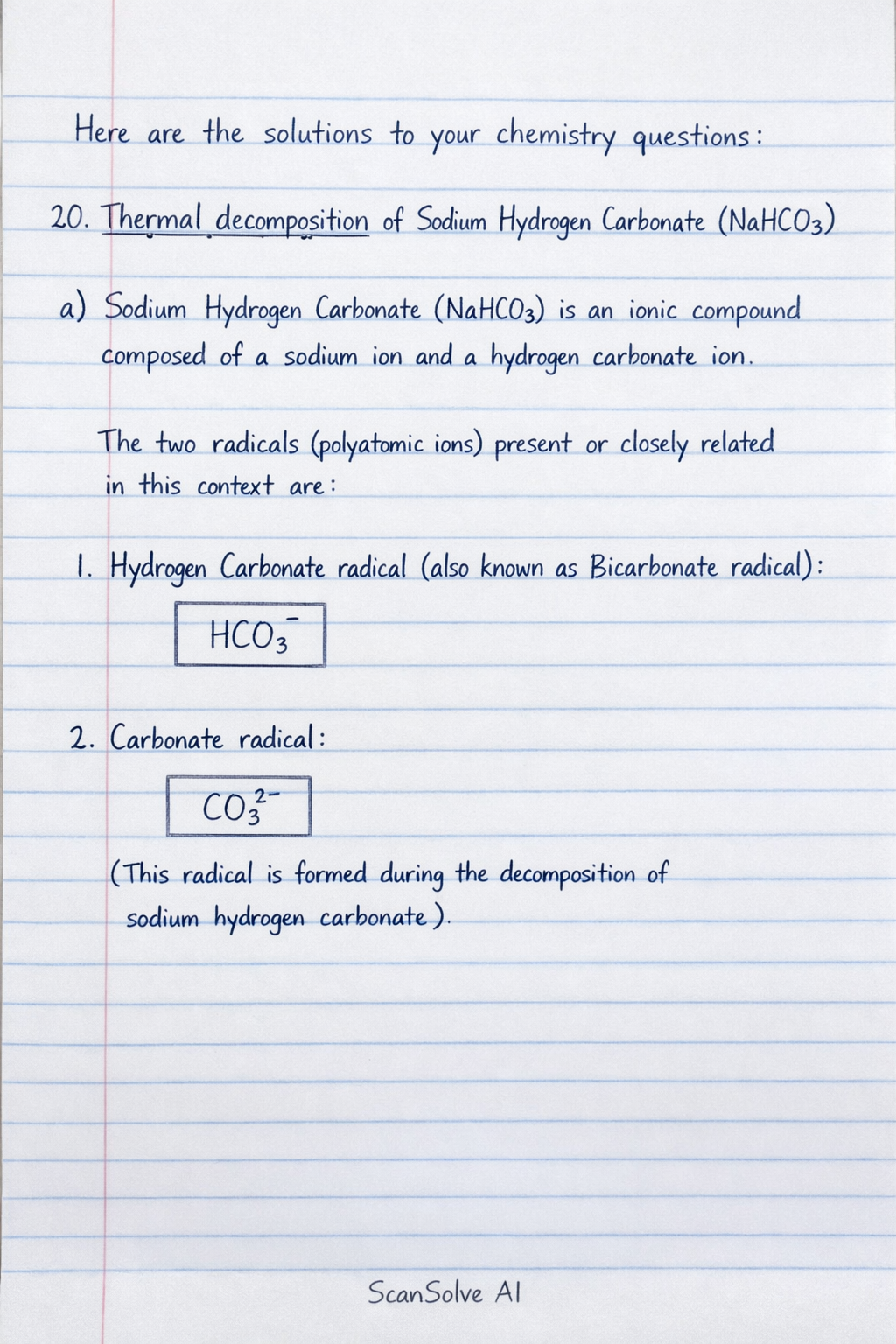
Here are the solutions to your chemistry questions:
20. Thermal decomposition of Sodium Hydrogen Carbonate (NaHCO$_3$)
a) Sodium Hydrogen Carbonate (NaHCO$_3$) is an ionic compound composed of a sodium ion and a hydrogen carbonate ion.
The two radicals (polyatomic ions) present or closely related in this context are:
1. Hydrogen Carbonate radical (also known as Bicarbonate radical): $\boxed{\text{HCO}_3^-}$
2. Carbonate radical: $\boxed{\text{CO}_3^{2-}}$ (This radical is formed during the decomposition of sodium hydrogen carbonate).
b) The thermal decomposition of Sodium Hydrogen Carbonate produces Sodium Carbonate, Water, and Carbon (IV) oxide.
Step 1: Write the unbalanced chemical equation with state symbols.
$$ \text{NaHCO}_3(s) \xrightarrow{\Delta} \text{Na}_2\text{CO}_3(s) + \text{H}_2\text{O}(g) + \text{CO}_2(g) $$
Step 2: Balance the sodium atoms. There is 1 Na on the left and 2 Na on the right. Place a coefficient of 2 in front of NaHCO$_3$.
$$ 2\text{NaHCO}_3(s) \xrightarrow{\Delta} \text{Na}_2\text{CO}_3(s) + \text{H}_2\text{O}(g) + \text{CO}_2(g) $$
Step 3: Verify the balance of all other atoms:
Sodium (Na): Left = $2 \times 1 = 2$, Right = $1 \times 2 = 2$ (Balanced)
Hydrogen (H): Left = $2 \times 1 = 2$, Right = $1 \times 2 = 2$ (Balanced)
Carbon (C): Left = $2 \times 1 = 2$, Right = $1 \times 1 (\text{in Na}_2\text{CO}_3) + 1 \times 1 (\text{in CO}_2) = 2$ (Balanced)
Oxygen (O): Left = $2 \times 3 = 6$, Right = $1 \times 3 (\text{in Na}_2\text{CO}_3) + 1 \times 1 (\text{in H}_2\text{O}) + 1 \times 2 (\text{in CO}_2) = 3 + 1 + 2 = 6$ (Balanced)
The balanced chemical equation for this thermal decomposition is:
$$ \boxed{2\text{NaHCO}_3(s) \rightarrow \text{Na}_2\text{CO}_3(s) + \text{H}_2\text{O}(g) + \text{CO}_2(g)} $$
21. Doping Silicon
a) Silicon (Si) has an atomic number Z=14, meaning a neutral Silicon atom has 14 electrons.
Step 1: Fill the atomic orbitals in order of increasing energy.
1s orbital: 2 electrons
2s orbital: 2 electrons
2p orbital: 6 electrons
3s orbital: 2 electrons
3p orbital: The remaining $14 - (2+2+6+2) = 2$ electrons.
The s, p configuration for a neutral Silicon atom is:
$$ \boxed{1s^2 2s^2 2p^6 3s^2 3p^2} $$
b) The element used for doping has "exactly one more electron in its p-orbital than Silicon."
Step 1: Silicon's outermost p-orbital configuration is $3p^2$.
Step 2: An element with one more electron in its p-orbital would have a $3p^3$ configuration. This means it is in the same period (Period 3) but one group to the right of Silicon (Group 14).
Step 3: The element in Period 3, Group 15 is Phosphorus (P).
Step 4: Verify the electron configuration for Phosphorus (P, Z=15).
1s orbital: 2 electrons
2s orbital: 2 electrons
2p orbital: 6 electrons
3s orbital: 2 electrons
3p orbital: The remaining $15 - (2+2+6+2) = 3$ electrons.
The element used for doping is Phosphorus (P).
Its s, p configuration is:
$$ \boxed{1s^2 2s^2 2p^6 3s^2 3p^3} $$
20. Thermal decomposition of Sodium Hydrogen Carbonate (NaHCO_3)
|Physics
20. Thermal decomposition of Sodium Hydrogen Carbonate (NaHCO_3)
ScanSolve AI Answer
Here are the solutions to your chemistry questions:
20. Thermal decomposition of Sodium Hydrogen Carbonate (NaHCO3)
a) Sodium Hydrogen Carbonate (NaHCO3) is an ionic compound composed of a sodium ion and a hydrogen carbonate ion.
The two radicals (polyatomic ions) present or closely related in this context are:
Hydrogen Carbonate radical (also known as Bicarbonate radical): HCO3−
Carbonate radical: CO32− (This radical is formed during the decomposition of sodium hydrogen carbonate).
b) The thermal decomposition of Sodium Hydrogen Carbonate produces Sodium Carbonate, Water, and Carbon (IV) oxide.
Step 1: Write the unbalanced chemical equation with state symbols.
NaHCO3(s)ΔNa2CO3(s)+H2O(g)+CO2(g)
Step 2: Balance the sodium atoms. There is 1 Na on the left and 2 Na on the right. Place a coefficient of 2 in front of NaHCO3.
2NaHCO3(s)ΔNa2CO3(s)+H2O(g)+CO2(g)
Step 3: Verify the balance of all other atoms:
Sodium (Na): Left = 2×1=2, Right = 1×2=2 (Balanced)
Hydrogen (H): Left = 2×1=2, Right = 1×2=2 (Balanced)
Carbon (C): Left = 2×1=2, Right = 1×1(inNa2CO3)+1×1(inCO2)=2 (Balanced)
Oxygen (O): Left = 2×3=6, Right = 1×3(inNa2CO3)+1×1(inH2O)+1×2(inCO2)=3+1+2=6 (Balanced)
The balanced chemical equation for this thermal decomposition is:
2\text{NaHCO_3(s) \rightarrow Na_2CO_3(s) + H_2O(g) + CO_2(g)}
21. Doping Silicon
a) Silicon (Si) has an atomic number Z=14, meaning a neutral Silicon atom has 14 electrons.
Step 1: Fill the atomic orbitals in order of increasing energy.
1s orbital: 2 electrons
2s orbital: 2 electrons
2p orbital: 6 electrons
3s orbital: 2 electrons
3p orbital: The remaining 14−(2+2+6+2)=2 electrons.
The s, p configuration for a neutral Silicon atom is:
1s22s22p63s23p2
b) The element used for doping has "exactly one more electron in its p-orbital than Silicon."
Step 1: Silicon's outermost p-orbital configuration is 3p2.
Step 2: An element with one more electron in its p-orbital would have a 3p3 configuration. This means it is in the same period (Period 3) but one group to the right of Silicon (Group 14).
Step 3: The element in Period 3, Group 15 is Phosphorus (P).
Step 4: Verify the electron configuration for Phosphorus (P, Z=15).
1s orbital: 2 electrons
2s orbital: 2 electrons
2p orbital: 6 electrons
3s orbital: 2 electrons
3p orbital: The remaining 15−(2+2+6+2)=3 electrons.
The element used for doping is Phosphorus (P).
Its s, p configuration is:
1s22s22p63s23p3
Need help with your own homework?
Get instant step-by-step solutions to any question. Free to start.