
How do we find the harmonic number ?
ScanSolve AI Answer
Step-by-step solution
2 stepsYou're asking a great follow-up question! The harmonic number () can be found in two main ways, depending on what information you have:
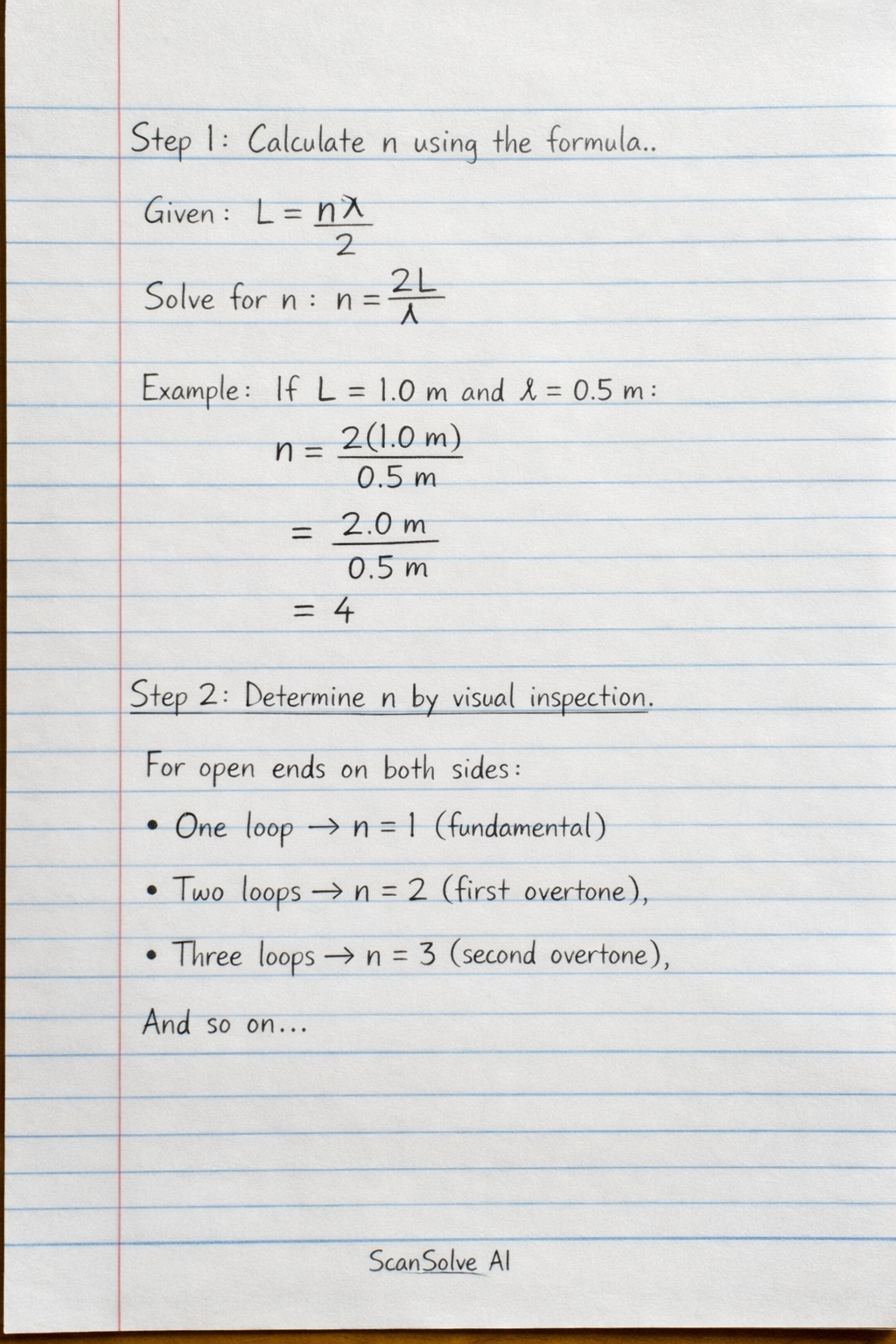
Calculate using the formula.
If you know the length of the medium () and the wavelength () of the standing wave, you can rearrange the formula to solve for :
For example, if and , then .
Determine by visual inspection of the wave pattern.
For a standing wave with open ends on both sides (meaning antinodes at both ends), the harmonic number () is simply the number of half-wavelengths (or "loops" or "segments") that fit into the length of the medium.
- If you see one "loop" (one antinode in the middle), (fundamental frequency).
- If you see two "loops" (two antinodes), (first overtone).
- If you see three "loops" (three antinodes), (second overtone), and so on.
In the previous problem you sent a photo of, the wire had fixed ends (nodes at both ends), and we counted 5 loops, so . If it were open on both sides and showed 5 loops, would also be 5.
Still stuck on this one?
Ask a follow-up, and the answer starts from this question.
More Physics Questions
Handwritten Step-by-Step Solution
Get this as a handwritten image on WhatsApp — like a tutor wrote it for you.
Try on WhatsApp