

This physics problem tests your understanding of fundamental physical laws and their applications. The step-by-step solution below breaks down the problem using relevant equations and physical reasoning.
ScanSolve AI Answer
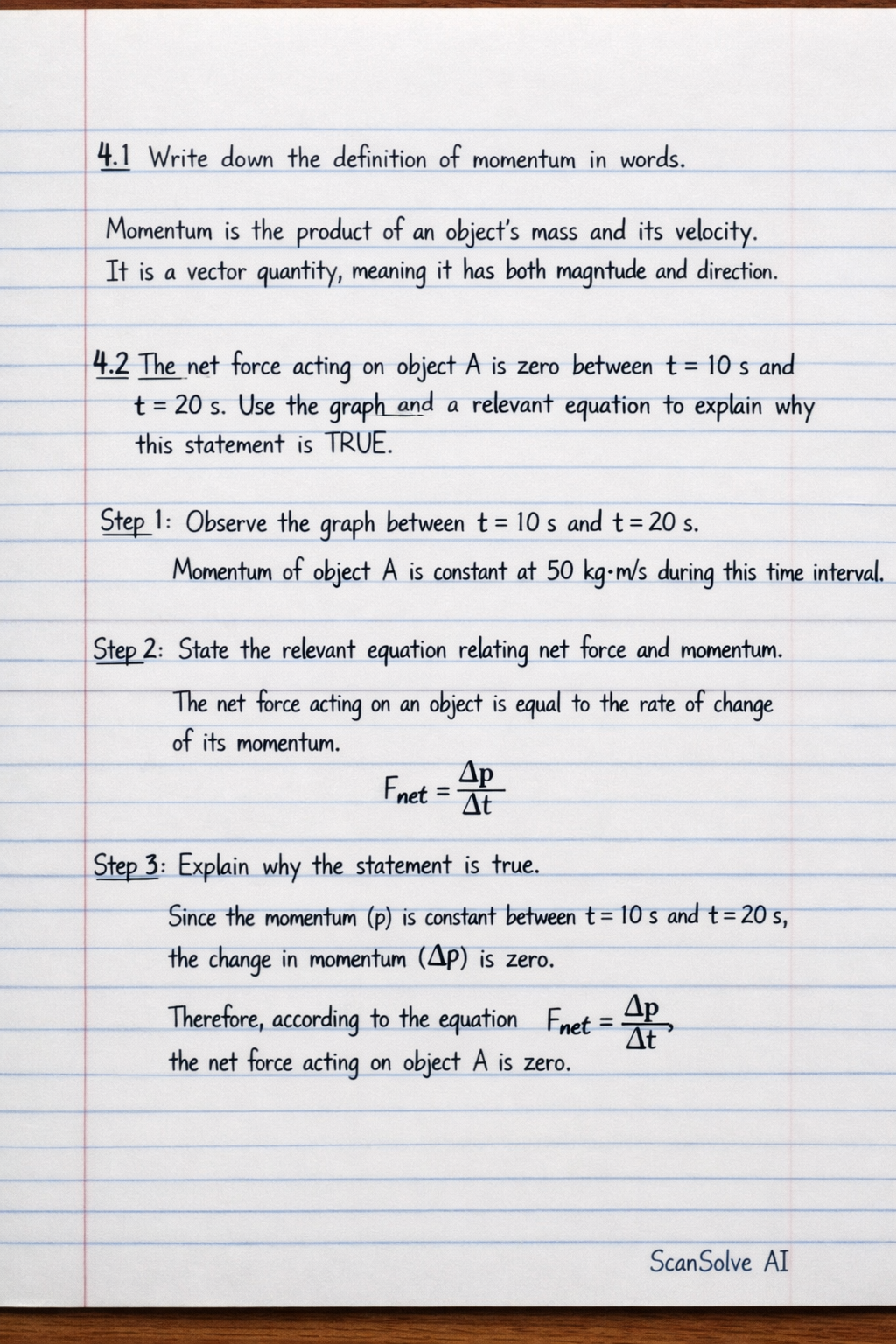
Here are the solutions to the questions: 4.1 Write down the definition of momentum in words. Momentum is the product of an object's mass and its velocity. It is a vector quantity, meaning it has both magnitude and direction. 4.2 The net force acting on object A is zero between t = 10 s and t = 20 s. Use the graph and a relevant equation to explain why this statement is TRUE. Step 1: Observe the graph between t = 10 s and t = 20 s. From the graph, the momentum of object A is constant at 50 kg · m/s during this time interval. Step 2: State the relevant equation relating net force and momentum. The net force acting on an object is equal to the rate of change of its momentum. F_net = ( p)/( t) Step 3: Explain why the statement is true. Since the momentum (p) is constant between t = 10 s and t = 20 s, the change in momentum ( p) is zero. Therefore, according to the equation F_net = ( p)/( t), the net force acting on object A is zero. 4.3 Calculate the magnitude of the impulse that object A experiences between t = 20 s and t = 50 s. Step 1: Determine the initial and final momentum from the graph. At t = 20 s, the initial momentum p_i = 50 kg · m/s. At t = 50 s, the final momentum p_f = -120 kg · m/s. Step 2: Calculate the impulse using the impulse-momentum theorem. Impulse (J) is the change in momentum: J = p = p_f - p_i J = (-120 kg · m/s) - (50 kg · m/s) J = -170 kg · m/s Step 3: State the magnitude of the impulse. The magnitude of the impulse is the absolute value of J. |J| = |-170 kg · m/s| = 170 kg · m/s The magnitude of the impulse is 170 kg · m/s. 4.4 At t = 50 s, object A collides with another object, B, which has a momentum of 70 kg · m/s EAST. Use the information from the graph and the relevant principle to calculate the momentum of object B after the collision. Step 1: Define a positive direction and identify the momentum values before and after the collision for object A from the graph. Let EAST be the positive direction. Momentum of object A just before collision (p_A,before) at t = 50 s is -120 kg · m/s (meaning 120 kg · m/s WEST). Momentum of object A just after collision (p_A,after) at t = 50 s is 50 kg · m/s (meaning 50 kg · m/s EAST). Step 2: Identify the momentum of object B before the collision. Momentum of object B before collision (p_B,before) is 70 kg · m/s EAST, so p_B,before = +70 kg · m/s. Step 3: Apply the principle of conservation of momentum. The total momentum before the collision is equal to the total momentum after the collision. p_A,before + p_B,before = p_A,after + p_B,after Step 4: Substitute the known values and solve for p_B,after. (-120 kg · m/s) + (70 kg · m/s) = (50 kg · m/s) + p_B,after -50 kg · m/s = 50 kg · m/s + p_B,after p_B,after = -50 kg · m/s - 50 kg · m/s p_B,after = -100 kg · m/s Step 5: State the momentum of object B after the collision, including direction. The negative sign indicates the direction is opposite to EAST, which is WEST. The momentum of object B after the collision is 100 kg · m/s WEST. That's 2 down. 3 left today — send the next one.