
We read your photo as:
In an electrolysis, a current of 200 A was passed through molten oxide of metal Q for 58 minutes and 64.8 g of the metal deposited. Determine:
ScanSolve AI Answer
Answers
2 partsStep-by-step solution
8 stepsHere's the solution to question 4:
4. In an electrolysis, a current of was passed through molten oxide of metal for 58 minutes and of the metal deposited. Determine:
, , molar gas volume stp
Part i· 4 steps
Charge on metal Q
Calculate the total quantity of electricity passed ().
First, convert time from minutes to seconds:
Now, calculate the charge:
Calculate the moles of metal Q deposited.
Calculate the moles of electrons passed.
Determine the charge on metal Q ().
The deposition of metal Q from its oxide involves the reduction of ions:
From this equation, moles of electrons are required to deposit 1 mole of Q.
Therefore, the ratio of moles of electrons to moles of Q is :Rounding to the nearest whole number, the charge on metal Q is 3.
The charge on metal Q is
Part ii
The volume of oxygen gas produced at standard temperature and pressure
Identify the reaction at the anode.
Since molten oxide of metal Q is electrolyzed, oxide ions () are oxidized at the anode to produce oxygen gas.
This equation shows that 4 moles of electrons are required to produce 1 mole of oxygen gas.
Use the moles of electrons passed (calculated in part i).
Calculate the moles of oxygen gas produced.
Calculate the volume of oxygen gas at standard temperature and pressure (STP).
Rounding to three significant figures:
The volume of oxygen gas produced is
Try one yourself
A new problem that tests the same skill.
Still stuck on this one?
Ask a follow-up, and the answer starts from this question.
More Physics Questions
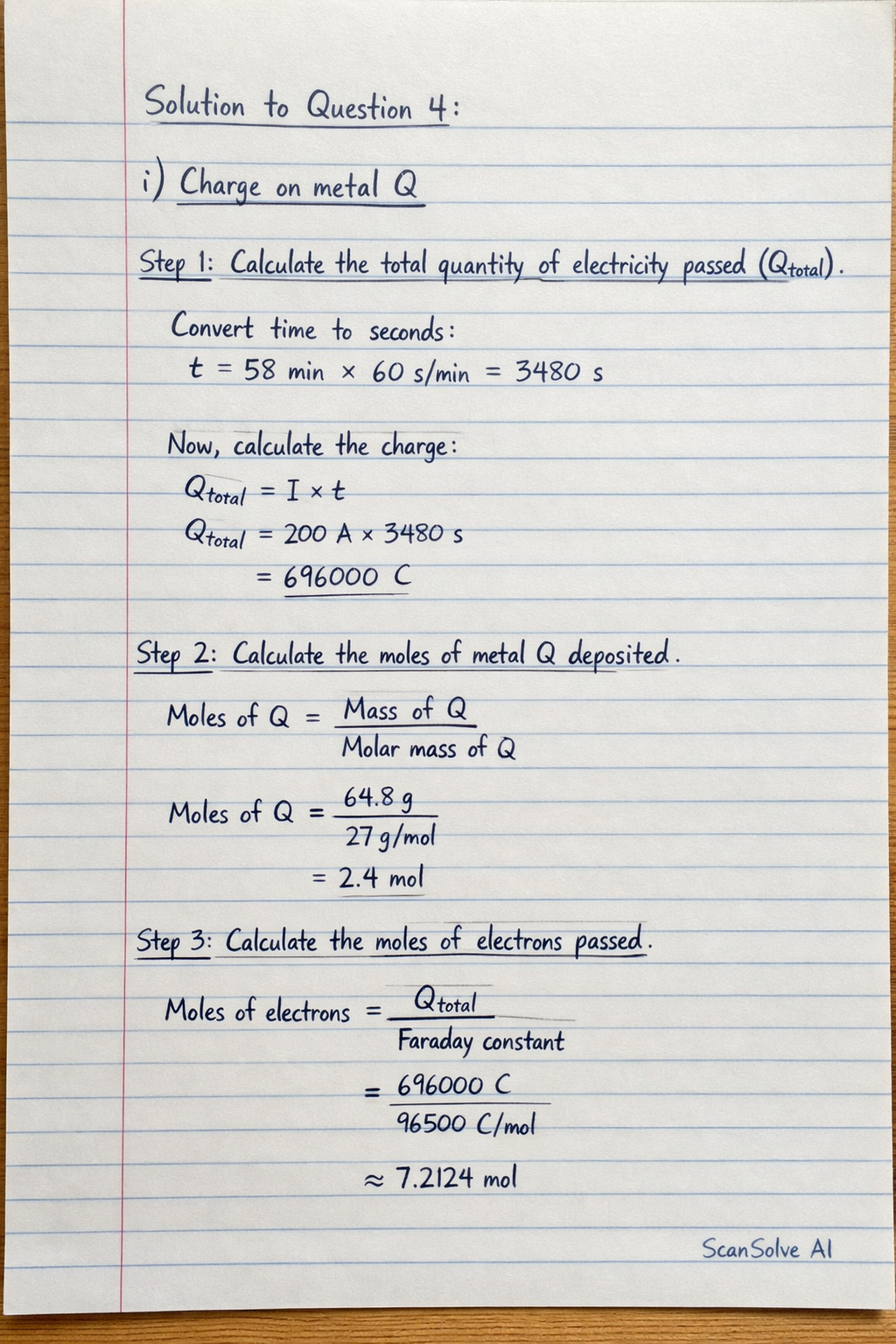
Handwritten Step-by-Step Solution
Get this as a handwritten image on WhatsApp — like a tutor wrote it for you.
Try on WhatsApp