5 The unit for measurement for density is......

Physics
5 The unit for measurement for density is......

ScanSolve AI Answer

Answer

\frac{mass}{volume} $$

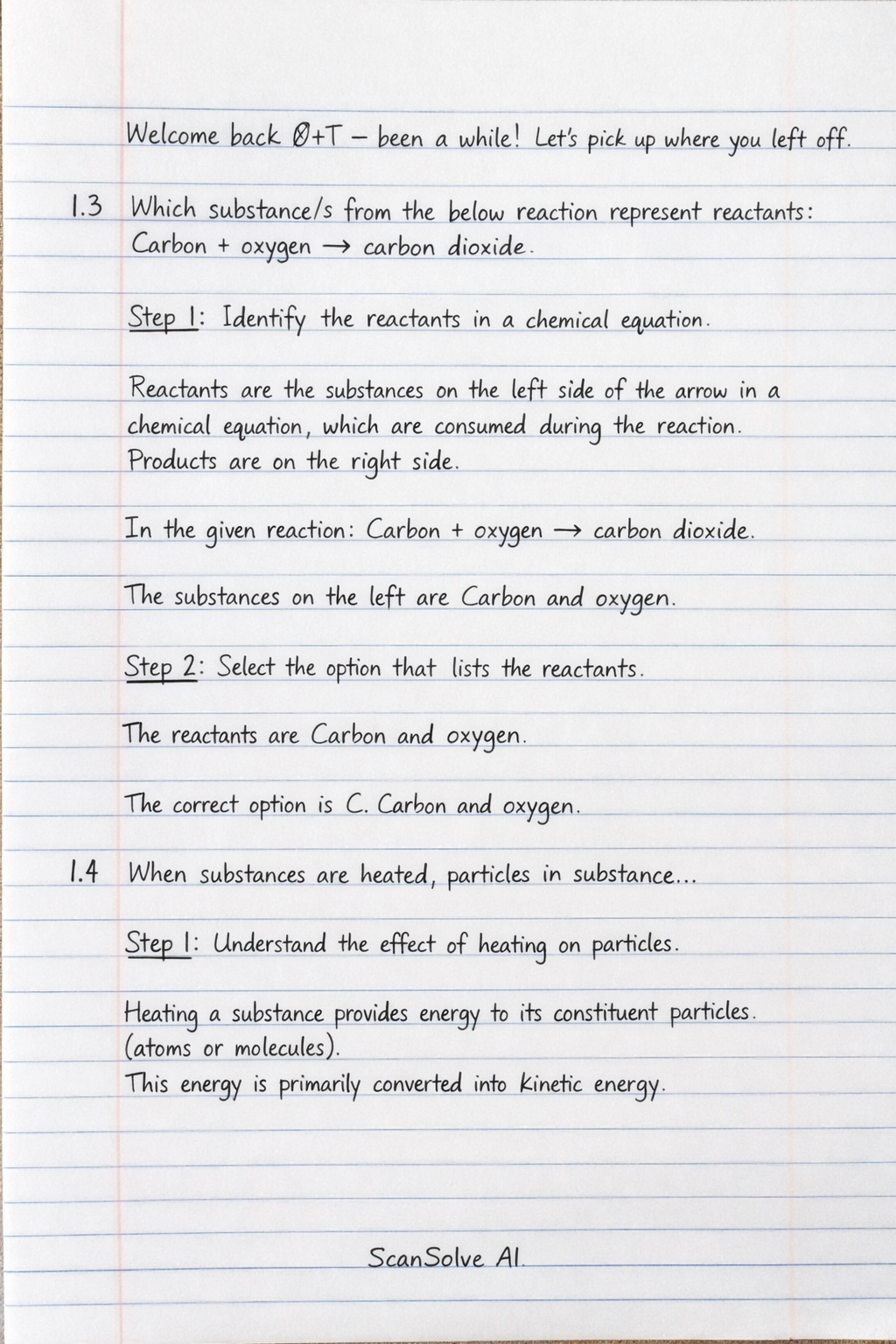
1.3 Which substance/s from the below reaction represent reactants: Carbon + oxygen \rightarrow carbon dioxide

Step 1: Identify the reactants in a chemical equation. Reactants are the substances on the left side of the arrow in a chemical equation, which are consumed during the reaction. Products are on the right side. In the given reaction: Carbon + oxygen \rightarrow carbon dioxide The substances on the left are Carbon and oxygen.

Step 2: Select the option that lists the reactants. The reactants are Carbon and oxygen.

The correct option is C. Carbon and oxygen.


1.4 When substances are heated, particles in substance...

Step 1: Understand the effect of heating on particles. Heating a substance provides energy to its constituent particles (atoms or molecules). This energy is primarily converted into kinetic energy.

Step 2: Evaluate the given options based on the effect of heating.

  • A. Gain kinetic energy: When particles gain kinetic energy, they move faster and vibrate more vigorously. This is consistent with heating.
  • B. Move slower: This is incorrect; heating makes particles move faster.
  • C. Remain the same: This is incorrect; heating changes the energy and motion of particles.
  • D. Come closer to each other: This is generally incorrect; increased kinetic energy usually leads to particles moving further apart, causing expansion.

The correct option is A. Gain kinetic energy.


1.5 The unit for measurement for density is...

Step 1: Recall the definition and formula for density. Density (ρ\rho) is defined as mass per unit volume. ρ=massvolume\rho = \frac{mass}{volume}

Step 2: Determine the standard units for mass and volume. Common units for mass include grams (g) and kilograms (kg). Common units for volume include cubic centimeters (cm³), cubic meters (m³), and cubic decimeters (dm³).

Step 3: Combine the units to find possible units for density and evaluate the options. Possible units for density include g/cm³, kg/m³, kg/cm³, or g/dm³.

  • A. Km/m²: This is a unit of length per area, not density.
  • B. Kg/cm³: This is a unit of mass (kg) per volume (cm³), which is a valid unit for density.
  • C. g/dm: This is a unit of mass (g) per length (dm), not density. For density, it would be g/dm³.
  • D. °C: This is a unit for temperature, not density.

The correct option is B. Kg/cm³.

Send me the next one 📸

Was this helpful?

Need help with your own homework?

Get instant step-by-step solutions to any question. Free to start.

Ask Your Question
Handwritten step-by-step solution preview

Handwritten Step-by-Step Solution

Get this as a handwritten image on WhatsApp — like a tutor wrote it for you.

Try on WhatsApp

Still have questions?

Quick Answer

1.3 Which substance/s from the below reaction represent reactants: Carbon + oxygen → carbon dioxide Step 1: Identify the reactants in a chemical equation.

5 The unit for measurement for density is......
Physics

This physics problem tests your understanding of fundamental physical laws and their applications. The step-by-step solution below breaks down the problem using relevant equations and physical reasoning.

ScanSolve AI Answer
1.3 Which substance/s from the below reaction represent reactants: Carbon + oxygen → carbon dioxide Step 1: Identify the reactants in a chemical equation. Reactants are the substances on the left side of the arrow in a chemical equation, which are consumed during the reaction. Products are on the right side. In the given reaction: Carbon + oxygen → carbon dioxide The substances on the left are Carbon and oxygen. Step 2: Select the option that lists the reactants. The reactants are Carbon and oxygen. The correct option is C. Carbon and oxygen. --- 1.4 When substances are heated, particles in substance... Step 1: Understand the effect of heating on particles. Heating a substance provides energy to its constituent particles (atoms or molecules). This energy is primarily converted into kinetic energy. Step 2: Evaluate the given options based on the effect of heating. A. Gain kinetic energy: When particles gain kinetic energy, they move faster and vibrate more vigorously. This is consistent with heating. B. Move slower: This is incorrect; heating makes particles move faster. C. Remain the same: This is incorrect; heating changes the energy and motion of particles. D. Come closer to each other: This is generally incorrect; increased kinetic energy usually leads to particles moving further apart, causing expansion. The correct option is A. Gain kinetic energy. --- 1.5 The unit for measurement for density is... Step 1: Recall the definition and formula for density. Density () is defined as mass per unit volume. = massvolume Step 2: Determine the standard units for mass and volume. Common units for mass include grams (g) and kilograms (kg). Common units for volume include cubic centimeters (cm³), cubic meters (m³), and cubic decimeters (dm³). Step 3: Combine the units to find possible units for density and evaluate the options. Possible units for density include g/cm³, kg/m³, kg/cm³, or g/dm³. A. Km/m²: This is a unit of length per area, not density. B. Kg/cm³: This is a unit of mass (kg) per volume (cm³), which is a valid unit for density. C. g/dm: This is a unit of mass (g) per length (dm), not density. For density, it would be g/dm³. D. °C: This is a unit for temperature, not density. The correct option is B. Kg/cm³. Send me the next one 📸