We read your photo as:

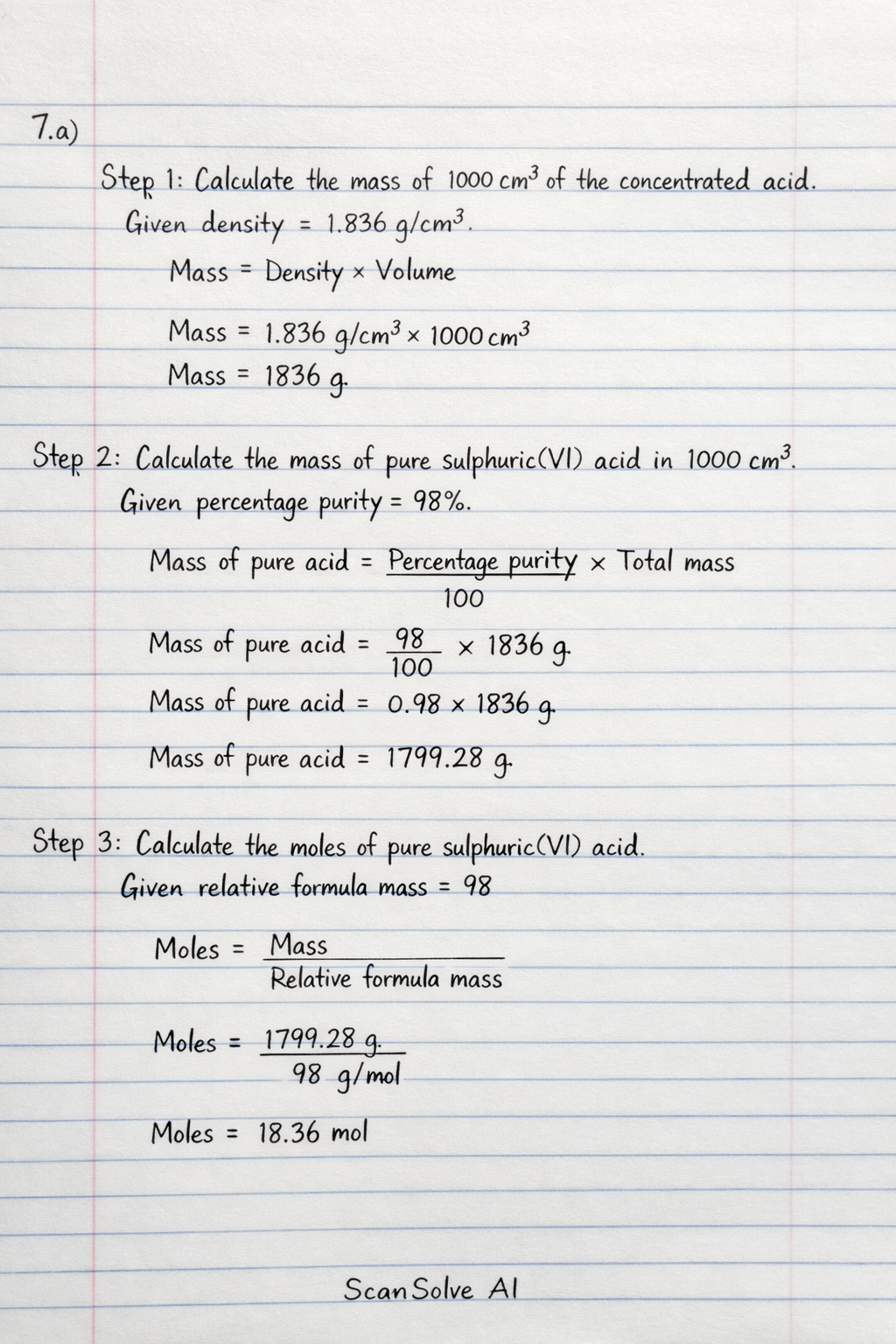
Given density = 1.836 g/cm³.

Physics

ScanSolve AI Answer

Step-by-step solution

6 steps

7.a)

  1. Calculate the mass of 1000 cm31000 \, \text{cm}^3 of the concentrated acid.

    Given density =1.836 g/cm3= 1.836 \, \text{g/cm}^3.

    Mass=Density×Volume\text{Mass} = \text{Density} \times \text{Volume} Mass=1.836 g/cm3×1000 cm3=1836 g\text{Mass} = 1.836 \, \text{g/cm}^3 \times 1000 \, \text{cm}^3 = 1836 \, \text{g}
  2. Calculate the mass of pure sulphuric(VI) acid in 1000 cm31000 \, \text{cm}^3.

    Given percentage purity =98%= 98\%.

    Mass of pure acid=Percentage purity100×Total mass\text{Mass of pure acid} = \frac{\text{Percentage purity}}{100} \times \text{Total mass} Mass of pure acid=98100×1836 g=0.98×1836 g=1799.28 g\text{Mass of pure acid} = \frac{98}{100} \times 1836 \, \text{g} = 0.98 \times 1836 \, \text{g} = 1799.28 \, \text{g}
  3. Calculate the moles of pure sulphuric(VI) acid.

    Given relative formula mass =98= 98.

    Moles=MassRelative formula mass\text{Moles} = \frac{\text{Mass}}{\text{Relative formula mass}} Moles=1799.28 g98 g/mol=18.36 mol\text{Moles} = \frac{1799.28 \, \text{g}}{98 \, \text{g/mol}} = 18.36 \, \text{mol}
  4. Determine the concentration (molarity) of the acid.

    Since the moles were calculated for 1000 cm31000 \, \text{cm}^3 (1 L1 \, \text{L}) of solution, this is the molarity.

    Concentration=MolesVolume in L=18.36 mol1 L=18.36 M\text{Concentration} = \frac{\text{Moles}}{\text{Volume in L}} = \frac{18.36 \, \text{mol}}{1 \, \text{L}} = 18.36 \, \text{M}

    The concentration of the acid is 18.36 M\boxed{\text{18.36 M}}.

    7.b)

  5. Use the dilution formula M1V1=M2V2M_1V_1 = M_2V_2.

    M1M_1 (concentration of concentrated acid) =18.36 M= 18.36 \, \text{M} (from 7.a))
    V1V_1 (volume of concentrated acid) =?= ?
    M2M_2 (desired concentration of diluted acid) =2 M= 2 \, \text{M}
    V2V_2 (desired volume of diluted acid) =2000 cm3= 2000 \, \text{cm}^3

  6. Substitute the values into the formula and solve for V1V_1.

    M1V1=M2V2M_1V_1 = M_2V_2 18.36 M×V1=2 M×2000 cm318.36 \, \text{M} \times V_1 = 2 \, \text{M} \times 2000 \, \text{cm}^3 V1=2 M×2000 cm318.36 MV_1 = \frac{2 \, \text{M} \times 2000 \, \text{cm}^3}{18.36 \, \text{M}} V1=400018.36 cm3V_1 = \frac{4000}{18.36} \, \text{cm}^3 V1≈217.86 cm3V_1 \approx 217.86 \, \text{cm}^3

    The volume of concentrated sulphuric(VI) acid needed is 217.86 cm3\boxed{\text{217.86 cm}^3}.

    8.a)
    The criteria for testing the purity of water include checking its boiling point and freezing point. Pure water boils at 100∘C100^\circ\text{C} and freezes at 0∘C0^\circ\text{C} at standard atmospheric pressure. Any deviation from these specific temperatures indicates the presence of impurities. Another criterion is electrical conductivity; pure water has very low conductivity, while impurities increase it.

Was this helpful?

Still stuck on this one?

Ask a follow-up, and the answer starts from this question.

Got a different question?Ask your own question
Handwritten step-by-step solution preview

Handwritten Step-by-Step Solution

Get this as a handwritten image on WhatsApp — like a tutor wrote it for you.

Try on WhatsApp