
We read your photo as:
A 10 kg body P is in equilibrium under the action of its weight, a tension T in a string at 60 degrees to the horizontal, and a horizontal force F. Calculate the tension T.
Physics
ScanSolve AI Answer
Answer
Step-by-step solution
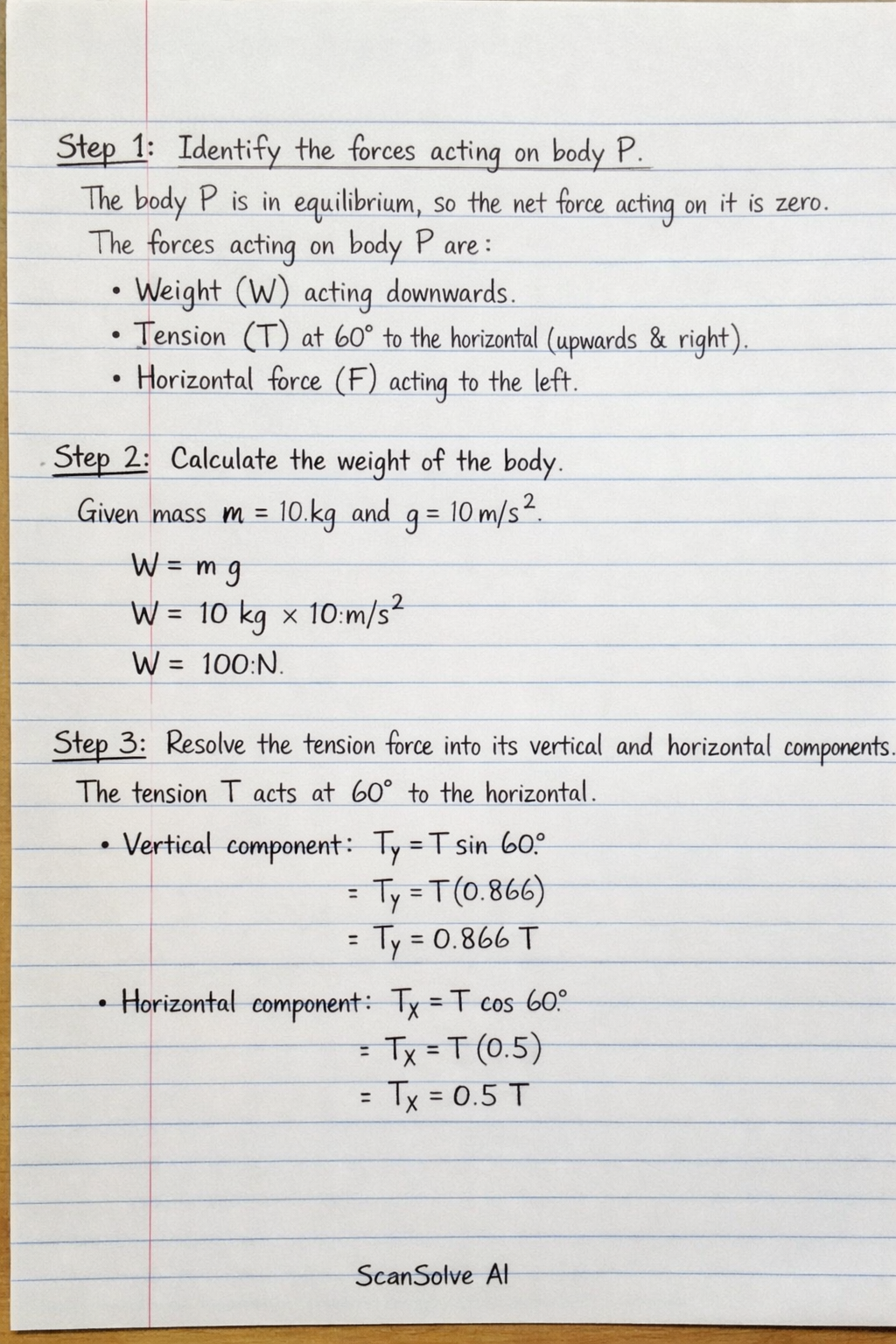
5 stepsIdentify the forces acting on body P.
The body P is in equilibrium, meaning the net force acting on it is zero. The forces acting on body P are:
- The weight of the body (W) acting vertically downwards.
- The tension (T) in the string, acting upwards and to the right at an angle of to the horizontal.
- A horizontal force (F) acting to the left.
Calculate the weight of the body.
Given mass and acceleration due to gravity .
Resolve the tension force into its vertical and horizontal components.
The tension T acts at an angle of to the horizontal.
- Vertical component of tension: (upwards)
- Horizontal component of tension: (to the right)
Apply the condition for vertical equilibrium.
Since the body is in equilibrium, the sum of vertical forces must be zero. The upward vertical component of tension must balance the downward weight.
Solve for the tension T.
Substitute the value of W and .
To rationalize the denominator, multiply the numerator and denominator by :
Using :
The tension in the string is .
Was this helpful?
Try one yourself
A new problem that tests the same skill.
Still stuck on this one?
Ask a follow-up, and the answer starts from this question.
Got a different question?Ask your own question
More Physics Questions
QA body of mass 2.5 kg is suspended by two strings XP and YP. If the angle between XP and the…QDefine a rigid body. 2. Distinguish between torque and couple. 3. A body of mass 3kg is pulled by a…QA system of masses and strings is in equilibrium. Find T, m, and F given the provided diagram and…QTwo masses, 5 kg and 7 kg, are connected by a string over a frictionless pulley. Calculate the…QWhan an elastic string of natural length 2m is fixed at one end and hangs vertically supporting a…
Browse by topic:Mechanics
Handwritten Step-by-Step Solution
Get this as a handwritten image on WhatsApp — like a tutor wrote it for you.
Try on WhatsApp