We read your photo as:

A 500 g aluminum calorimeter contains 300 g of liquid X. An electric heater with a current of 3.0 A and voltage of 220 V is used to heat the liquid for 2 minutes. If the initial temperature of the liq

Physics

ScanSolve AI Answer

Answer

18.6∘C\text{18.6}^\circ \text{C}

Step-by-step solution

6 steps

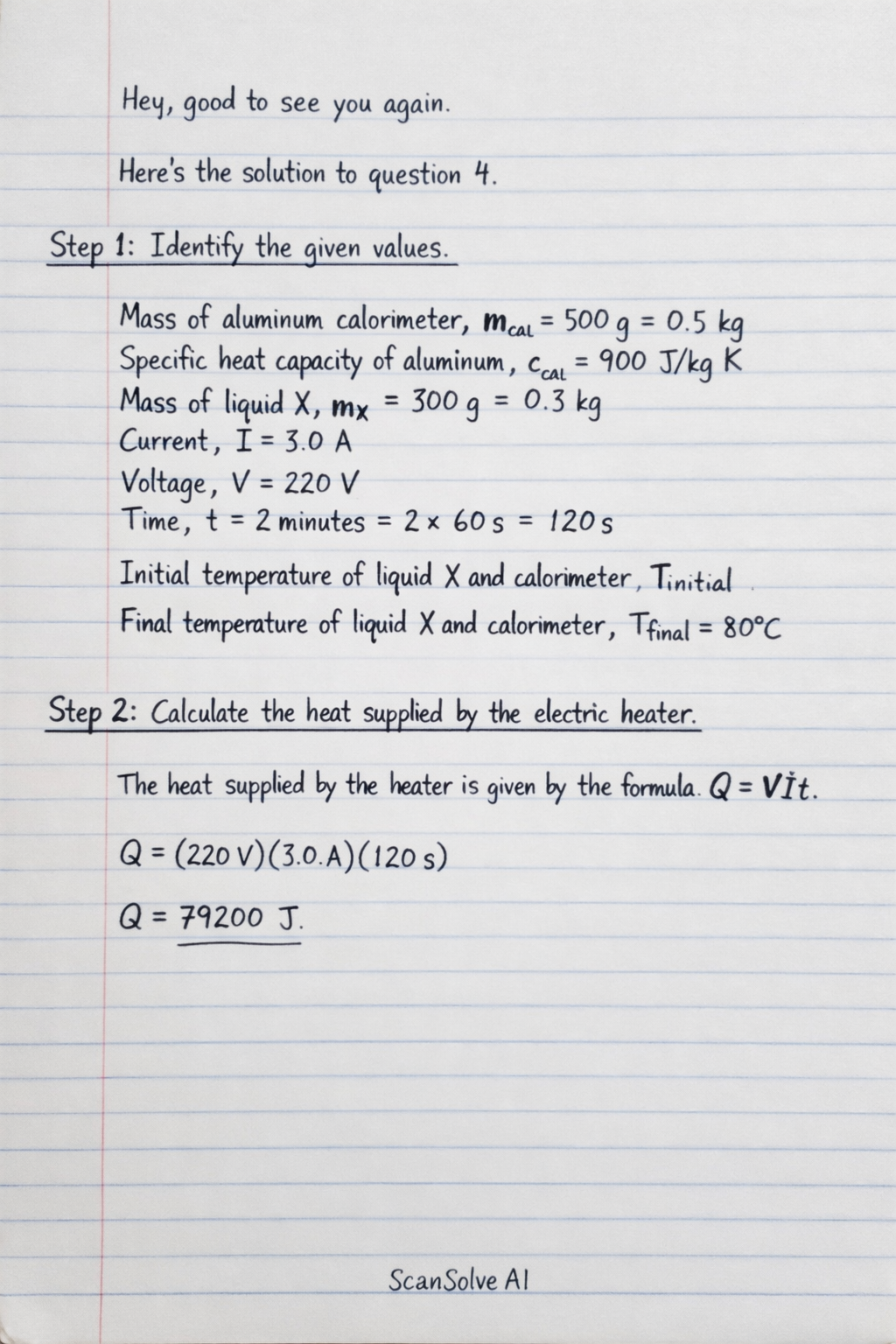
Here's the solution to question 4.

  1. Identify the given values.

    Mass of aluminum calorimeter, mcal=500 g=0.5 kgm_{cal} = 500 \text{ g} = 0.5 \text{ kg}
    Specific heat capacity of aluminum, ccal=900 J/kg Kc_{cal} = 900 \text{ J/kg K}
    Mass of liquid X, mX=300 g=0.3 kgm_X = 300 \text{ g} = 0.3 \text{ kg}
    Current, I=3.0 AI = 3.0 \text{ A}
    Voltage, V=220 VV = 220 \text{ V}
    Time, t=2 minutes=2×60 s=120 st = 2 \text{ minutes} = 2 \times 60 \text{ s} = 120 \text{ s}
    Initial temperature of liquid X and calorimeter, TinitialT_{initial}
    Final temperature of liquid X and calorimeter, Tfinal=80∘CT_{final} = 80^\circ \text{C}

  2. Calculate the heat supplied by the electric heater.

    The heat supplied by the heater is given by the formula Q=VItQ = VIt.

    Q=(220 V)(3.0 A)(120 s)Q = (220 \text{ V})(3.0 \text{ A})(120 \text{ s}) Q=79200 JQ = 79200 \text{ J}
  3. Calculate the heat gained by the aluminum calorimeter.

    The heat gained by the calorimeter is given by Qcal=mcalccalΔTQ_{cal} = m_{cal} c_{cal} \Delta T.
    The temperature rise for the calorimeter is ΔT=Tfinal−Tinitial=(80−Tinitial)∘C\Delta T = T_{final} - T_{initial} = (80 - T_{initial})^\circ \text{C}.

    Qcal=(0.5 kg)(900 J/kg K)(80−Tinitial)Q_{cal} = (0.5 \text{ kg})(900 \text{ J/kg K})(80 - T_{initial}) Qcal=450(80−Tinitial) JQ_{cal} = 450(80 - T_{initial}) \text{ J}
  4. Calculate the heat gained by liquid X.

    The heat gained by liquid X is given by QX=mXcXΔTQ_X = m_X c_X \Delta T.
    The specific heat capacity of liquid X is cX=2800 J/kg Kc_X = 2800 \text{ J/kg K}.
    The temperature rise for liquid X is ΔT=Tfinal−Tinitial=(80−Tinitial)∘C\Delta T = T_{final} - T_{initial} = (80 - T_{initial})^\circ \text{C}.

    QX=(0.3 kg)(2800 J/kg K)(80−Tinitial)Q_X = (0.3 \text{ kg})(2800 \text{ J/kg K})(80 - T_{initial}) QX=840(80−Tinitial) JQ_X = 840(80 - T_{initial}) \text{ J}
  5. Apply the principle of conservation of energy.

    The heat supplied by the heater is equal to the total heat gained by the calorimeter and liquid X.

    Q=Qcal+QXQ = Q_{cal} + Q_X 79200=450(80−Tinitial)+840(80−Tinitial)79200 = 450(80 - T_{initial}) + 840(80 - T_{initial}) 79200=(450+840)(80−Tinitial)79200 = (450 + 840)(80 - T_{initial}) 79200=1290(80−Tinitial)79200 = 1290(80 - T_{initial})
  6. Solve for the initial temperature, TinitialT_{initial}.

    80−Tinitial=79200129080 - T_{initial} = \frac{79200}{1290} 80−Tinitial≈61.39580 - T_{initial} \approx 61.395 Tinitial=80−61.395T_{initial} = 80 - 61.395 Tinitial≈18.605∘CT_{initial} \approx 18.605^\circ \text{C}

    Rounding to one decimal place:

    Tinitial≈18.6∘CT_{initial} \approx 18.6^\circ \text{C}

    The initial temperature of the liquid is 18.6∘C\text{18.6}^\circ \text{C}.

Was this helpful?

Try one yourself

A new problem that tests the same skill.

Still stuck on this one?

Ask a follow-up, and the answer starts from this question.

Got a different question?Ask your own question
Handwritten step-by-step solution preview

Handwritten Step-by-Step Solution

Get this as a handwritten image on WhatsApp — like a tutor wrote it for you.

Try on WhatsApp