
We read your photo as:
A 5000 kg delivery van moving at 10 m/s collides with a 2000 kg car moving at -15 m/s. If the car's final velocity is 5 m/s, what is the van's final velocity?
ScanSolve AI Answer
Answer
Step-by-step solution
8 stepsHere are the solutions for the collision problem:
3.1:
Define a positive direction and list the given values.
Let "towards the right" be the positive direction.
Mass of delivery van () =
Initial velocity of delivery van () =
Mass of car () =
Initial velocity of car () = (moving left)
Final velocity of car () = (moving right)Apply the law of conservation of linear momentum.
The total momentum before the collision equals the total momentum after the collision:
Substitute the values into the equation and solve for .
The magnitude of the velocity of the delivery van immediately after the collision is .
3.2:
Calculate the total initial kinetic energy of the system.
Calculate the total final kinetic energy of the system.
Using from 3.1 and .
Calculate the change in kinetic energy.
The change in the kinetic energy of the system is .
3.3:
Since the kinetic energy of the system is not conserved (it changed by ), the collision is INELASTIC.3.4:
Identify the given values and the impulse-momentum theorem for the car.
Mass of car () =
Initial velocity of car () =
Final velocity of car () =
Collision duration () =
The impulse-momentum theorem states that .Substitute the values into the formula and solve for the average force ().
The magnitude of the force that the delivery van exerts on the car is .
Try one yourself
A new problem that tests the same skill.
Still stuck on this one?
Ask a follow-up, and the answer starts from this question.
More Physics Questions
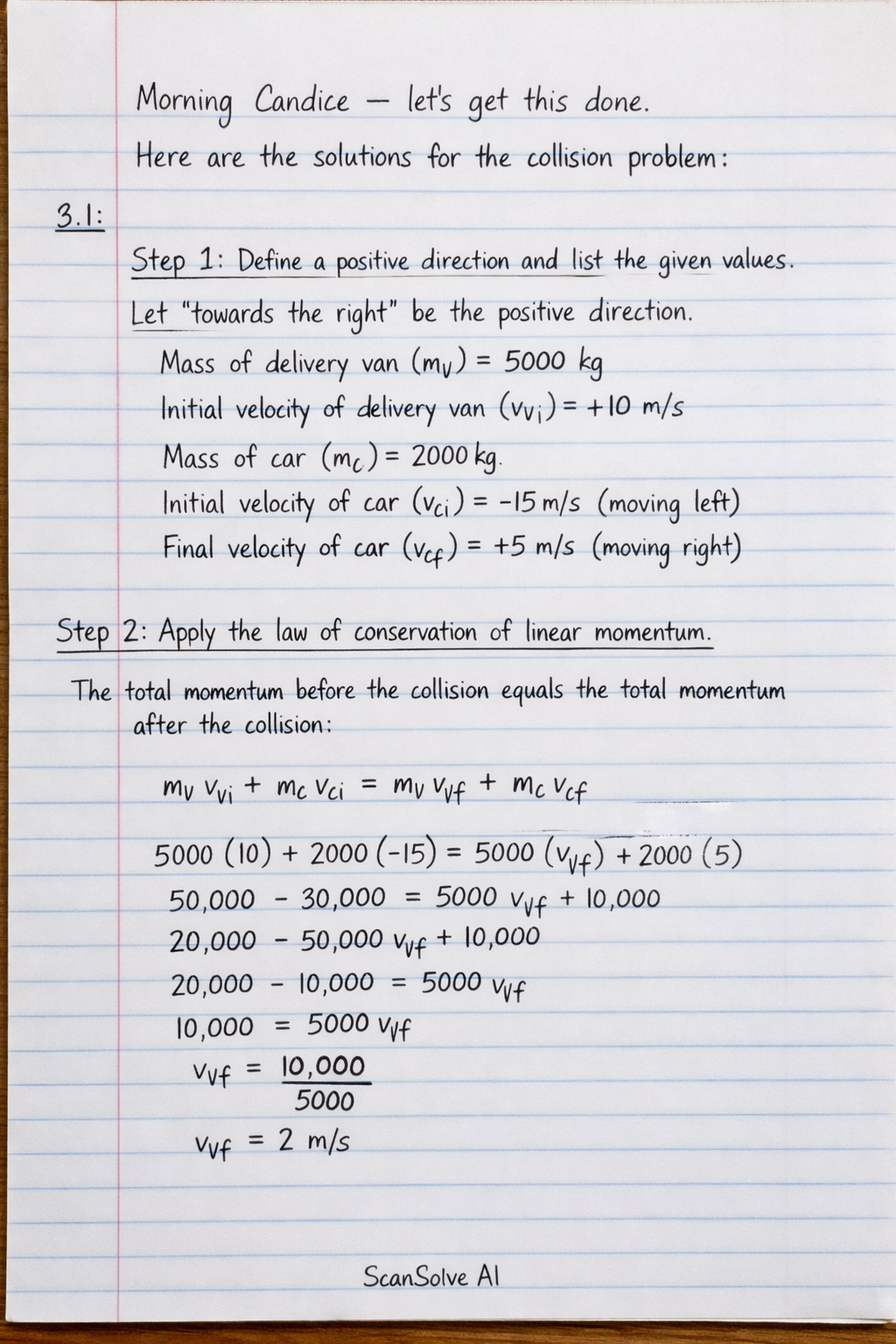
Handwritten Step-by-Step Solution
Get this as a handwritten image on WhatsApp — like a tutor wrote it for you.
Try on WhatsApp