
We read your photo as:
A 60 kg object is to be accelerated vertically upwards at 10 m/s2. Calculate the upward force needed to achieve this. (g = 10 m/s2)
ScanSolve AI Answer
Answer
Step-by-step solution
5 stepsB)
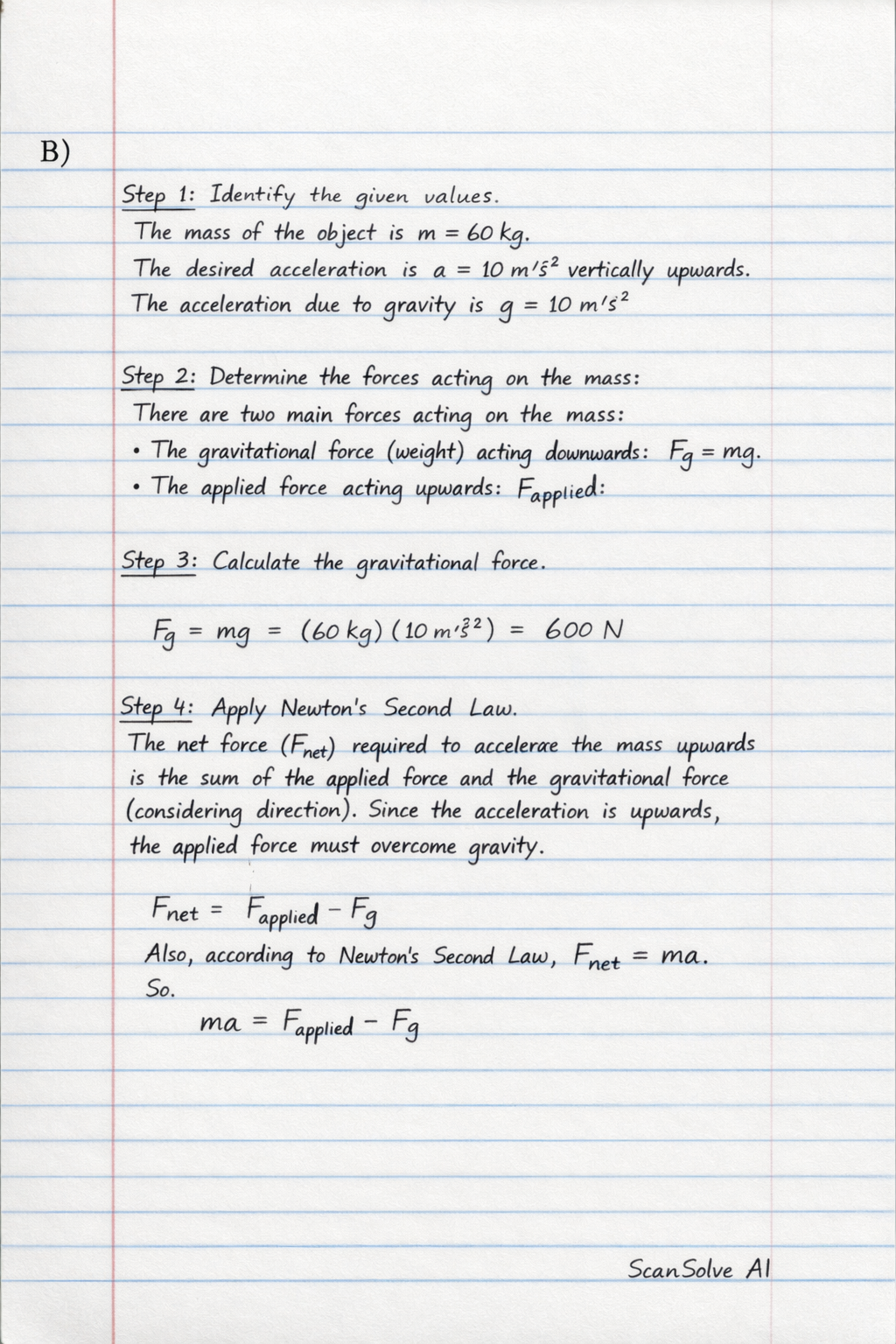
Identify the given values.
The mass of the object is kg.
The desired acceleration is m s vertically upwards.
The acceleration due to gravity is m s.Determine the forces acting on the mass.
There are two main forces acting on the mass:
- The gravitational force (weight) acting downwards: .
- The applied force acting upwards: .
Calculate the gravitational force.
Apply Newton's Second Law.
The net force () required to accelerate the mass upwards is the sum of the applied force and the gravitational force (considering direction). Since the acceleration is upwards, the applied force must overcome gravity.
Also, according to Newton's Second Law, .
So,Solve for the applied force.
Rearrange the equation to solve for :
Substitute the values:
The force that has to be exerted is 1200 N.
The final answer is .
Try one yourself
A new problem that tests the same skill.
Still stuck on this one?
Ask a follow-up, and the answer starts from this question.
More Physics Questions
Handwritten Step-by-Step Solution
Get this as a handwritten image on WhatsApp — like a tutor wrote it for you.
Try on WhatsApp