

This physics problem tests your understanding of fundamental physical laws and their applications. The step-by-step solution below breaks down the problem using relevant equations and physical reasoning.
ScanSolve AI Answer
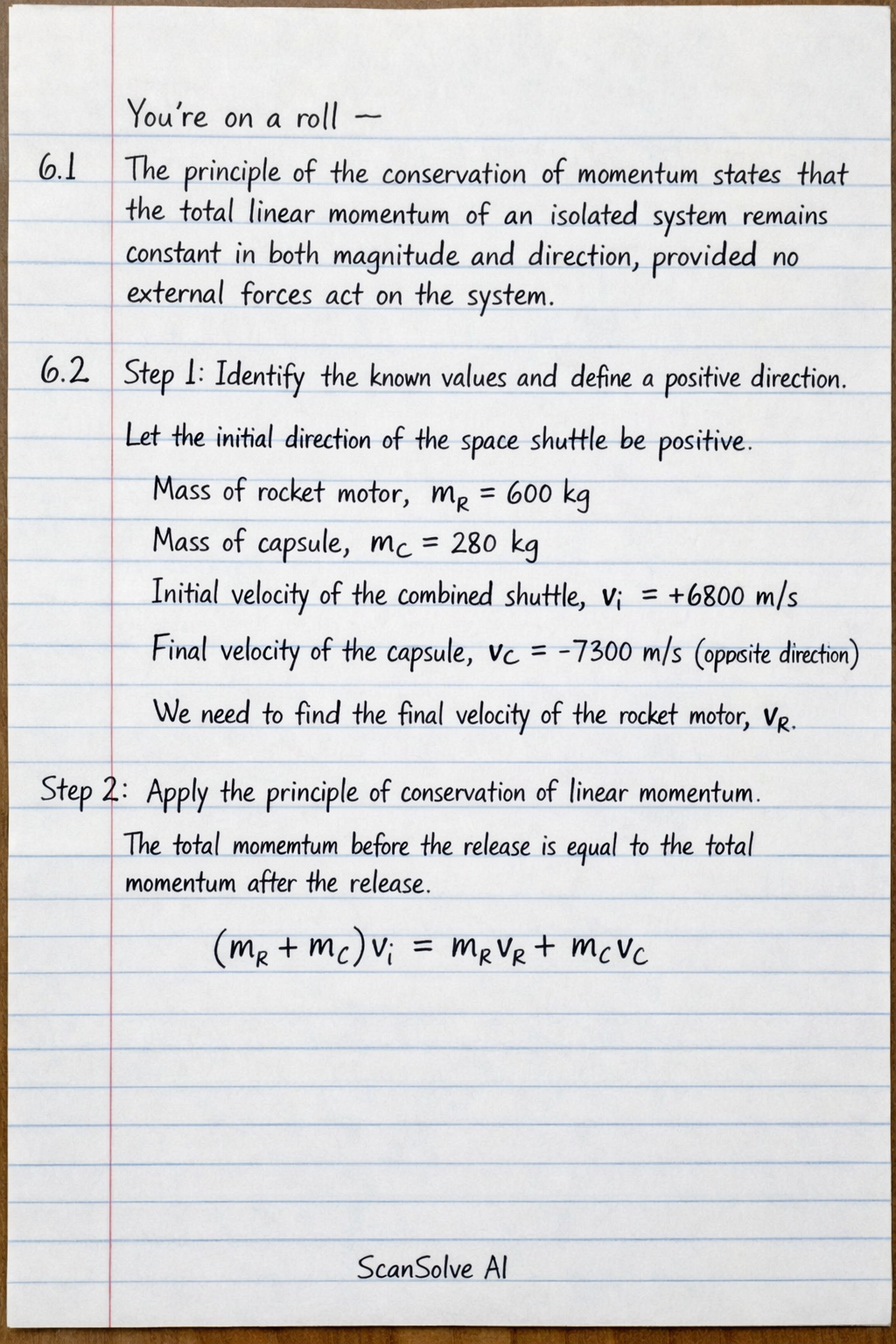
You're on a roll — 6.1 The principle of the conservation of momentum states that the total linear momentum of an isolated system remains constant in both magnitude and direction, provided no external forces act on the system. 6.2 Step 1: Identify the known values and define a positive direction. Let the initial direction of the space shuttle be positive. Mass of rocket motor, m_R = 600 \, kg Mass of capsule, m_C = 280 \, kg Initial velocity of the combined shuttle, v_i = +6800 \, m/s Final velocity of the capsule, v_C = -7300 \, m/s (opposite direction) We need to find the final velocity of the rocket motor, v_R. Step 2: Apply the principle of conservation of linear momentum. The total momentum before the release is equal to the total momentum after the release. (m_R + m_C) v_i = m_R v_R + m_C v_C Step 3: Substitute the values and solve for v_R. (600 \, kg + 280 \, kg) (6800 \, m/s) = (600 \, kg) v_R + (280 \, kg) (-7300 \, m/s) (880 \, kg) (6800 \, m/s) = 600 v_R - 2044000 \, kg·m/s 5984000 \, kg·m/s = 600 v_R - 2044000 \, kg·m/s 5984000 + 2044000 = 600 v_R 8028000 = 600 v_R v_R = (8028000)/(600) v_R = 13380 \, m/s The speed of the rocket motor immediately after it is released from the capsule is 13380 m/s. 6.3 The "collision" (separation) is inelastic. Step 1: Calculate the total kinetic energy before the separation. KE_i = (1)/(2) (m_R + m_C) v_i^2 KE_i = (1)/(2) (600 \, kg + 280 \, kg) (6800 \, m/s)^2 KE_i = (1)/(2) (880 \, kg) (46240000 \, m^2/s^2) KE_i = 440 × 46240000 \, J KE_i = 20345600000 \, J Step 2: Calculate the total kinetic energy after the separation. KE_f = (1)/(2) m_R v_R^2 + (1)/(2) m_C v_C^2 KE_f = (1)/(2) (600 \, kg) (13380 \, m/s)^2 + (1)/(2) (280 \, kg) (-7300 \, m/s)^2 KE_f = 300 × 179024400 \, J + 140 × 53290000 \, J KE_f = 53707320000 \, J + 7460600000 \, J KE_f = 61167920000 \, J Step 3: Compare the initial and final kinetic energies. Since KE_f = 61167920000 \, J and KE_i = 20345600000 \, J, the kinetic energy is not conserved (KE_f ≠ KE_i). In fact, the kinetic energy has increased. This increase comes from the chemical energy stored in the rocket motor's fuel, which is converted into kinetic energy during the separation process. Therefore, the event is inelastic. Got more? Send 'em!