
We read your photo as:
A ball is dropped from a height. What is the height of the building if it takes 4 seconds to reach the ground? Also, what is the initial speed required to throw a ball to a maximum height of 100m?
ScanSolve AI Answer
Answer
Step-by-step solution
9 stepsIdentify the given values and the formula for free fall.
For an object dropped from rest, the initial velocity m/s.
The time taken to reach the ground s.
The acceleration due to gravity m/s.
The formula for the distance (height) is .Substitute the values into the formula and calculate the height.
The height of the building is 78.4 m.
The correct option is (d).
Identify the given values and the formula for vertical motion.
The maximum height attained m.
At the maximum height, the final velocity m/s.
The acceleration due to gravity m/s (negative because it opposes the upward motion).
The formula relating initial velocity, final velocity, acceleration, and displacement is .Substitute the values into the formula and solve for the initial speed .
Rounding to one decimal place, the initial speed is 44.3 m/s.
Comparing with the options, 44.2 m/s is the closest.The correct option is (b).
Identify the given values and the formula for weight.
The mass of the man kg.
The acceleration due to gravity on Earth m/s.
The acceleration due to gravity on the Moon .
The formula for weight is .Calculate the acceleration due to gravity on the Moon.
Calculate the weight of the man on the Moon.
Rounding to the nearest whole number, the weight is approximately 98 N.
The correct option is (d).
Identify the given values and the formula for weight.
The weight of the object on Earth N.
The acceleration due to gravity on Earth m/s.
The formula for weight is .Rearrange the formula to solve for mass and substitute the values.
The mass of the object is 20 kg.
Try one yourself
A new problem that tests the same skill.
Still stuck on this one?
Ask a follow-up, and the answer starts from this question.
More Physics Questions
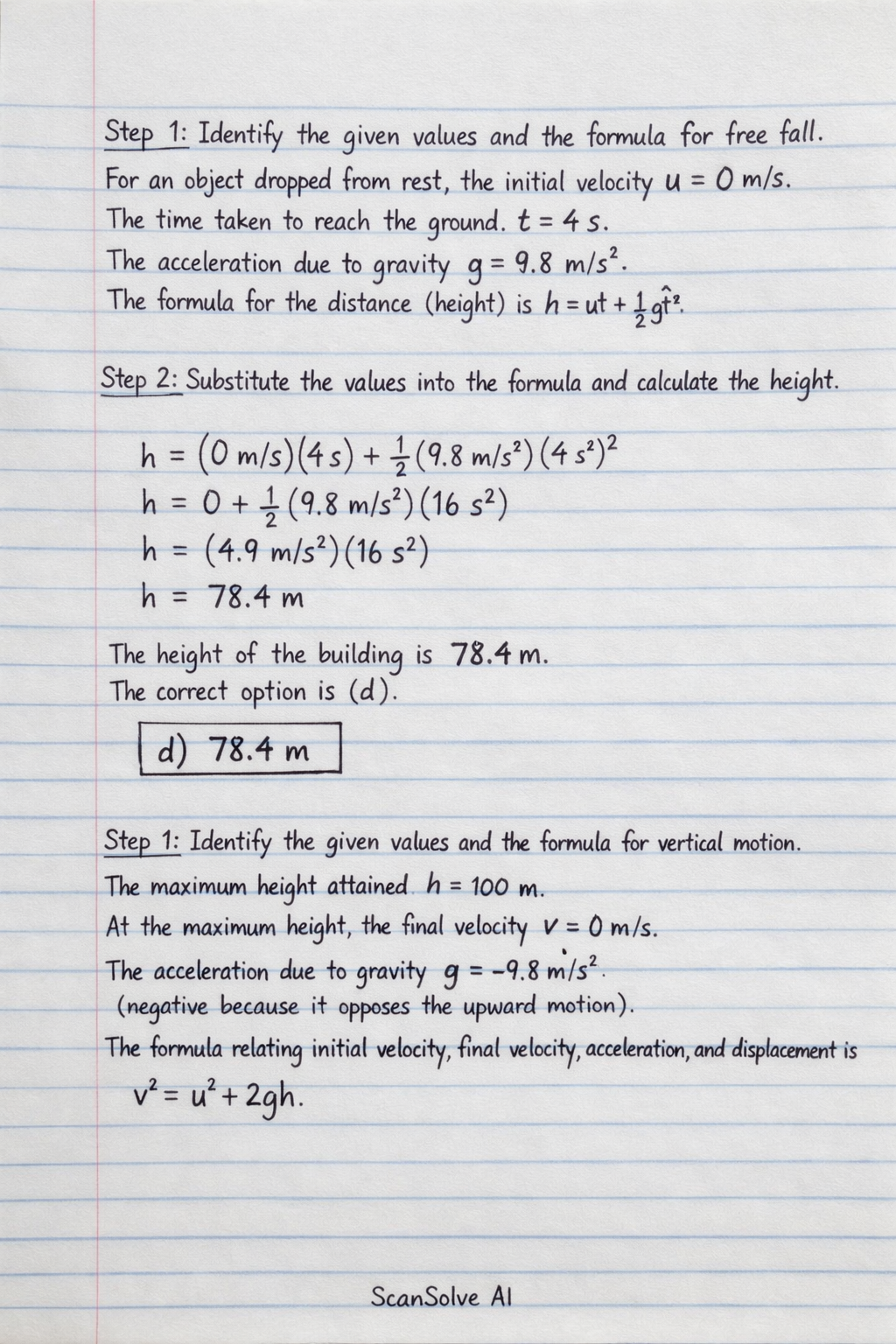
Handwritten Step-by-Step Solution
Get this as a handwritten image on WhatsApp — like a tutor wrote it for you.
Try on WhatsApp