
We read your photo as:
A ball is thrown upwards with an initial velocity of 30 m/s. At what height will its kinetic energy be equal to its potential energy?
ScanSolve AI Answer
Answer
Step-by-step solution
6 stepsThis is your last free one today. Let's solve it.
Identify the given values.
Initial velocity of the ball, .
Acceleration due to gravity, .State the condition for energy.
We need to find the height where the kinetic energy (KE) equals the potential energy (PE).
where is the mass of the ball and is its velocity at height .
Apply the principle of conservation of mechanical energy.
The total mechanical energy at the start (ground level) is equal to the total mechanical energy at height .
Initial total energy ():
At , .Total energy at height ():
Since at this height, we can write:
Equate the initial total energy to the total energy at height .
Solve for .
Cancel out the mass from both sides:
Substitute the given values and calculate .
The height at which its kinetic energy will equal its potential energy is .
Comparing this with the given options:
A. 45.0 m
B. 22.5 m
C. 15.0 m
D. 30.0 mThe correct option is B.
The final answer is .
Try one yourself
A new problem that tests the same skill.
Still stuck on this one?
Ask a follow-up, and the answer starts from this question.
More Physics Questions
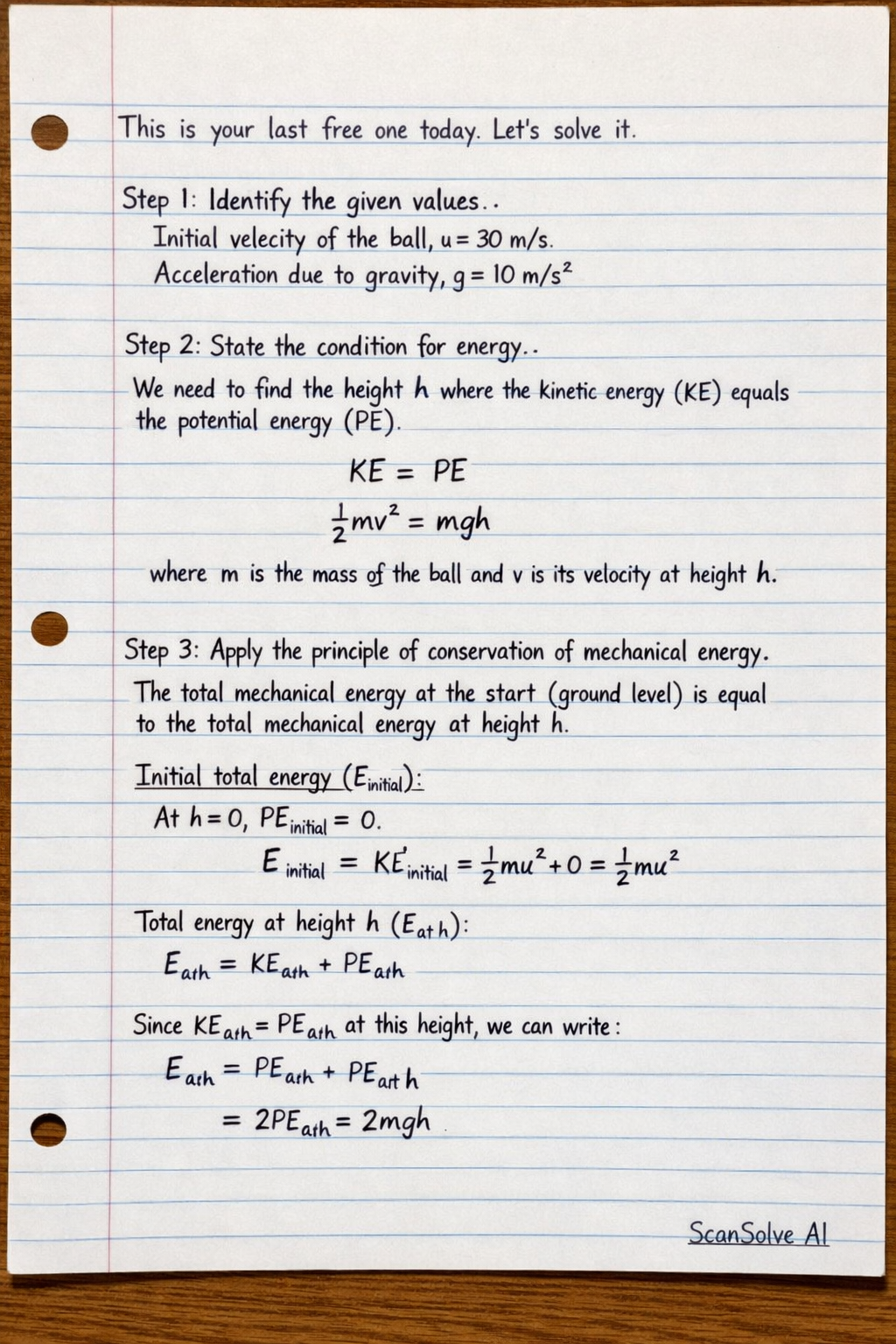
Handwritten Step-by-Step Solution
Get this as a handwritten image on WhatsApp — like a tutor wrote it for you.
Try on WhatsApp