
A block-and-tackle system is used to lift a load of 20 N through a vertical height of 10 m. if the efficiency of the system is 40%, how much work is done against friction?
Physics
ScanSolve AI Answer
Answer
Step-by-step solution
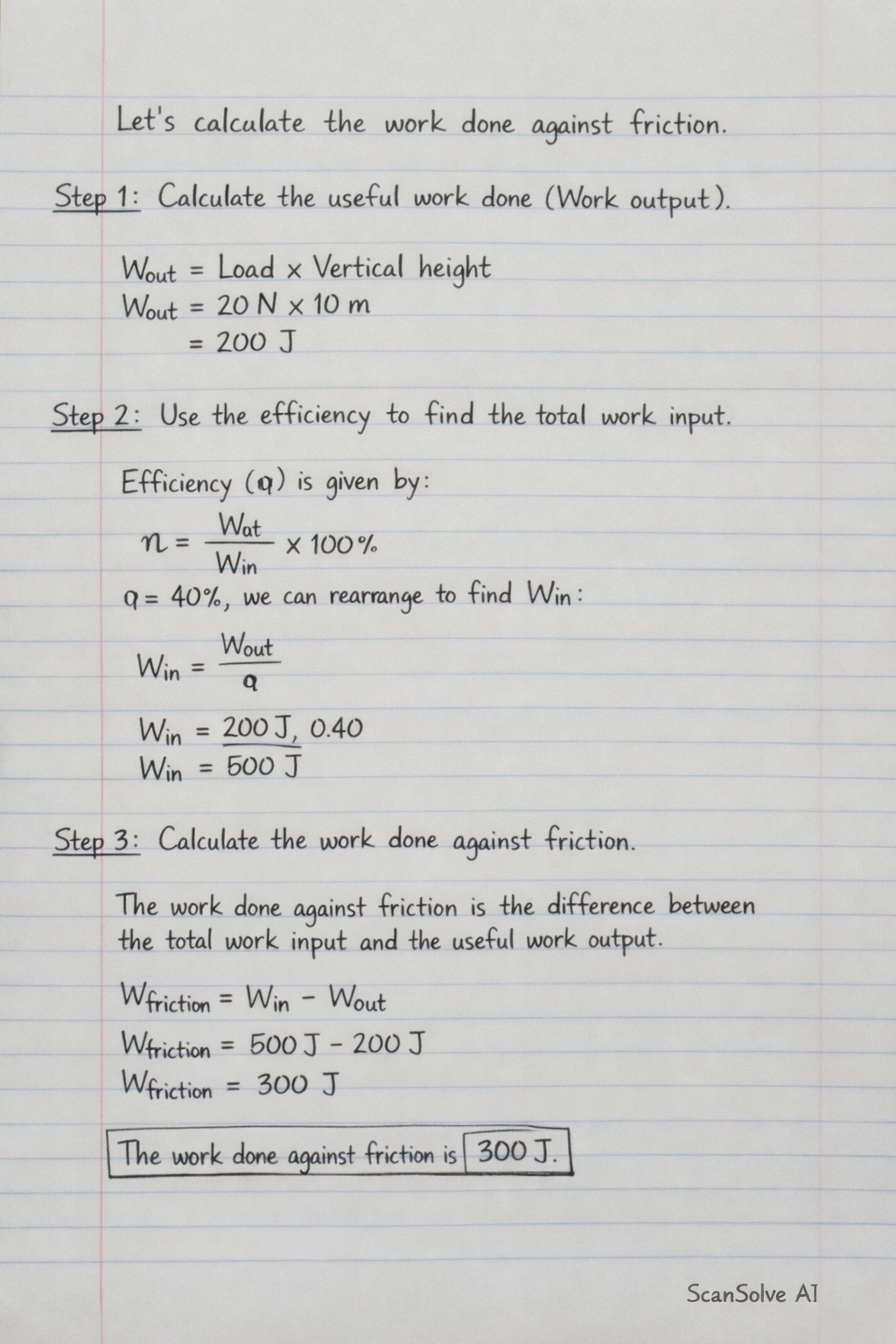
3 stepsLet's calculate the work done against friction.
Calculate the useful work done (Work output).
The useful work done is the work done on the load.
Use the efficiency to find the total work input.
Efficiency () is given by:
Given , we can rearrange to find :
Calculate the work done against friction.
The work done against friction is the difference between the total work input and the useful work output.
The work done against friction is .
Was this helpful?
Try one yourself
A new problem that tests the same skill.
Still stuck on this one?
Ask a follow-up, and the answer starts from this question.
Got a different question?Ask your own question
More Physics Questions
QA block and tackle pulley system has a movable block with a mass of 10 kg. The effort applied is 70…QA block and tackle system of pulleys consisting of 6 pulleys is used to raise a load of 600 N…QA 40 kg box is pulled up an incline of 15 degrees by a horizontal force of 200 N. If the box moves…QA box of mass 40 kg is dragged along the floor by a rope inclined at 60° to the horizontal. The…QCalculate the work done by a force of 20 N applied over a distance of 40 m.
Browse by topic:Mechanics
Handwritten Step-by-Step Solution
Get this as a handwritten image on WhatsApp — like a tutor wrote it for you.
Try on WhatsApp