
We read your photo as:
A block of mass m is dropped from a height h onto a spring with spring constant K. What is the maximum distance the spring will be compressed?
ScanSolve AI Answer
Answer
Step-by-step solution
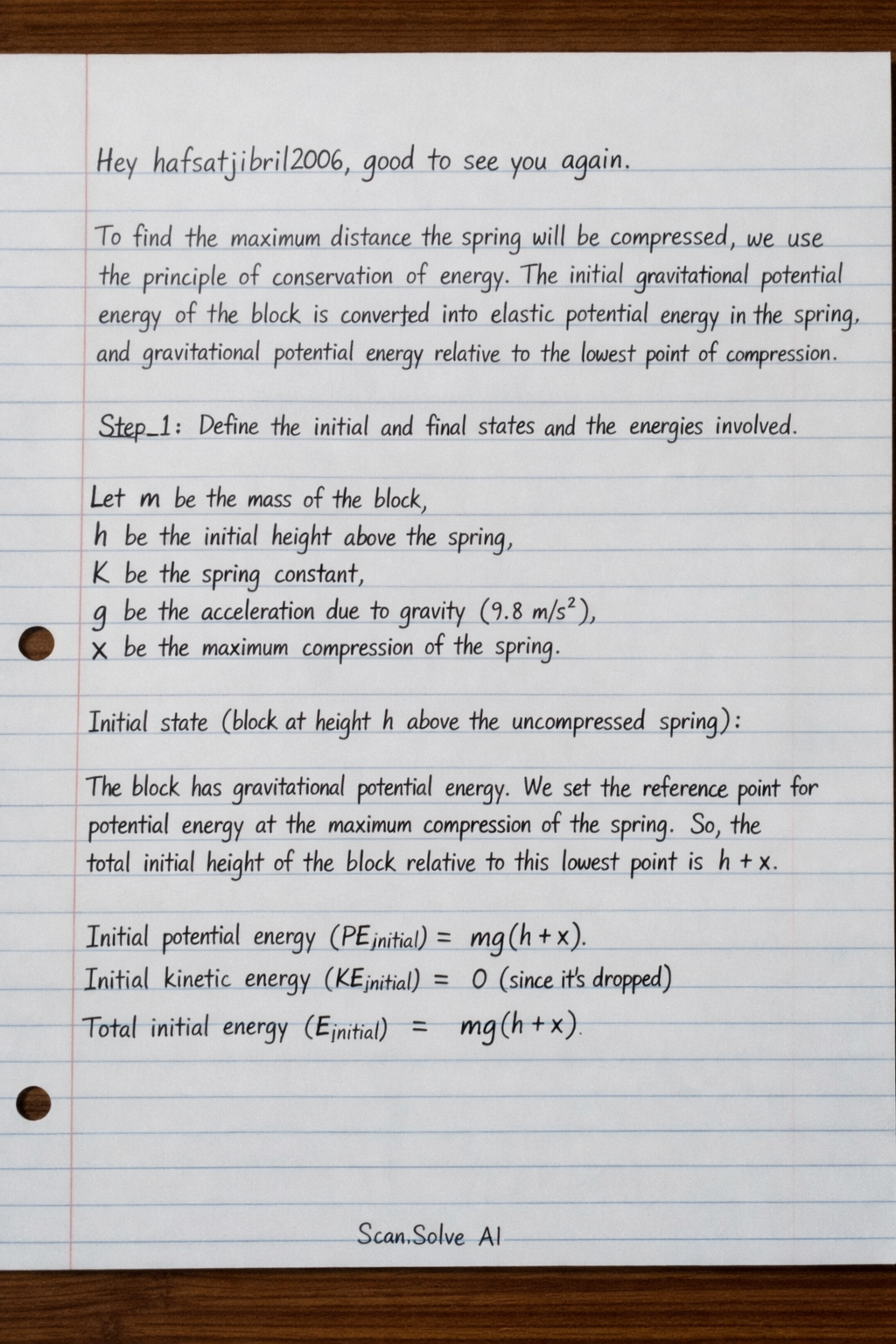
6 stepsTo find the maximum distance the spring will be compressed, we use the principle of conservation of energy. The initial gravitational potential energy of the block is converted into elastic potential energy in the spring and gravitational potential energy relative to the lowest point of compression.
Define the initial and final states and the energies involved.
Let be the mass of the block, be the initial height above the spring, be the spring constant, be the acceleration due to gravity (), and be the maximum compression of the spring.
Initial state (block at height above the uncompressed spring):
The block has gravitational potential energy. We set the reference point for potential energy at the maximum compression of the spring. So, the total initial height of the block relative to this lowest point is .
Initial potential energy () =
Initial kinetic energy () = 0 (since it's dropped)
Total initial energy () =Final state (spring maximally compressed by ):
The block is momentarily at rest, so .
The spring is compressed by , so it has elastic potential energy () = .
At this point, the block is at the reference height for gravitational potential energy, so .
Total final energy () =Apply the conservation of energy principle.
Substitute the given values into the equation.
Given:
Rearrange the equation into a standard quadratic form ().
Solve the quadratic equation for using the quadratic formula .
Here, , , and .
We get two possible values for :
Choose the physically meaningful solution.
Since represents a distance of compression, it must be a positive value.
Therefore, .Rounding to three significant figures:
The maximum distance through which the spring will be compressed is:
Try one yourself
A new problem that tests the same skill.
Still stuck on this one?
Ask a follow-up, and the answer starts from this question.
More Physics Questions
Handwritten Step-by-Step Solution
Get this as a handwritten image on WhatsApp — like a tutor wrote it for you.
Try on WhatsApp