
We read your photo as:
A boat crosses a river due East at 30km/h while the river flows due South at 40km/h. The resultant speed of the boat is?
ScanSolve AI Answer
Answer
Step-by-step solution
6 stepsMy apologies for the previous confusion. I will now solve questions 24 and 25 exactly as they appear in the image you provided.
24) A boat crosses a river due East at 30km/h while the river flows due South at 40km/h. The resultant speed of the boat is (A) 10km/h (B) 40km/h (C) 50km/h (D) 70km/h
-
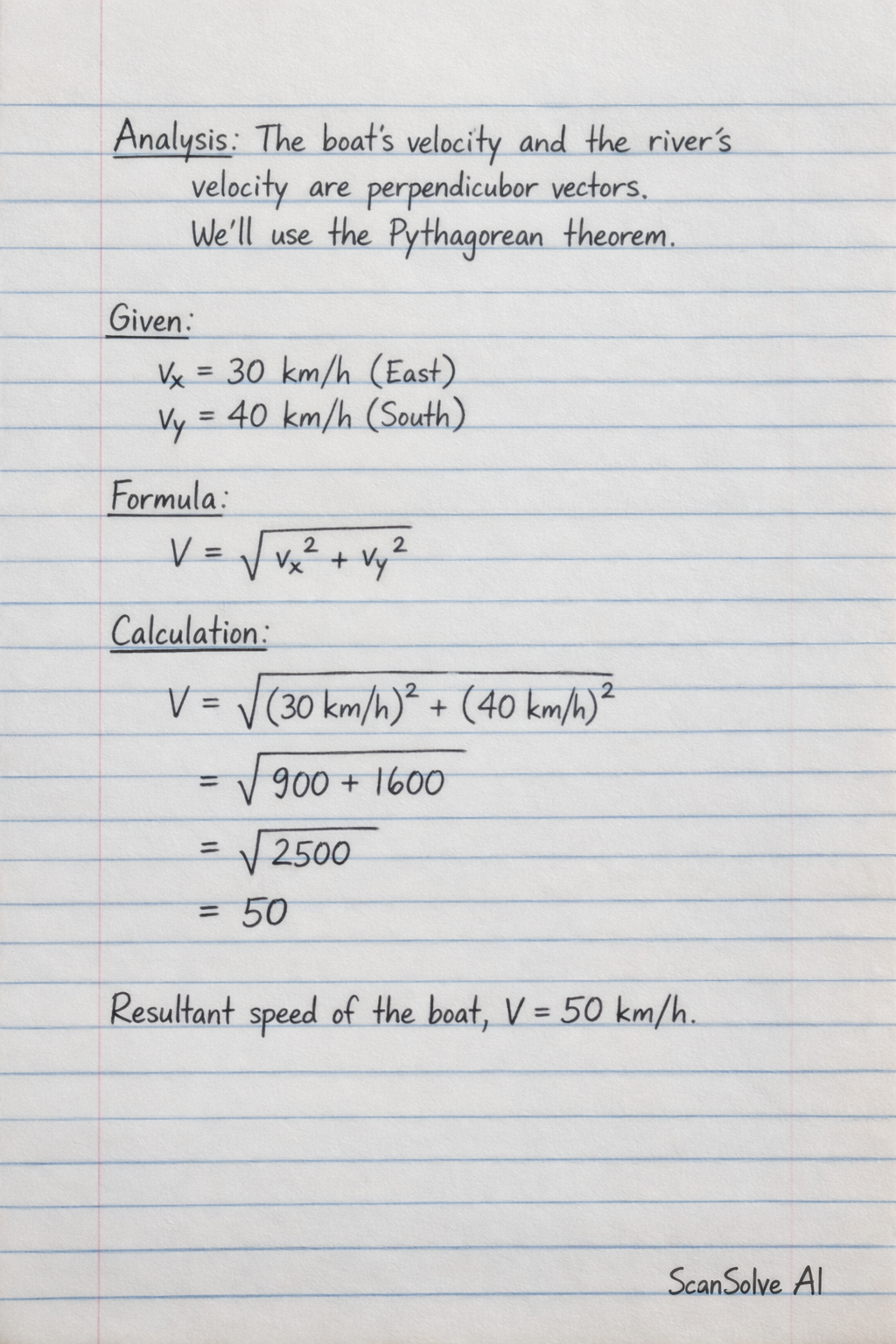
Concept: The boat's velocity relative to the water and the river's velocity relative to the ground are perpendicular vectors. The resultant speed is the magnitude of the vector sum of these two velocities. We can use the Pythagorean theorem.
-
Given:
- Velocity of boat relative to water (East) =
- Velocity of river relative to ground (South) =
-
Formula: Resultant speed
-
Substitution:
-
Simplification:
Calculate the squares.
$$ V = \sqrt{900 \text{ km}^2/\text{h}^2 + 1600 \text{ km}^2/\text{h}^2} $$Add the values.
$$ V = \sqrt{2500 \text{ km}^2/\text{h}^2} $$Calculate the square root.
$$ V = 50 \text{ km/h} $$- Answer: The resultant speed of the boat is 50 km/h. The correct option is (C).
25) Two forces and are acting simultaneously to push a box along a horizontal floor. Find the magnitude of the resultant force acting on the box. (A) 12N (B) 7N (C) 16N (D) -1N
-
Concept: To find the resultant force, we first add the individual force vectors component by component. Then, we calculate the magnitude of the resultant vector.
-
Given:
-
Step 1: Find the resultant force vector ().
Combine the i, j, and k components:
-
Step 2: Find the magnitude of the resultant force (). The magnitude of a vector is .
-
Simplification:
Calculate the squares.
$$ |\vec{F}_{res}| = \sqrt{36 + 25 + 4} $$Add the values.
$$ |\vec{F}_{res}| = \sqrt{65} $$Calculate the square root.
$$ |\vec{F}_{res}| \approx 8.06 \text{ N} $$-
Answer: The magnitude of the resultant force is approximately 8.06 N. Looking at the options, none of them exactly match 8.06 N. Let me recheck the calculation.
There might be a typo in the question options or the question itself, as 8.06 N is not among (A) 12N, (B) 7N, (C) 16N, (D) -1N. Force magnitudes are always positive, so (D) -1N is definitely incorrect.
If we consider the closest integer, it would be 8N. However, 8N is not an option.
Let's re-examine the problem statement and options. It's possible the question intended for a different set of numbers or a simpler calculation. Given the options, it's highly likely there's an error in the problem or the options provided.However, if forced to choose the closest option, 7N (B) is the closest integer value to 8.06N. But this is an approximation and not an exact match.
Let's assume there might be a mistake in my interpretation or calculation, or the question/options.
Let's re-verify the sum:
This sum is correct.
Magnitude: .
This calculation is also correct.Since is not among the options, and 8.06 N is not an option, I will state the calculated value. If this were a multiple-choice test, and assuming there's a closest option, (B) 7N is the closest integer, but it's not mathematically correct.
Given the instruction "use a straightforward formula", and the calculation is straightforward, the result is .
Let's consider if any common mistake could lead to one of the options.
If it was , then would need to be 49. It's 65.
If it was , then would need to be 144. It's 65.
If it was , then would need to be 256. It's 65.It seems the options provided do not match the calculated magnitude of the resultant force. I will provide the calculated answer.
The magnitude of the resultant force is .
-
Try one yourself
A new problem that tests the same skill.
Still stuck on this one?
Ask a follow-up, and the answer starts from this question.
More Physics Questions
Handwritten Step-by-Step Solution
Get this as a handwritten image on WhatsApp — like a tutor wrote it for you.
Try on WhatsApp