A body is projected under gravity from a fixed point with a speed of u at an angle of elevation θ. Show that the trajectory of the projectile is y = x tan θ - gx²/2u² sec²θ.

Physics
A body is projected under gravity from a fixed point with a speed of u at an angle of elevation θ. Show that the trajectory of the projectile is y = x tan θ - gx²/2u² sec²θ.

ScanSolve AI Answer

Answer

the equation for the trajectory of the projectile is:

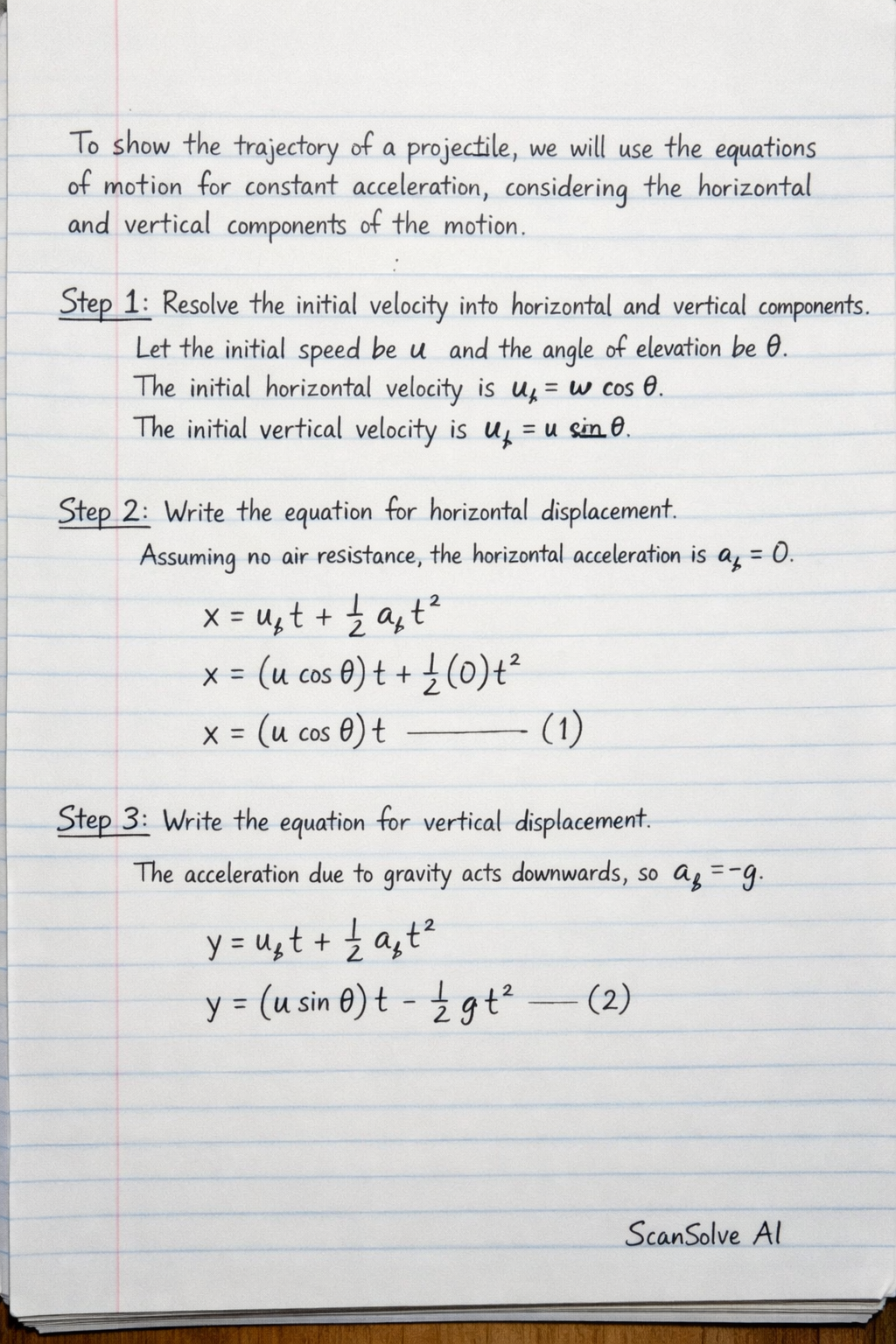
To show the trajectory of a projectile, we will use the equations of motion for constant acceleration, considering the horizontal and vertical components of the motion.

Step 1: Resolve the initial velocity into horizontal and vertical components. Let the initial speed be uu and the angle of elevation be θ\theta. The initial horizontal velocity is ux=ucosθu_x = u \cos \theta. The initial vertical velocity is uy=usinθu_y = u \sin \theta.

Step 2: Write the equation for horizontal displacement. Assuming no air resistance, the horizontal acceleration is ax=0a_x = 0. The horizontal displacement xx after time tt is given by: x=uxt+12axt2x = u_x t + \frac{1}{2} a_x t^2 x=(ucosθ)t+12(0)t2x = (u \cos \theta) t + \frac{1}{2} (0) t^2 x=(ucosθ)t(1)x = (u \cos \theta) t \quad (1)

Step 3: Write the equation for vertical displacement. The acceleration due to gravity acts downwards, so ay=ga_y = -g. The vertical displacement yy after time tt is given by: y=uyt+12ayt2y = u_y t + \frac{1}{2} a_y t^2 y=(usinθ)t12gt2(2)y = (u \sin \theta) t - \frac{1}{2} g t^2 \quad (2)

Step 4: Eliminate time (tt) from the equations. From equation (1), solve for tt: t=xucosθt = \frac{x}{u \cos \theta} Substitute this expression for tt into equation (2): y=(usinθ)(xucosθ)12g(xucosθ)2y = (u \sin \theta) \left(\frac{x}{u \cos \theta}\right) - \frac{1}{2} g \left(\frac{x}{u \cos \theta}\right)^2

Step 5: Simplify the equation. Simplify the first term: y=xusinθucosθ=xtanθy = x \frac{u \sin \theta}{u \cos \theta} = x \tan \theta Simplify the second term: y=xtanθ12gx2u2cos2θy = x \tan \theta - \frac{1}{2} g \frac{x^2}{u^2 \cos^2 \theta} Recall that 1cos2θ=sec2θ\frac{1}{\cos^2 \theta} = \sec^2 \theta. Therefore, the equation for the trajectory of the projectile is: y=xtanθgx22u2sec2θy = x \tan \theta - \frac{g x^2}{2 u^2} \sec^2 \theta This matches the required equation.

3 done, 2 left today. You're making progress.

Was this helpful?

Need help with your own homework?

Get instant step-by-step solutions to any question. Free to start.

Ask Your Question
Handwritten step-by-step solution preview

Handwritten Step-by-Step Solution

Get this as a handwritten image on WhatsApp — like a tutor wrote it for you.

Try on WhatsApp

Still have questions?

Quick Answer

To show the trajectory of a projectile, we will use the equations of motion for constant acceleration, considering the horizontal and vertical components of the motion.

A body is projected under gravity from a fixed point with a speed of u at an angle of elevation θ. Show that the trajectory of the projectile is y = x tan θ - gx²/2u² sec²θ.
Physics

This physics problem tests your understanding of fundamental physical laws and their applications. The step-by-step solution below breaks down the problem using relevant equations and physical reasoning.

ScanSolve AI Answer
To show the trajectory of a projectile, we will use the equations of motion for constant acceleration, considering the horizontal and vertical components of the motion. Step 1: Resolve the initial velocity into horizontal and vertical components. Let the initial speed be u and the angle of elevation be . The initial horizontal velocity is u_x = u . The initial vertical velocity is u_y = u . Step 2: Write the equation for horizontal displacement. Assuming no air resistance, the horizontal acceleration is a_x = 0. The horizontal displacement x after time t is given by: x = u_x t + (1)/(2) a_x t^2 x = (u ) t + (1)/(2) (0) t^2 x = (u ) t (1) Step 3: Write the equation for vertical displacement. The acceleration due to gravity acts downwards, so a_y = -g. The vertical displacement y after time t is given by: y = u_y t + (1)/(2) a_y t^2 y = (u ) t - (1)/(2) g t^2 (2) Step 4: Eliminate time (t) from the equations. From equation (1), solve for t: t = (x)/(u ) Substitute this expression for t into equation (2): y = (u ) ((x)/(u )) - (1)/(2) g ((x)/(u ))^2 Step 5: Simplify the equation. Simplify the first term: y = x (u )/(u ) = x Simplify the second term: y = x - (1)/(2) g (x^2)/(u^2 ^2 ) Recall that (1)/(^2 ) = ^2 . Therefore, the equation for the trajectory of the projectile is: y = x - (g x^2)/(2 u^2) ^2 This matches the required equation. 3 done, 2 left today. You're making progress.