This physics problem tests your understanding of fundamental physical laws and their applications. The step-by-step solution below breaks down the problem using relevant equations and physical reasoning.
A bulb intended to light a room takes 100 J of electrical energy per unit time. The efficiency of the bulb, if 30 J of the energy is converted to heat is:
Physics

ScanSolve AI Answer
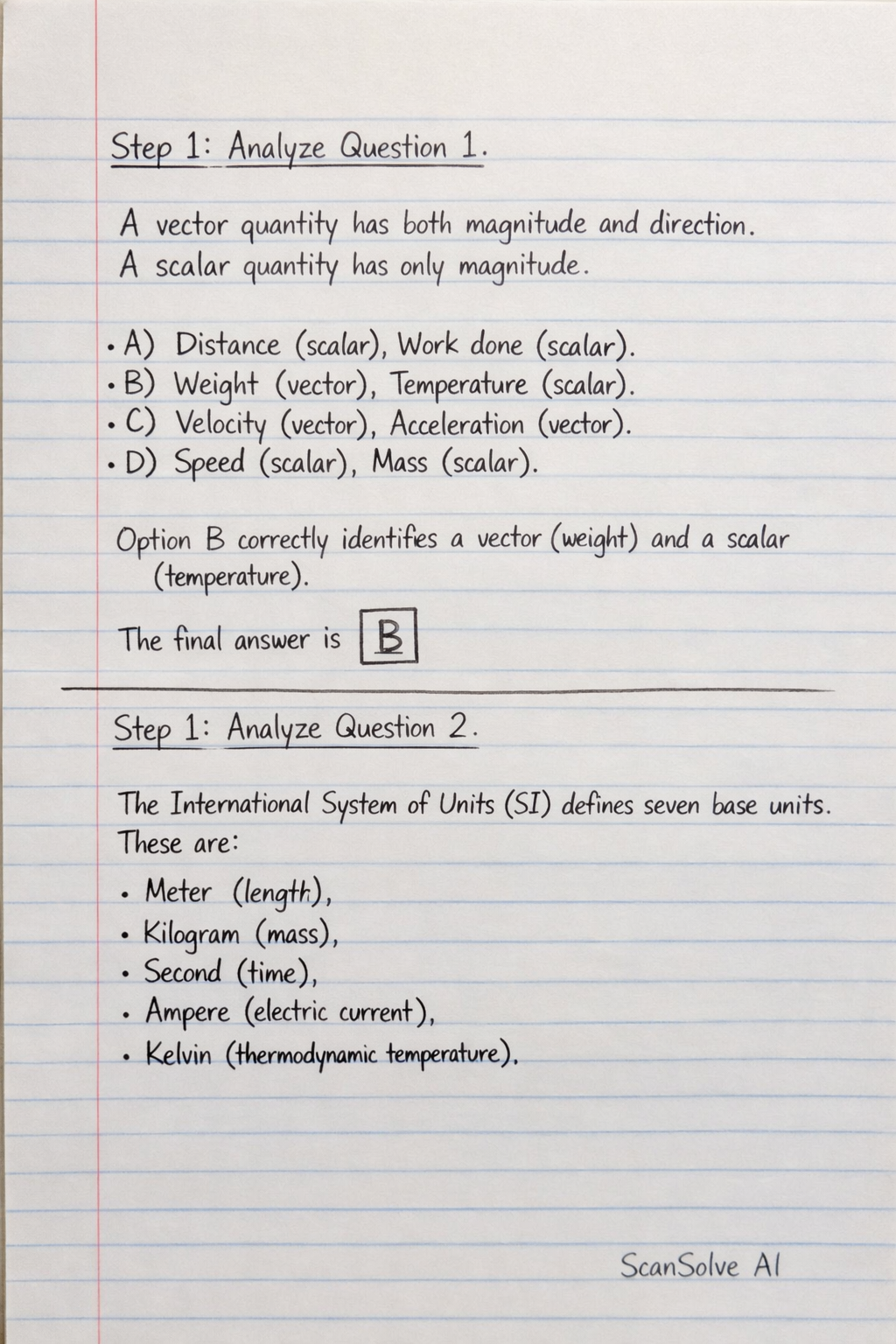
Step 1: Analyze Question 1. A vector quantity has both magnitude and direction. A scalar quantity has only magnitude.
- A) Distance (scalar), Work done (scalar).
- B) Weight (vector), Temperature (scalar).
- C) Velocity (vector), Acceleration (vector).
- D) Speed (scalar), Mass (scalar). Option B correctly identifies a vector (weight) and a scalar (temperature).
The final answer is
Step 1: Analyze Question 2. The International System of Units (SI) defines seven base units. These are meter (length), kilogram (mass), second (time), ampere (electric current), kelvin (thermodynamic temperature),
Was this helpful?
Still stuck on this one?
Ask a follow-up, and the answer starts from this question.
Got a different question?Ask your own question
More Physics Questions
QAn electric bulb is marked 60 W, 240 V. Determine the energy the bulb consumes in one minute.QA 40 W bulb is used for 15 minutes. Calculate the heat generated.QA 10.0 W light bulb is used for 5 seconds. How much energy does it consume?QCalculate the energy consumed by the bulb in one day.QA 100 W lamp is used for 6 hours daily for 30 days. Calculate the total energy consumed in kilowatt-…

Handwritten Step-by-Step Solution
Get this as a handwritten image on WhatsApp — like a tutor wrote it for you.
Try on WhatsAppScanSolve AI Answer
Step 1: Analyze Question 1. A vector quantity has both magnitude and direction. A scalar quantity has only magnitude. A) Distance (scalar), Work done (scalar). B) Weight (vector), Temperature (scalar). C) Velocity (vector), Acceleration (vector). D) Speed (scalar), Mass (scalar). Option B correctly identifies a vector (weight) and a scalar (temperature). The final answer is B --- Step 1: Analyze Question 2. The International System of Units (SI) defines seven base units. These are meter (length), kilogram (mass), second (time), ampere (electric current), kelvin (thermodynamic temperature),