
We read your photo as:
A bus travels from rest with uniform acceleration for 30 s, then at a constant speed for 60 s, and finally decelerates uniformly to rest in 40 s. The total distance covered is 2090 m. Calculate (a) th
ScanSolve AI Answer
Answers
2 partsStep-by-step solution
7 stepsHere are the calculations for the bus journey.
Part a· 3 steps
The maximum speed, in km/h the bus attained.
Determine the total distance from the area under the speed-time graph.
The graph is a trapezium. The area of a trapezium is given by , where and are the lengths of the parallel sides and is the perpendicular height.
In this case, the parallel sides are the time intervals where speed is constant (top) and the total time (bottom). The height is the maximum speed ().
The duration of constant speed is from s to s, so s.
The total time is from s to s, so s.
The total distance is given as 2090 m.Calculate the maximum speed in m/s.
Convert the maximum speed from m/s to km/h.
To convert m/s to km/h, multiply by or 3.6.
The maximum speed attained is .
Part b
The acceleration in the first 30 seconds.
Identify the initial and final speeds and time for the first 30 seconds.
The bus starts from rest, so initial speed m/s.
The final speed at s is the maximum speed, m/s.
The time taken is s.Calculate the acceleration.
Acceleration is the gradient of the speed-time graph, given by .
The acceleration in the first 30 seconds is .
Part c· 2 steps
The distance travelled during the last 20 seconds.
Determine the time interval for the last 20 seconds.
The total journey time is 130 seconds. The last 20 seconds are from s to s.
Calculate the deceleration during the last phase.
The deceleration phase is from s to s.
Initial speed at s is m/s.
Final speed at s is 0 m/s.
Time taken for deceleration is s.So, the acceleration is m/s.
Step
Try one yourself
A new problem that tests the same skill.
Still stuck on this one?
Ask a follow-up, and the answer starts from this question.
More Physics Questions
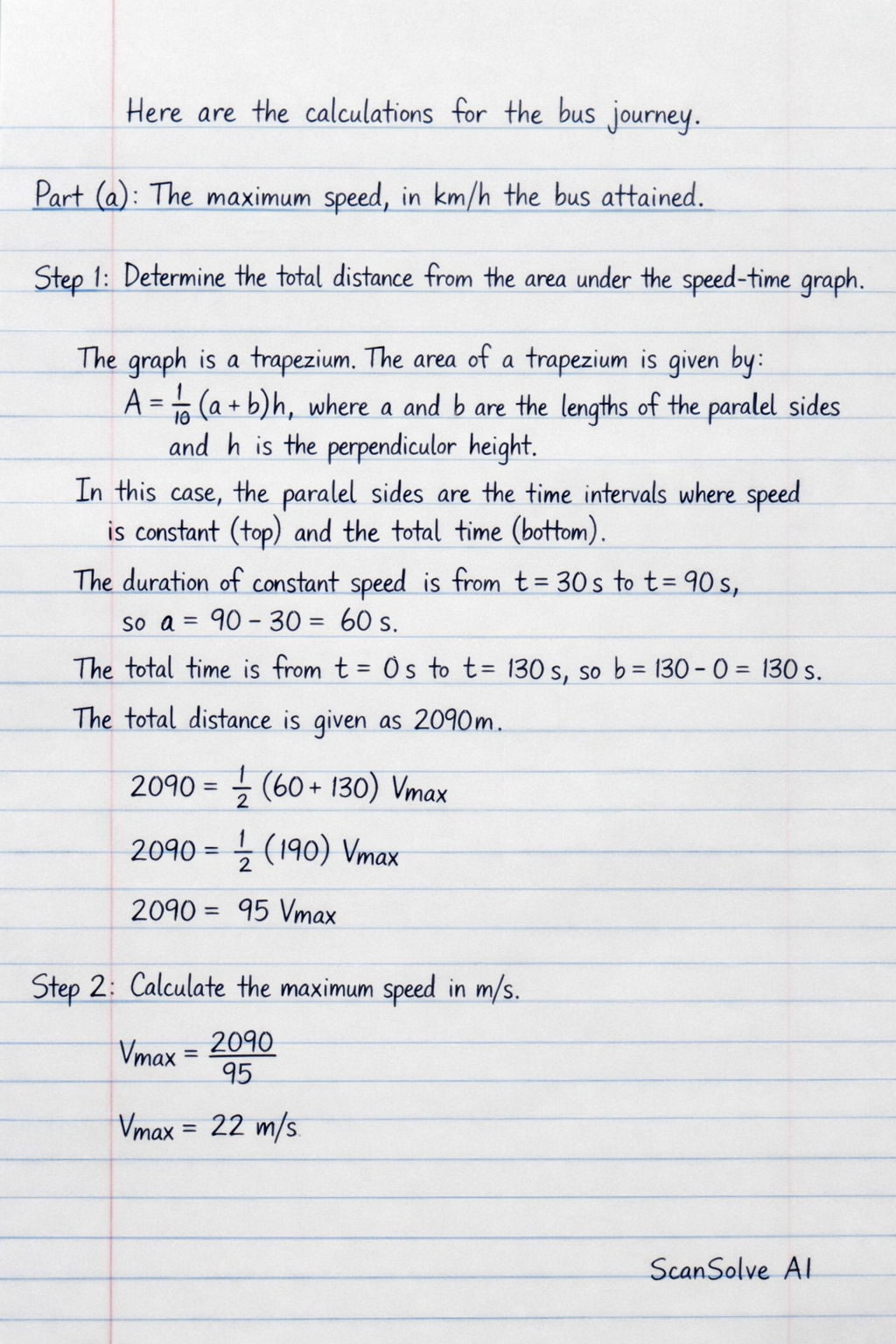
Handwritten Step-by-Step Solution
Get this as a handwritten image on WhatsApp — like a tutor wrote it for you.
Try on WhatsApp