
We read your photo as:
A) Calculate the effective resistance of bulbs A and B. b) Switch S is now closed for a short time. Determine the reading on: Voltmeter V1, Voltmeter V3
ScanSolve AI Answer
Step-by-step solution
11 stepsPart 1
Part a· 3 steps
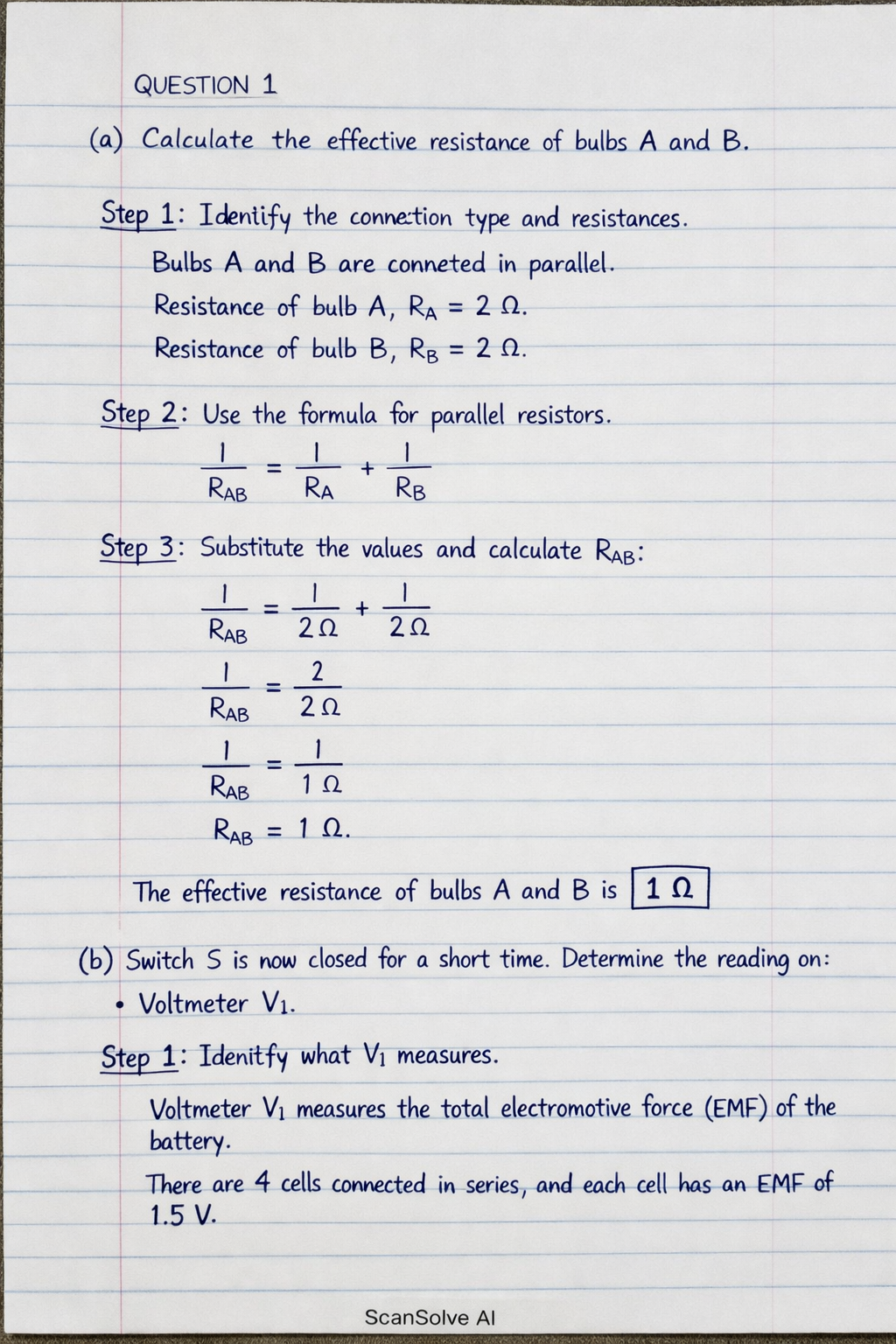
Calculate the effective resistance of bulbs A and B.
Identify the connection type and resistances.
Bulbs A and B are connected in parallel.
Resistance of bulb A, .
Resistance of bulb B, .Use the formula for parallel resistors.
Substitute the values and calculate .
The effective resistance of bulbs A and B is
Part b· 5 steps
Switch S is now closed for a short time. Determine the reading on
- Voltmeter V1
Identify what V1 measures.
Voltmeter V1 measures the total electromotive force (EMF) of the battery.
There are 4 cells connected in series, and each cell has an EMF of 1.5 V.Calculate the total EMF.
The reading on Voltmeter V1 is
- Voltmeter V3
Calculate the total resistance of the circuit.
The parallel combination of A and B () is in series with bulb C ().
Calculate the total current in the circuit.
Using Ohm's Law, .
Calculate the voltage across bulb C (reading on V3).
Using Ohm's Law, .
The reading on Voltmeter V3 is
Part c· 3 steps
Calculate the energy transferred in bulb C in 3 seconds if the current in the circuit is 2 A.
Identify the given values.
Current, .
Time, .
Resistance of bulb C, .Use the formula for energy transferred.
Substitute the values and calculate the energy.
The energy transferred in bulb C is $\boxed{36 ,
Still stuck on this one?
Ask a follow-up, and the answer starts from this question.
More Physics Questions
Handwritten Step-by-Step Solution
Get this as a handwritten image on WhatsApp — like a tutor wrote it for you.
Try on WhatsApp