
We read your photo as:
A car travelling at velocity of 20 km/hr, accelerates for 4 secs to reach a velocity of 60 km/hr. Find the acceleration in m/s² and the distance covered in the 4 secs.
Physics
ScanSolve AI Answer
Here are the solutions to the questions you provided. I will solve all the questions I can clearly read from the image.
Question 1: A car travelling at velocity of 20 km/hr, accelerates for 4 secs to reach a velocity of 60 km/hr. Find the acceleration in m/s² and the distance covered in the 4 secs.
Step 1: Convert initial and final velocities from km/hr to m/s.
Initial velocity, $u = 20 km/hr = 20 \times \frac{1000 m}{3600 s} = \frac{200}{36} m/s = \frac{5
Was this helpful?
Still stuck on this one?
Ask a follow-up, and the answer starts from this question.
Got a different question?Ask your own question
More Physics Questions
QA car accelerates from 0 to 20 m/s in 4 seconds. Find its acceleration.QA car accelerates from rest to 20 m/s in 10s, stays at 20 m/s for 20s, then decelerates to rest in…QA car accelerates from rest to 20 m/s in 10 s, maintains this speed for 20 s, and then decelerates…QA car is moving with an initial velocity of 20 m/s and has an acceleration of 2 m/s². Calculate the…QA car starts with an initial velocity of 3 m/s and reaches a final velocity of 9 m/s in 4 seconds…
Browse by topic:Mechanics
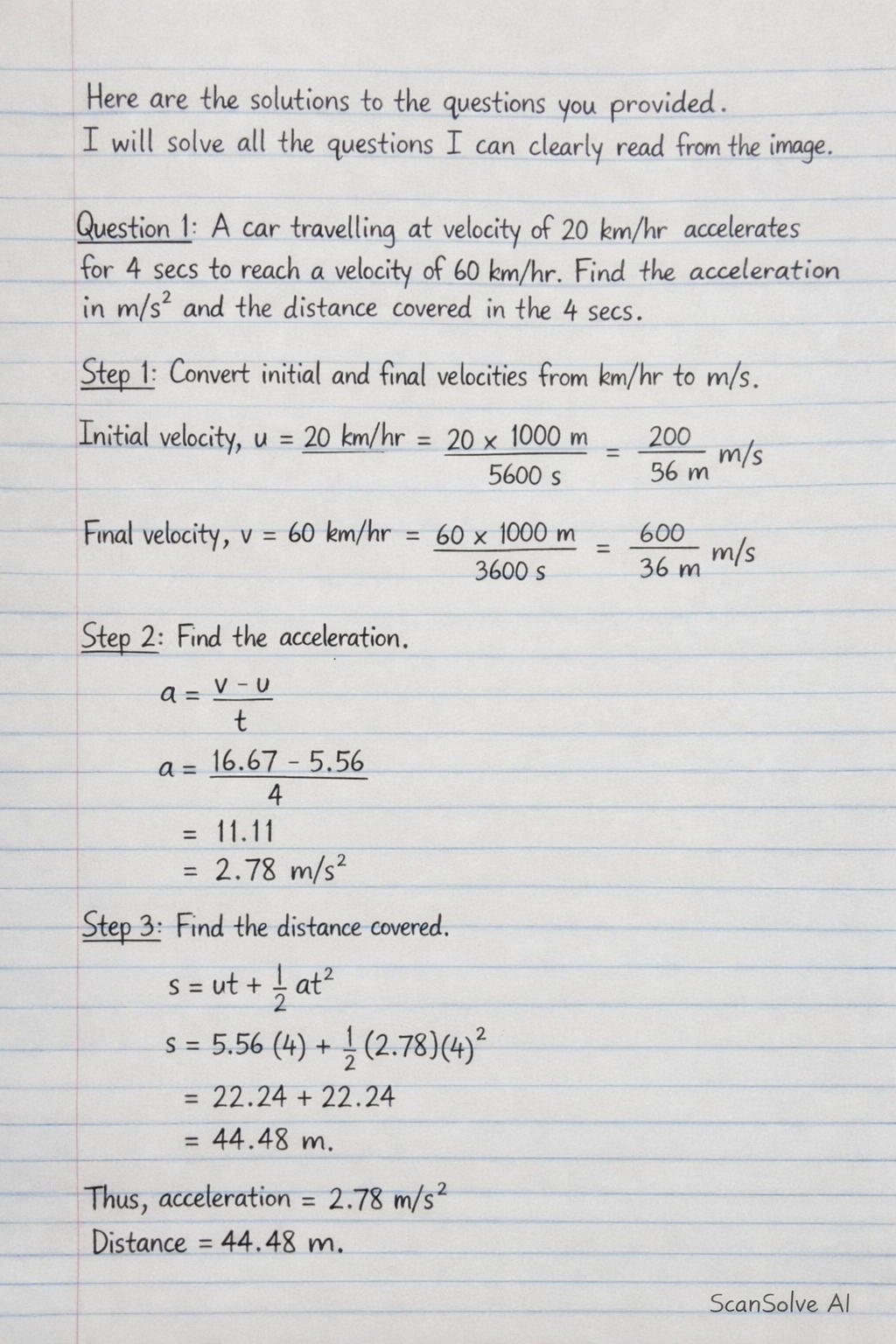
Handwritten Step-by-Step Solution
Get this as a handwritten image on WhatsApp — like a tutor wrote it for you.
Try on WhatsApp