
We read your photo as:
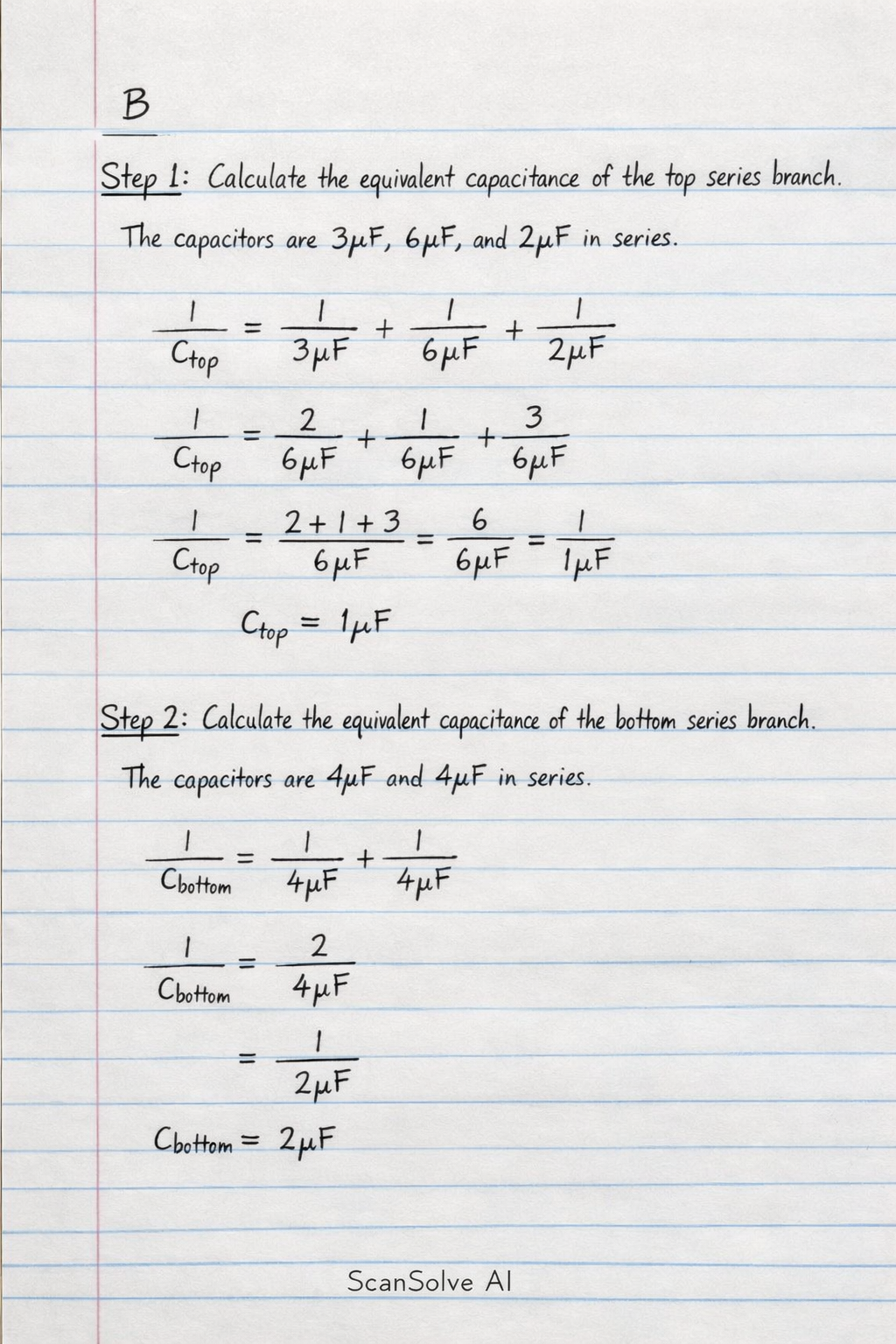
A circuit contains three capacitors in series: 3μF, 6μF, and 2μF. Another branch has two capacitors in series: 4μF and 4μF. These two branches are in parallel. What is the total capacitance?
Physics
ScanSolve AI Answer
Step-by-step solution
4 stepsB
Calculate the equivalent capacitance of the top series branch.
The capacitors are , , and in series.
For capacitors in series, the reciprocal of the equivalent capacitance is the sum of the reciprocals of individual capacitances.Calculate the equivalent capacitance of the bottom series branch.
The capacitors are and in series.
Calculate the equivalent capacitance of the parallel combination of the top and bottom branches.
For capacitors in parallel, the equivalent capacitance is the sum of individual capacitances.
Calculate the total effective capacitance of the circuit.
The capacitor on the left, , and the capacitor on the right are all in series.
Find a common denominator, which is .
The effective capacitance is . This matches option B.
The final answer is .
Was this helpful?
Still stuck on this one?
Ask a follow-up, and the answer starts from this question.
Got a different question?Ask your own question
More Physics Questions
QDetermine the total equivalent capacitance of a parallel circuit with three branches. Branch 1 has a…QCalculate the equivalent capacitance of three capacitors in series with capacitances 6 μF, 4 μF, and…QCalculate the equivalent capacitance for three capacitors in series with values 6 μF, 4 μF, and 3…QCalculate the total capacitance of capacitors connected in parallel (C1=1µF, C2=5µF, C3=8µF). Write…QCalculate the equivalent capacitance of capacitors C1=0.1 ext uF, C2=0.2 ext uF, C3=0.3 ext uF when…
Handwritten Step-by-Step Solution
Get this as a handwritten image on WhatsApp — like a tutor wrote it for you.
Try on WhatsApp