
We read your photo as:
A concave mirror has a radius of curvature of 20 cm. If an object is placed 30 cm away from the mirror, where is the image formed?
ScanSolve AI Answer
Answers
2 partsStep-by-step solution
2 stepsStep 1: Identify given values and determine the focal length.
The object distance is .
The radius of curvature of the concave mirror is .
For a concave mirror, the focal length is half the radius of curvature and is negative according to the Cartesian sign convention.
According to the Cartesian sign convention, for a real object placed in front of the mirror, the object distance is negative.
Step 2: Calculate the image position () using the mirror formula.
The mirror formula is:
Substitute the values of and :
Rearrange the formula to solve for :
To combine the fractions, find a common denominator, which is 30:
Part i· 1 step
The position
The image is formed in front of the mirror.
Determine the nature of the image.
The negative sign of indicates that the image is formed on the same side as the object (in front of the mirror). Images formed in front of a mirror are real.
For a real image formed by a mirror, it is always inverted.
Part ii· 1 step
The nature
The image is Real and Inverted.
Calculate the magnification ().
The magnification formula is:
Substitute the values of and :
The negative sign of confirms that the image is inverted. The magnitude indicates that the image is diminished (smaller than the object).
Part iii
Magnification
Try one yourself
A new problem that tests the same skill.
Still stuck on this one?
Ask a follow-up, and the answer starts from this question.
More Physics Questions
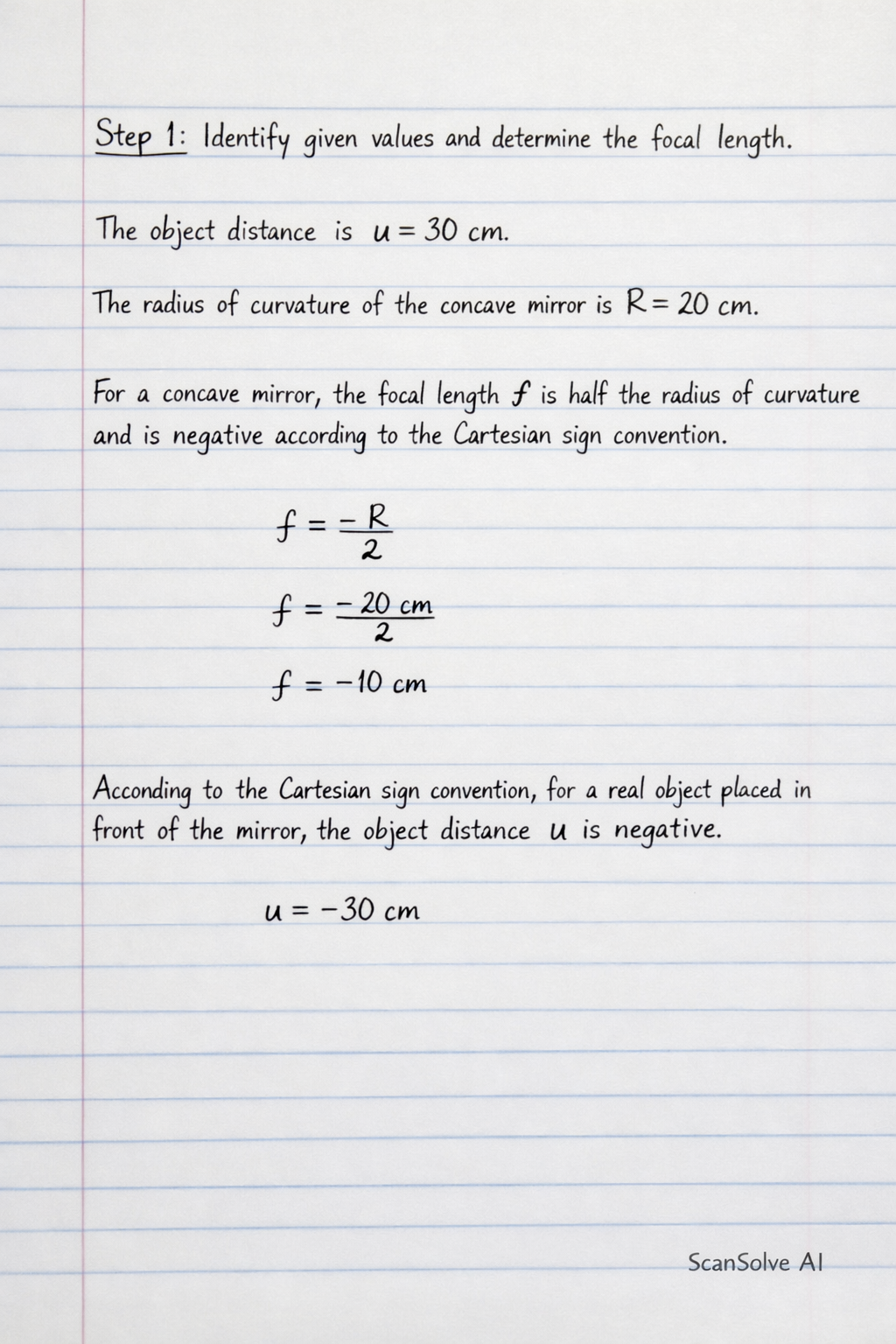
Handwritten Step-by-Step Solution
Get this as a handwritten image on WhatsApp — like a tutor wrote it for you.
Try on WhatsApp