

This physics problem tests your understanding of fundamental physical laws and their applications. The step-by-step solution below breaks down the problem using relevant equations and physical reasoning.
ScanSolve AI Answer
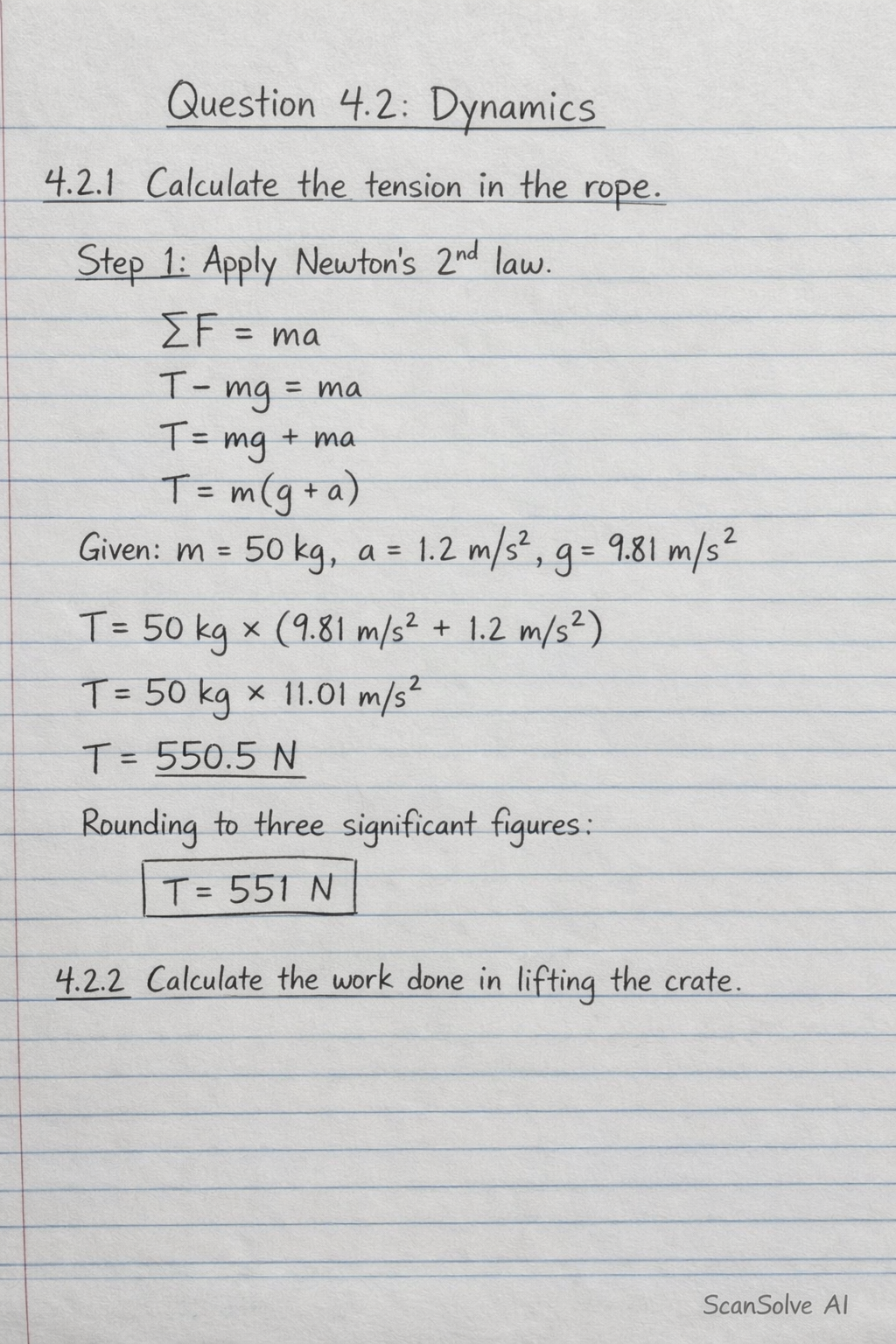
QUESTION 4.2: DYNAMICS 4.2.1 Calculate the tension in the rope. Step 1: Apply Newton's second law of motion. The forces acting on the crate are the tension (T) upwards and its weight (mg) downwards. The net force causes an upward acceleration (a). Given mass m = 50 kg, acceleration a = 1.2 m/s^2, and assuming g = 9.81 m/s^2. F = ma T - mg = ma T = mg + ma = m(g+a) Substitute the values: T = 50 kg × (9.81 m/s^2 + 1.2 m/s^2) T = 50 kg × 11.01 m/s^2 T = 550.5 N Rounding to three significant figures: 551 N 4.2.2 Calculate the work done in lifting the crate. Step 1: Calculate the work done (W) by the tension force. The formula for work done is W = F × s × . Since the tension force and displacement are in the same direction ( = 0^, so = 1), the formula simplifies to W = T × s. Given distance s = 30 m and tension T = 550.5 N from 4.2.1. W = 550.5 N × 30 m W = 16515 J Rounding to three significant figures: 16500 J QUESTION 4.3: DYNAMICS 4.3.1 Calculate the maximum static frictional force acting on the box. Step 1: Calculate the normal force (N) acting on the box. The normal force is perpendicular to the inclined plane. The component of gravity perpendicular to the plane is mg . Given mass m = 25 kg, angle = 25^, and assuming g = 9.81 m/s^2. N = mg N = 25 kg × 9.81 m/s^2 × (25^) N = 245.25 N × 0.9063077 N ≈ 222.29 N Step 2: Calculate the maximum static frictional force (f_s,max) using the formula f_s,max = _s N. Given coefficient of static friction _s = 0.35. f_s,max = 0.35 × 222.29 N f_s,max ≈ 77.80 N Rounding to three significant figures: 77.8 N 4.3.2 Show that the box is indeed about to slide down the plane. Step 1: Calculate the component of the gravitational force acting down the inclined plane. F_down = mg F_down = 25 kg × 9.81 m/s^2 × (25^) F_down = 245.25 N × 0.422618 F_down ≈ 103.6 N Step 2: Compare the force component down the plane (F_down) with the maximum static frictional force (f_s,max). From 4.3.1, f_s,max ≈ 77.8 N. Since F_down (103.6 N) > f_s,max (77.8 N), the force pulling the box down the plane is greater than the maximum static friction that can oppose it. Therefore, the box will indeed slide down the plane. What's next?