Give me a crazy complex question on angular acceleration

Physics

ScanSolve AI Answer

Step-by-step solution

5 steps

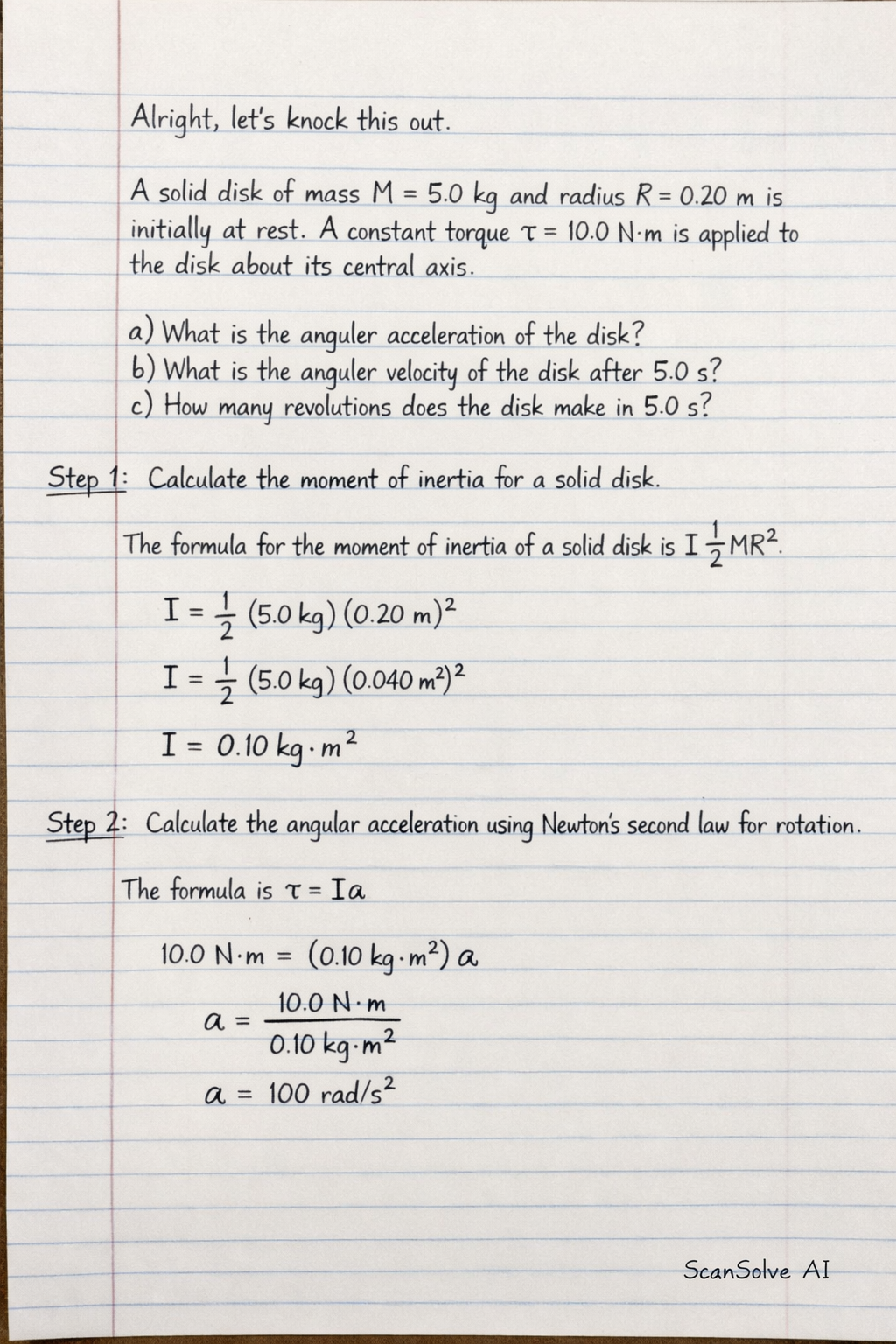
A solid disk of mass M=5.0 kgM = 5.0 \, \text{kg} and radius R=0.20 mR = 0.20 \, \text{m} is initially at rest. A constant torque τ=10.0 N⋅m\tau = 10.0 \, \text{N} \cdot \text{m} is applied to the disk about its central axis.

a) What is the angular acceleration of the disk?

b) What is the angular velocity of the disk after 5.0 s5.0 \, \text{s}?

c) How many revolutions does the disk make in 5.0 s5.0 \, \text{s}?

  1. Calculate the moment of inertia for a solid disk.

    The formula for the moment of inertia of a solid disk is I=12MR2I = \frac{1}{2}MR^2.

    I=12(5.0 kg)(0.20 m)2I = \frac{1}{2}(5.0 \, \text{kg})(0.20 \, \text{m})^2 I=12(5.0 kg)(0.040 m2)I = \frac{1}{2}(5.0 \, \text{kg})(0.040 \, \text{m}^2) I=0.10 kg⋅m2I = 0.10 \, \text{kg} \cdot \text{m}^2
  2. Calculate the angular acceleration using Newton's second law for rotation.

    The formula is τ=Iα\tau = I\alpha.

    10.0 N⋅m=(0.10 kg⋅m2)α10.0 \, \text{N} \cdot \text{m} = (0.10 \, \text{kg} \cdot \text{m}^2)\alpha α=10.0 N⋅m0.10 kg⋅m2\alpha = \frac{10.0 \, \text{N} \cdot \text{m}}{0.10 \, \text{kg} \cdot \text{m}^2} α=100 rad/s2\alpha = 100 \, \text{rad/s}^2
  3. Calculate the angular velocity after 5.0 s5.0 \, \text{s}.

    The formula for final angular velocity is ωf=ωi+αt\omega_f = \omega_i + \alpha t. Since the disk starts from rest, ωi=0\omega_i = 0.

    ωf=0+(100 rad/s2)(5.0 s)\omega_f = 0 + (100 \, \text{rad/s}^2)(5.0 \, \text{s}) ωf=500 rad/s\omega_f = 500 \, \text{rad/s}
  4. Calculate the angular displacement after 5.0 s5.0 \, \text{s}.

    The formula for angular displacement is θ=ωit+12αt2\theta = \omega_i t + \frac{1}{2}\alpha t^2.

    θ=(0)(5.0 s)+12(100 rad/s2)(5.0 s)2\theta = (0)(5.0 \, \text{s}) + \frac{1}{2}(100 \, \text{rad/s}^2)(5.0 \, \text{s})^2 θ=0+12(100 rad/s2)(25.0 s2)\theta = 0 + \frac{1}{2}(100 \, \text{rad/s}^2)(25.0 \, \text{s}^2) θ=1250 rad\theta = 1250 \, \text{rad}
  5. Convert the angular displacement from radians to revolutions.

    There are 2π2\pi radians in one revolution.

    Revolutions=1250 rad2π rad/rev\text{Revolutions} = \frac{1250 \, \text{rad}}{2\pi \, \text{rad/rev}} Revolutions≈198.9 rev\text{Revolutions} \approx 198.9 \, \text{rev}

    a) The angular acceleration is 100 rad/s2\boxed{100 \, \text{rad/s}^2}.

    b) The angular velocity after 5.0 s5.0 \, \text{s} is 500 rad/s\boxed{500 \, \text{rad/s}}.

    c) The number of revolutions in 5.0 s5.0 \, \text{s} is approximately 198.9 rev\boxed{198.9 \, \text{rev}}.

Was this helpful?

Still stuck on this one?

Ask a follow-up, and the answer starts from this question.

Got a different question?Ask your own question
Handwritten step-by-step solution preview

Handwritten Step-by-Step Solution

Get this as a handwritten image on WhatsApp — like a tutor wrote it for you.

Try on WhatsApp