
We read your photo as:
A) Inertia of a body
ScanSolve AI Answer
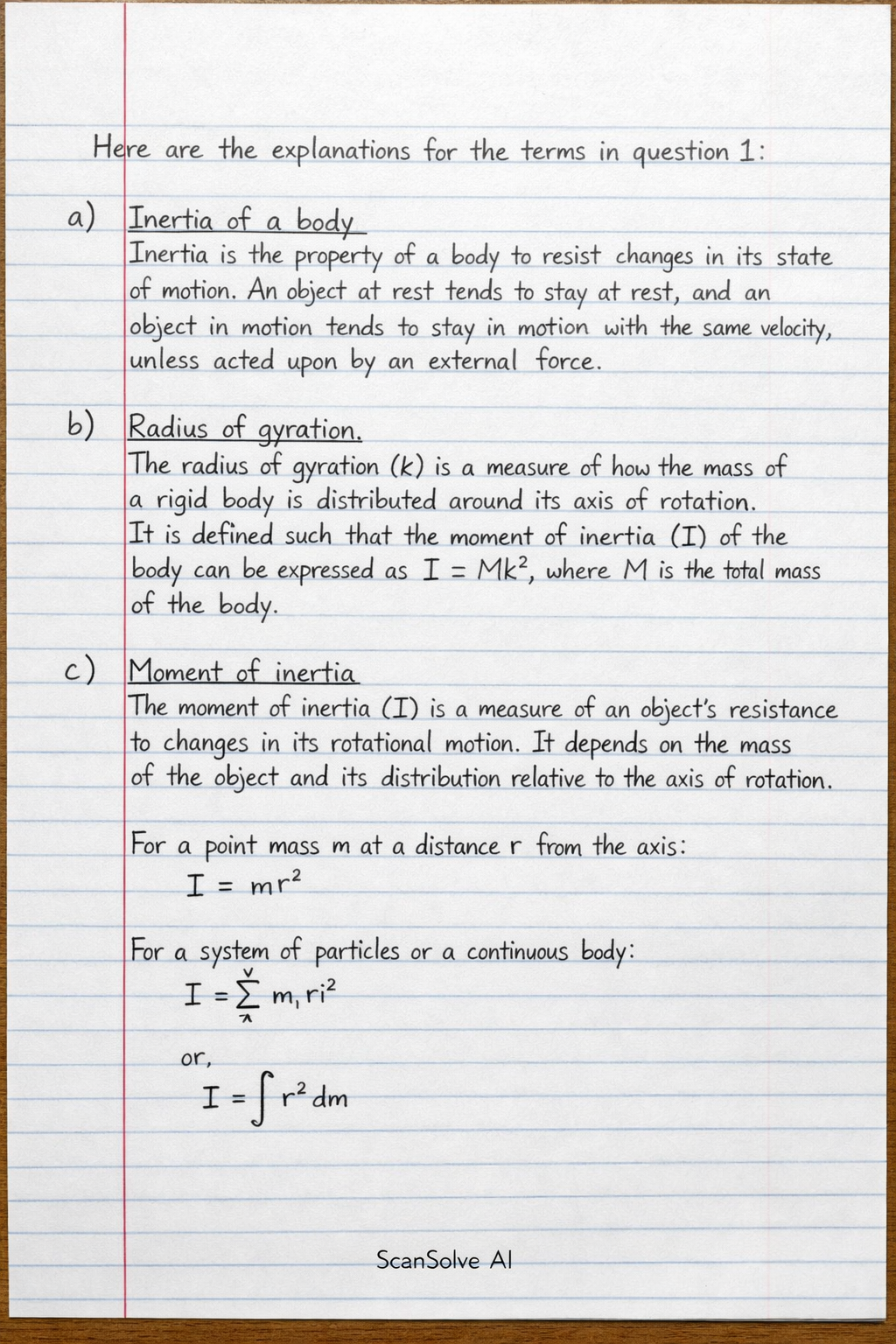
Here are the explanations for the terms in question 1:
a) Inertia of a body
Inertia is the property of a body to resist changes in its state of motion. An object at rest tends to stay at rest, and an object in motion tends to stay in motion with the same velocity, unless acted upon by an external force.
b) Radius of gyration
The radius of gyration () is a measure of how the mass of a rigid body is distributed around its axis of rotation. It is defined such that the moment of inertia () of the body can be expressed as , where is the total mass of the body.
c) Moment of inertia
The moment of inertia () is a measure of an object's resistance to changes in its rotational motion. It depends on the mass of the object and its distribution relative to the axis of rotation. For a point mass at a distance from the axis, . For a system of particles or a continuous body, it is the sum or integral of .
d) Angular acceleration
Angular acceleration () is the rate of change of angular velocity () with respect to time. It describes how quickly an object's rotational speed or direction of rotation is changing.
e) Total angular displacement
Total angular displacement () is the total angle through which a point or line has rotated around a central axis. It is the change in angular position of a rotating body.
f) Viscosity
Viscosity is a measure of a fluid's resistance to flow. It describes the internal friction within a fluid, where adjacent layers of the fluid exert shear forces on each other, opposing relative motion.
Still stuck on this one?
Ask a follow-up, and the answer starts from this question.
More Physics Questions
Handwritten Step-by-Step Solution
Get this as a handwritten image on WhatsApp — like a tutor wrote it for you.
Try on WhatsApp