
This physics problem tests your understanding of fundamental physical laws and their applications. The step-by-step solution below breaks down the problem using relevant equations and physical reasoning.
ScanSolve AI Answer
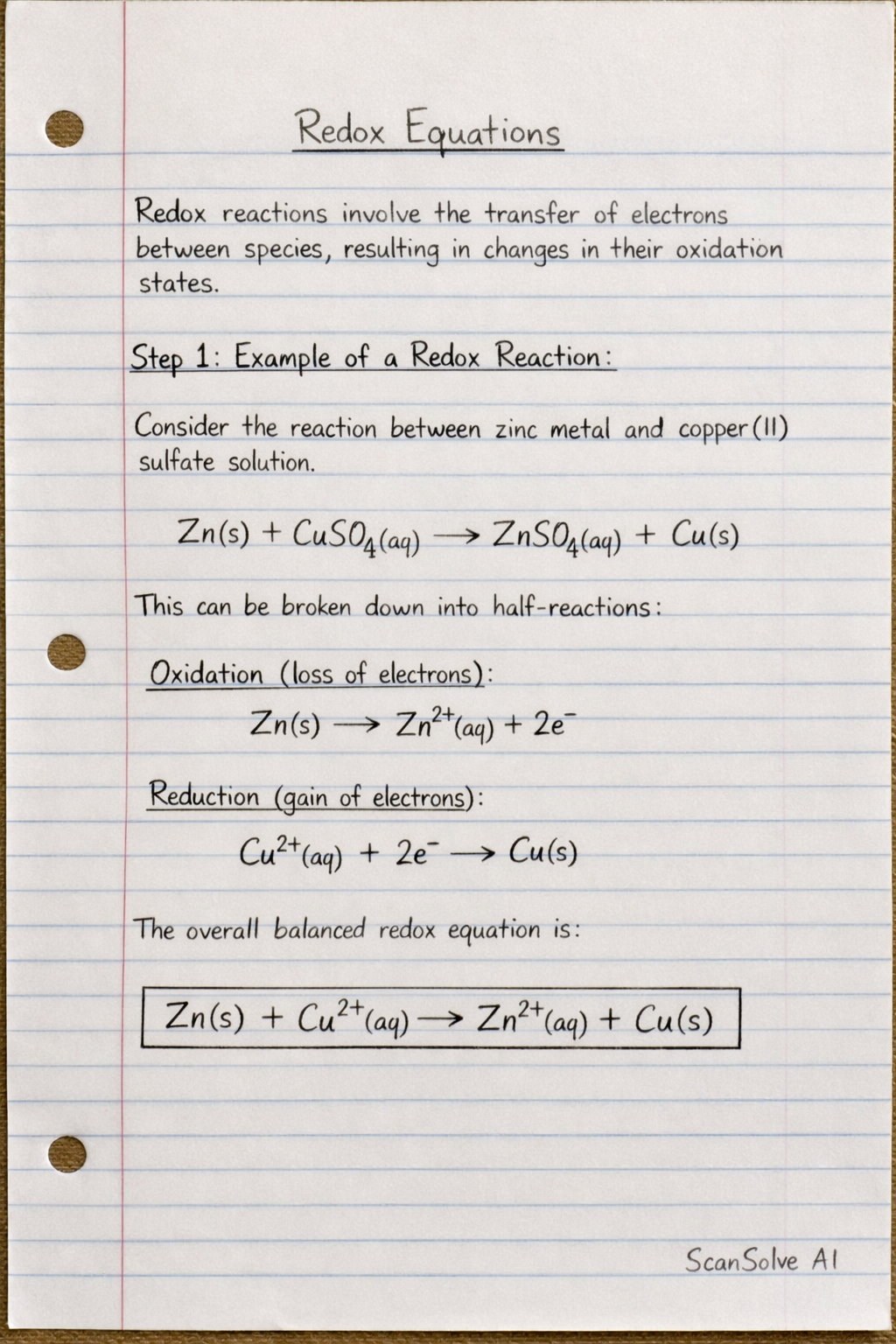
Here are some redox equations and thermal formulas: Redox Equations Redox (reduction-oxidation) reactions involve the transfer of electrons between species, resulting in changes in their oxidation states. Step 1: Example of a Redox Reaction Consider the reaction between zinc metal and copper(II) sulfate solution. Zn(s) + CuSO_4(aq) ZnSO_4(aq) + Cu(s) This can be broken down into half-reactions: Oxidation (loss of electrons): Zinc loses two electrons and its oxidation state changes from 0 to +2. Zn(s) Zn^2+(aq) + 2e^- Reduction (gain of electrons): Copper(II) ions gain two electrons and their oxidation state changes from +2 to 0. Cu^2+(aq) + 2e^- Cu(s) The overall balanced redox equation is: Zn(s) + Cu^2+(aq) Zn^2+(aq) + Cu(s) Thermal Formulas Thermal formulas describe the relationships between heat, temperature, and energy changes in systems. Step 1: Specific Heat Capacity This formula calculates the amount of heat (Q) required to change the temperature of a substance. Q = mc T Where: Q = heat energy (Joules, J) m = mass of the substance (kilograms, kg) c = specific heat capacity of the substance (J kg⁻¹ K⁻¹ or J kg⁻¹ °C⁻¹) T = change in temperature (Kelvin, K, or degrees Celsius, °C) Step 2: Latent Heat This formula calculates the heat (Q) absorbed or released during a phase change (e.g., melting, freezing, boiling, condensation) at constant temperature. Q = mL Where: Q = heat energy (Joules, J) m = mass of the substance (kilograms, kg) L = specific latent heat (J kg⁻¹) (e.g., specific latent heat of fusion for melting/freezing, specific latent heat of vaporization for boiling/condensation) Step 3: First Law of Thermodynamics This law states that the change in internal energy ( U) of a system is equal to the heat (Q) added to the system minus the work (W) done by the system. U = Q - W Where: U = change in internal energy of the system (Joules, J) Q = heat added to the system (Joules, J) W = work done by* the system (Joules, J) 3 done, 2 left today. You're making progress.