
We read your photo as:
A) Differences between adhesive force and cohesive force
ScanSolve AI Answer
Here are the answers for question 2:
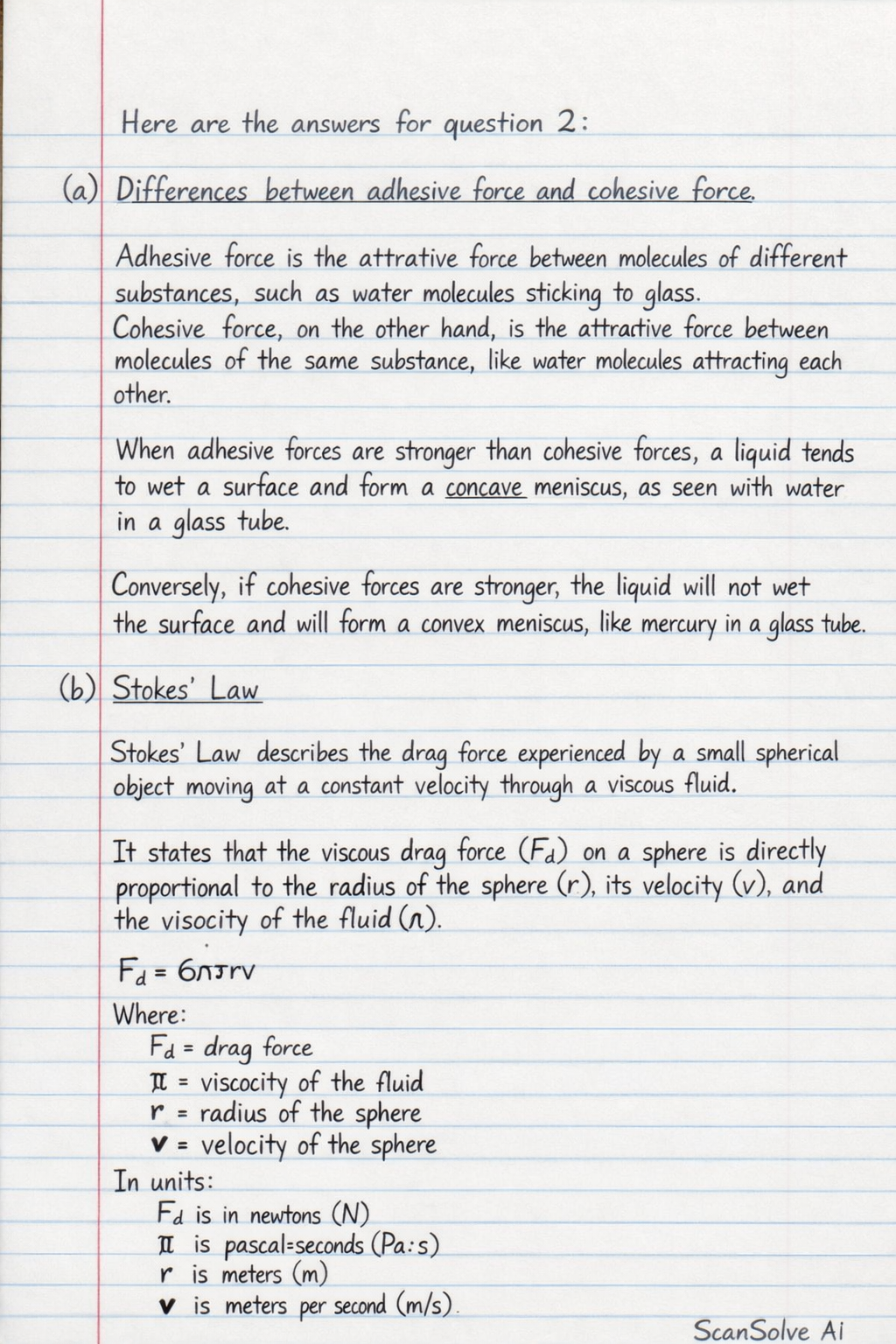
a) Differences between adhesive force and cohesive force
Adhesive force is the attractive force between molecules of different substances, such as water molecules sticking to glass. Cohesive force, on the other hand, is the attractive force between molecules of the same substance, like water molecules attracting each other. When adhesive forces are stronger than cohesive forces, a liquid tends to wet a surface and form a concave meniscus, as seen with water in a glass tube. Conversely, if cohesive forces are stronger, the liquid will not wet the surface and will form a convex meniscus, like mercury in a glass tube.
b) Stokes' Law
Stokes' Law describes the drag force experienced by a small spherical object moving at a constant velocity through a viscous fluid. It states that the viscous drag force () on a sphere is directly proportional to the radius of the sphere (), its velocity (), and the viscosity of the fluid ().
The formula for Stokes' Law is:
Where:
- is the viscous drag force.
- is the dynamic viscosity of the fluid.
- is the radius of the spherical object.
- is the terminal velocity of the object relative to the fluid.
Still stuck on this one?
Ask a follow-up, and the answer starts from this question.
More Physics Questions
Handwritten Step-by-Step Solution
Get this as a handwritten image on WhatsApp — like a tutor wrote it for you.
Try on WhatsApp