

This physics problem tests your understanding of fundamental physical laws and their applications. The step-by-step solution below breaks down the problem using relevant equations and physical reasoning.
ScanSolve AI Answer
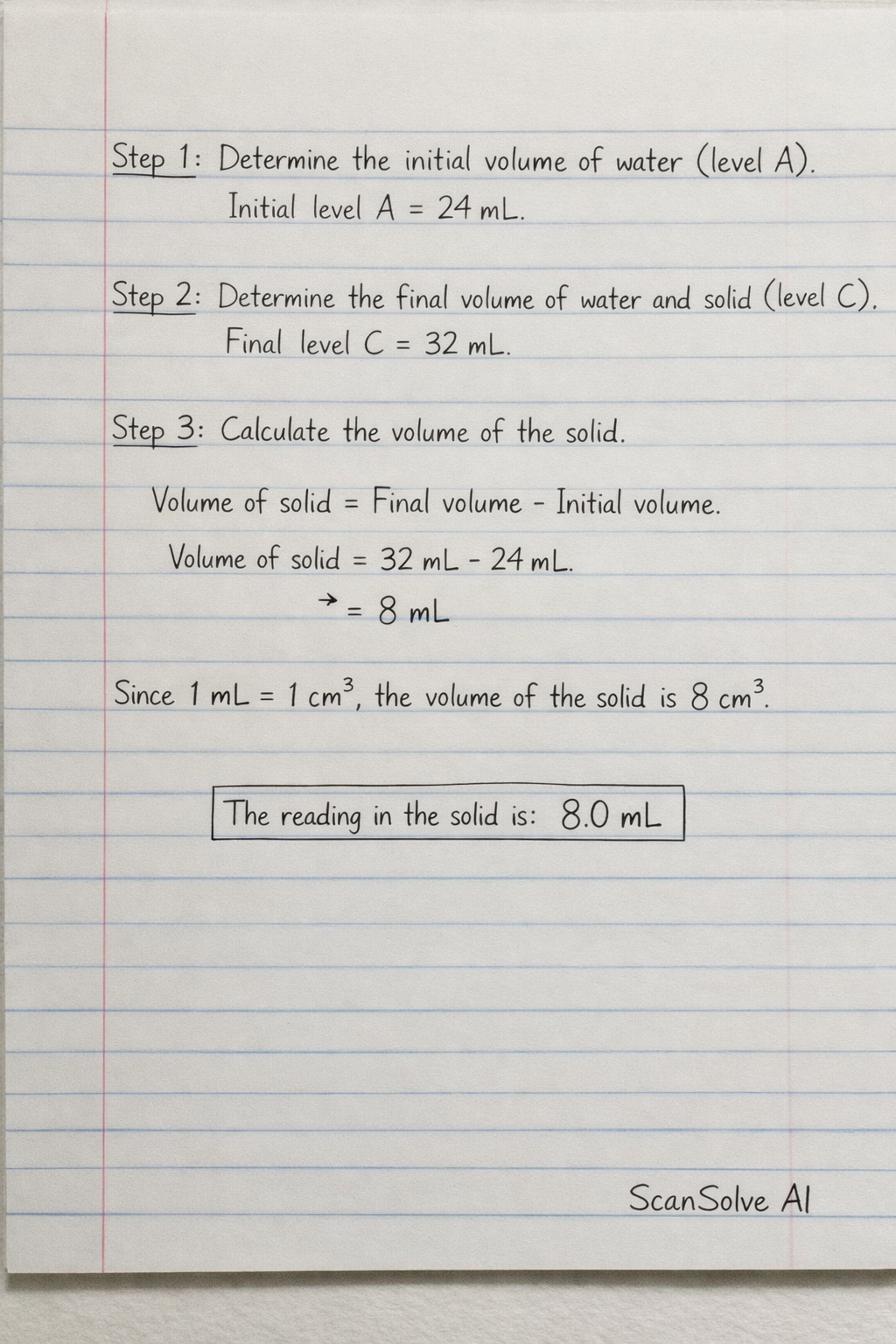
Step 1: Determine the initial volume of water (level A). From the image, the initial water level A is at 24 mL. Step 2: Determine the final volume of water and solid (level C). From the image, the final level C, after immersing solid B, is at 32 mL. Step 3: Calculate the volume of the solid. The volume of the solid is the difference between the final volume and the initial volume. Volume of solid = Final volume - Initial volume Volume of solid = 32 mL - 24 mL Volume of solid = 8 mL Since 1 mL = 1 cm^3, the volume of the solid is 8 cm^3. The reading in the solid (volume of the solid) is 8.0 mL. Step 1: Explain the observation for water. In water, the meniscus in the capillary tube is higher than the meniscus in the beaker, forming a concave meniscus. This occurs because the adhesive forces between water molecules and the glass walls are stronger than the cohesive forces between water molecules themselves. The water molecules are more attracted to the glass, causing them to climb up the tube against gravity. Step 2: Explain the observation for mercury. In mercury, the meniscus in the capillary tube is lower than the meniscus in the beaker, forming a convex meniscus. This occurs because the cohesive forces between mercury molecules are stronger than the adhesive forces between mercury molecules and the glass walls. The mercury molecules are more attracted to each other than to the glass, causing them to pull away from the glass and depress the liquid level in the tube. Step 1: Identify the given values and convert units. Area of hole, A = 2.0 cm^2 = 2.0 × (10^-2 m)^2 = 2.0 × 10^-4 m^2. Depth of tank, h = 2.0 m. Density of water, = 1000 kg/m^3. Acceleration due to gravity, g = 9.8 m/s^2. Step 2: Calculate the pressure exerted by the water at the bottom of the tank. The pressure P is given by the formula P = g h. P = (1000 kg/m^3) × (9.8 m/s^2) × (2.0 m) P = 19600 Pa Step 3: Calculate the force on the cork. The force F is given by the formula F = P × A. F = (19600 Pa) × (2.0 × 10^-4 m^2) F = 3.92 N The force on the cork is 3.92 N. Step 1: Explain the heat transfer mechanism in water. Water is a poor conductor of heat. This means that heat does not easily transfer through the bulk of the water by conduction. Step 2: Explain the role of convection. Heat transfer in liquids primarily occurs through convection. When water is heated from the bottom, the heated water becomes less dense and rises, while cooler, denser water sinks to take its place, creating convection currents that distribute heat throughout the liquid. Step 3: Apply to the given setup. In this setup, heat is applied near the top of the boiling tube. The water at the top heats up, becomes less dense, and boils. However, since the heat is applied at the top, there are no convection currents formed to transfer this heat downwards to the colder water at the bottom. The hot water stays at the top, and the cold, denser water remains at the bottom because it does not receive heat through conduction or convection. Send me the next one 📸