A cylinder of 50 mm diameter is 250 mm high and has a semi-ball at the top as shown in the sketch (FIGURE 2) below. Calculate the centre of gravity of the body from the table on which it is placed.

Physics
A cylinder of 50 mm diameter is 250 mm high and has a semi-ball at the top as shown in the sketch (FIGURE 2) below. Calculate the centre of gravity of the body from the table on which it is placed.

ScanSolve AI Answer

Answer

133.40 mm

QUESTION 5.2: CENTRE OF GRAVITY

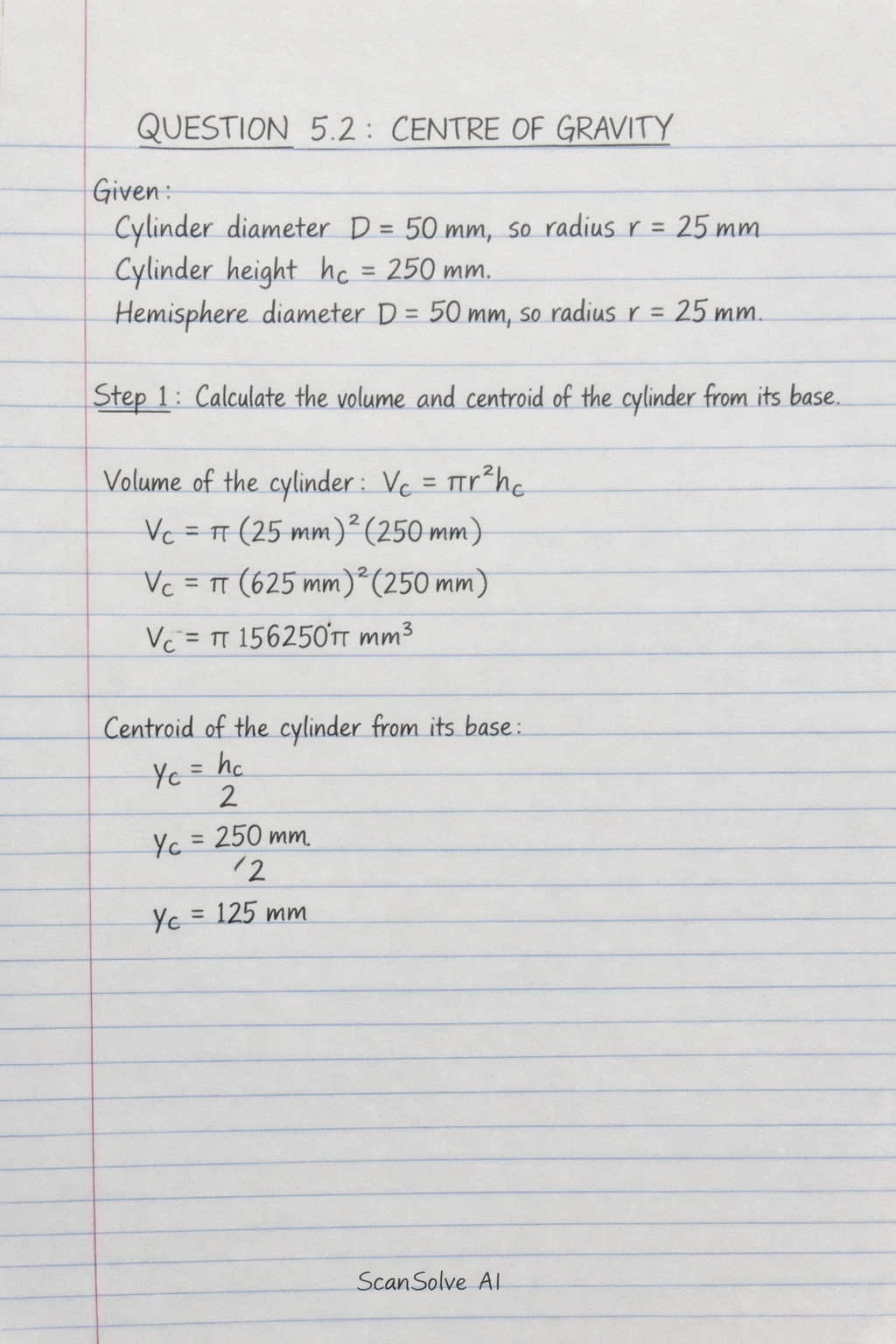
Given: Cylinder diameter D=50 mmD = 50 \text{ mm}, so radius r=25 mmr = 25 \text{ mm} Cylinder height hc=250 mmh_c = 250 \text{ mm} Hemisphere diameter D=50 mmD = 50 \text{ mm}, so radius r=25 mmr = 25 \text{ mm}

Step 1: Calculate the volume and centroid of the cylinder from its base (the table). The volume of the cylinder is Vc=πr2hcV_c = \pi r^2 h_c. Vc=π(25mm)2(250mm)=156250πmm3V_c = \pi (25 mm)^2 (250 mm) = 156250\pi mm^3 The centroid of the cylinder from its base is yc=hc2y_c = \frac{h_c}{2}. yc=250mm2=125mmy_c = \frac{250 mm}{2} = 125 mm

Step 2: Calculate the volume and centroid of the hemisphere from the base of the cylinder (the table). The volume of the hemisphere is Vh=23πr3V_h = \frac{2}{3} \pi r^3. Vh=23π(25mm)3=23π(15625)mm3=312503πmm3V_h = \frac{2}{3} \pi (25 mm)^3 = \frac{2}{3} \pi (15625) mm^3 = \frac{31250}{3}\pi mm^3 The centroid of a hemisphere from its flat base is 38r\frac{3}{8}r. Since the hemisphere is placed on top of the cylinder, its flat base is at hc=250 mmh_c = 250 \text{ mm} from the table. So, the centroid of the hemisphere from the table is yh=hc+38ry_h = h_c + \frac{3}{8}r. yh=250mm+38(25mm)=250mm+9.375mm=259.375mmy_h = 250 mm + \frac{3}{8}(25 mm) = 250 mm + 9.375 mm = 259.375 mm

Step 3: Calculate the overall centre of gravity Yˉ\bar{Y} of the composite body from the table using the formula Yˉ=Vcyc+VhyhVc+Vh\bar{Y} = \frac{V_c y_c + V_h y_h}{V_c + V_h}. Yˉ=(156250πmm3)(125mm)+(312503πmm3)(259.375mm)156250πmm3+312503πmm3\bar{Y} = \frac{(156250\pi mm^3)(125 mm) + (\frac{31250}{3}\pi mm^3)(259.375 mm)}{156250\pi mm^3 + \frac{31250}{3}\pi mm^3} We can cancel π\pi from all terms: Yˉ=(156250)(125)+(312503)(259.375)156250+312503\bar{Y} = \frac{(156250)(125) + (\frac{31250}{3})(259.375)}{156250 + \frac{31250}{3}} Yˉ=19531250+2701822.9166...156250+10416.6666...\bar{Y} = \frac{19531250 + 2701822.9166...}{156250 + 10416.6666...} Yˉ=22233072.9166...166666.6666...\bar{Y} = \frac{22233072.9166...}{166666.6666...} Yˉ133.40mm\bar{Y} \approx 133.40 mm The centre of gravity of the body from the table is 133.40mm\boxed{133.40 mm}.

What's next?

Was this helpful?

Need help with your own homework?

Get instant step-by-step solutions to any question. Free to start.

Ask Your Question
Handwritten step-by-step solution preview

Handwritten Step-by-Step Solution

Get this as a handwritten image on WhatsApp — like a tutor wrote it for you.

Try on WhatsApp

Still have questions?

Quick Answer

QUESTION 5.2: CENTRE OF GRAVITY Given: Cylinder diameter D = 50 mm, so radius r = 25 mm Cylinder height h_c = 250 mm Hemisphere diameter D = 50 mm, so radius r = 25 mm Step 1: Calculate the volume and centroid of the cylinder from its base (the table)…

A cylinder of 50 mm diameter is 250 mm high and has a semi-ball at the top as shown in the sketch (FIGURE 2) below. Calculate the centre of gravity of the body from the table on which it is placed.
Physics

This physics problem tests your understanding of fundamental physical laws and their applications. The step-by-step solution below breaks down the problem using relevant equations and physical reasoning.

ScanSolve AI Answer
QUESTION 5.2: CENTRE OF GRAVITY Given: Cylinder diameter D = 50 mm, so radius r = 25 mm Cylinder height h_c = 250 mm Hemisphere diameter D = 50 mm, so radius r = 25 mm Step 1: Calculate the volume and centroid of the cylinder from its base (the table). The volume of the cylinder is V_c = r^2 h_c. V_c = (25 mm)^2 (250 mm) = 156250 mm^3 The centroid of the cylinder from its base is y_c = (h_c)/(2). y_c = 250 mm2 = 125 mm Step 2: Calculate the volume and centroid of the hemisphere from the base of the cylinder (the table). The volume of the hemisphere is V_h = (2)/(3) r^3. V_h = (2)/(3) (25 mm)^3 = (2)/(3) (15625) mm^3 = (31250)/(3) mm^3 The centroid of a hemisphere from its flat base is (3)/(8)r. Since the hemisphere is placed on top of the cylinder, its flat base is at h_c = 250 mm from the table. So, the centroid of the hemisphere from the table is y_h = h_c + (3)/(8)r. y_h = 250 mm + (3)/(8)(25 mm) = 250 mm + 9.375 mm = 259.375 mm Step 3: Calculate the overall centre of gravity Y of the composite body from the table using the formula Y = (V_c y_c + V_h y_h)/(V_c + V_h). Y = (156250 mm^3)(125 mm) + ((31250)/(3) mm^3)(259.375 mm)156250 mm^3 + (31250)/(3) mm^3 We can cancel from all terms: Y = ((156250)(125) + (31250)/(3))(259.375)156250 + (31250)/(3) Y = (19531250 + 2701822.9166...)/(156250 + 10416.6666...) Y = (22233072.9166...)/(166666.6666...) Y ≈ 133.40 mm The centre of gravity of the body from the table is 133.40 mm. What's next?