

This physics problem tests your understanding of fundamental physical laws and their applications. The step-by-step solution below breaks down the problem using relevant equations and physical reasoning.
ScanSolve AI Answer
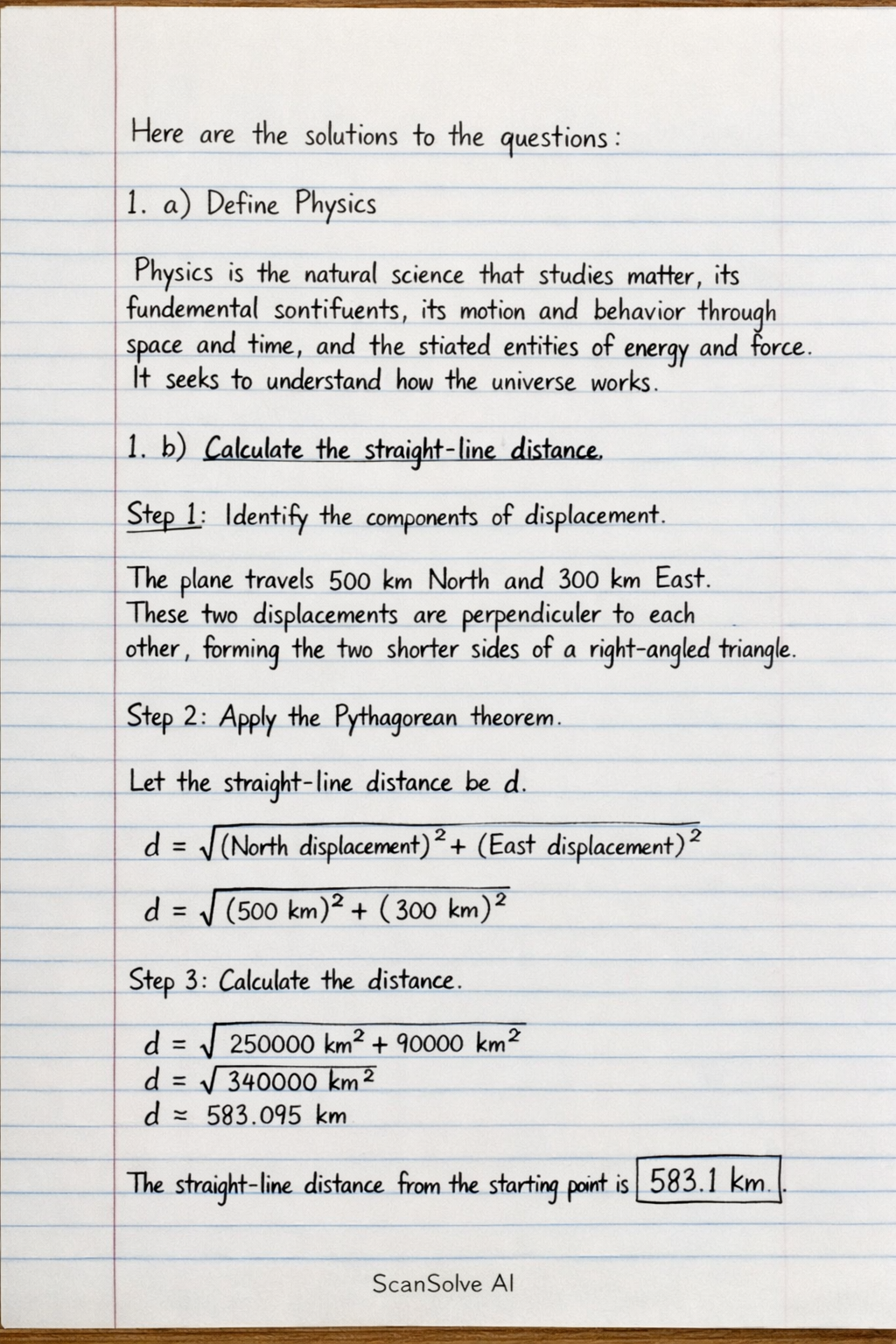
Here are the solutions to the questions: 1. a) Define Physics Physics is the natural science that studies matter, its fundamental constituents, its motion and behavior through space and time, and the related entities of energy and force. It seeks to understand how the universe works. 1. b) Calculate the straight-line distance Step 1: Identify the components of displacement. The plane travels 500 km North and 300 km East. These two displacements are perpendicular to each other, forming the two shorter sides of a right-angled triangle. Step 2: Apply the Pythagorean theorem. Let the straight-line distance be d. d = sqrt((North displacement))^2 + (East displacement)^2 d = sqrt((500 km))^2 + (300 km)^2 Step 3: Calculate the distance. d = sqrt(250000 km)^2 + 90000 km^2 d = sqrt(340000 km)^2 d ≈ 583.095 km The straight-line distance from the starting point is 583.1 km. 1. c) Explain two ways Physics contributes to Ghana's economic development. • Physics contributes to the energy sector through the development and maintenance of power generation systems (hydroelectric, thermal, solar) and efficient energy distribution, which is crucial for industrial growth and daily life. • It also supports the telecommunications and information technology sectors by enabling the design and operation of communication networks, electronic devices, and data processing systems, fostering innovation and connectivity. 2. a) List the seven fundamental quantities and their SI units. • Length: meter (m) • Mass: kilogram (kg) • Time: second (s) • Electric current: ampere (A) • Thermodynamic temperature: kelvin (K) • Amount of substance: mole (mol) • Luminous intensity: candela (cd) 2. b) Derive the SI unit of force from its fundamental units. Step 1: Recall Newton's second law of motion. Newton's second law states that force (F) is equal to mass (m) times acceleration (a). F = ma Step 2: Substitute the fundamental SI units for mass and acceleration. The SI unit for mass is the kilogram (kg). Acceleration is the rate of change of velocity, and velocity is the rate of change of displacement. So, acceleration has units of length per time squared. The SI unit for length is the meter (m) and for time is the second (s). Therefore, the SI unit for acceleration is ms^2. Step 3: Combine the units to derive the SI unit of force. F = kg × ms^2 The SI unit of force is kg · m · s^-2, which is also known as the Newton (N). 2. c) Explain why dimensional analysis is important in the study of Physics. Dimensional analysis is important because it helps to check the consistency of equations by ensuring that both sides of an equation have the same dimensions. It also aids in deriving relationships between physical quantities and in converting units between different systems, providing a powerful tool for understanding physical phenomena. 3. a) List five Physics-related careers found in Ghana's economy. • Electrical Engineer • Telecommunications Engineer • Civil Engineer • Medical Physicist • Renewable Energy Technician 3. b) Derive the dimension of velocity and acceleration. Step 1: Define velocity and its fundamental dimensions. Velocity (v) is defined as displacement (L) per unit time (T). Dimension of velocity = Dimension of displacementDimension of time Dimension of velocity = ([L])/([T]) The dimension of velocity is [L][T]^-1. Step 2: Define acceleration and its fundamental dimensions. Acceleration (a) is defined as the change in velocity per unit time. Dimension of acceleration = Dimension of velocityDimension of time Dimension of acceleration = [L][T]^-1[T] The dimension of acceleration is [L][T]^-2. 3. c) Explain how a mason or carpenter applies Physics principles in daily work. A mason applies physics principles by understanding forces and equilibrium when constructing stable walls and foundations, ensuring structures can withstand loads. They use concepts like leverage with tools and gravity for plumb lines. A carpenter uses principles of mechanics for cutting and shaping materials, understanding stress and strain in wood, and applying geometry for accurate measurements and angles to ensure structural integrity and fit. 4. a) State the use of the following instruments: i. Ammeter: An ammeter is used to measure the electric current flowing through a circuit. ii. Voltmeter: A voltmeter is used to measure the electric potential difference (voltage) between two points in a circuit. iii. Vernier caliper: A Vernier caliper is used to measure linear dimensions such as length, diameter (internal and external), and depth of objects with high precision. Drop the next question! 📸