
We read your photo as:
A) Physics is the natural science that studies matter, its fundamental constituents, its motion and behavior through space and time, and the related entities of energy and force.
ScanSolve AI Answer
a) Physics is the natural science that studies matter, its fundamental constituents, its motion and behavior through space and time, and the related entities of energy and force.
b) Four branches of physics are:
- Mechanics
- Thermodynamics
- Optics
- Electromagnetism
c) Three ways physics is important in day-to-day life:
- Physics principles are used in the design of lighting systems for homes and streets, allowing us to see at night.
- Understanding energy transformations (e.g., electrical to heat) is crucial for operating appliances like stoves and heaters.
- Physics explains how machines work, from simple levers to complex engines, enabling their design and efficient use.
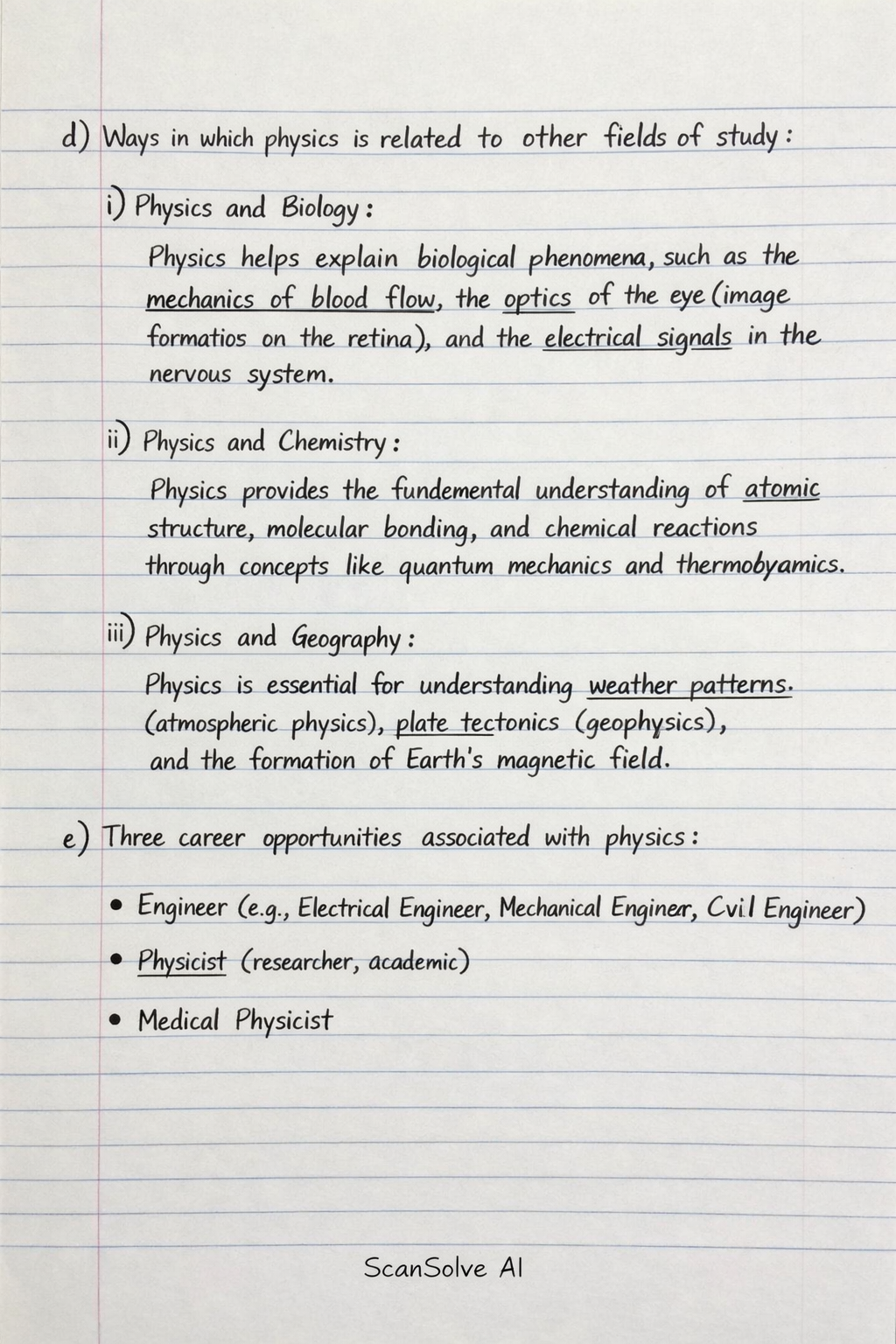
d) Ways in which physics is related to other fields of study:
i) Physics and Biology: Physics helps explain biological phenomena, such as the mechanics of blood flow, the optics of the eye (image formation on the retina), and the electrical signals in the nervous system.
ii) Physics and Chemistry: Physics provides the fundamental understanding of atomic structure, molecular bonding, and chemical reactions through concepts like quantum mechanics and thermodynamics.
iii) Physics and Geography: Physics is essential for understanding weather patterns (atmospheric physics), plate tectonics (geophysics), and the formation of Earth's magnetic field.
e) Three career opportunities associated with physics:
- Engineer (e.g., Electrical Engineer, Mechanical Engineer, Civil Engineer)
- Physicist (researcher, academic)
- Medical Physicist
Still stuck on this one?
Ask a follow-up, and the answer starts from this question.
More Psychology Questions
Handwritten Step-by-Step Solution
Get this as a handwritten image on WhatsApp — like a tutor wrote it for you.
Try on WhatsApp