
We read your photo as:
A) Define pressure and state its SI unit.
ScanSolve AI Answer
Answer
Step-by-step solution
4 stepsHere is the solution for question 2:
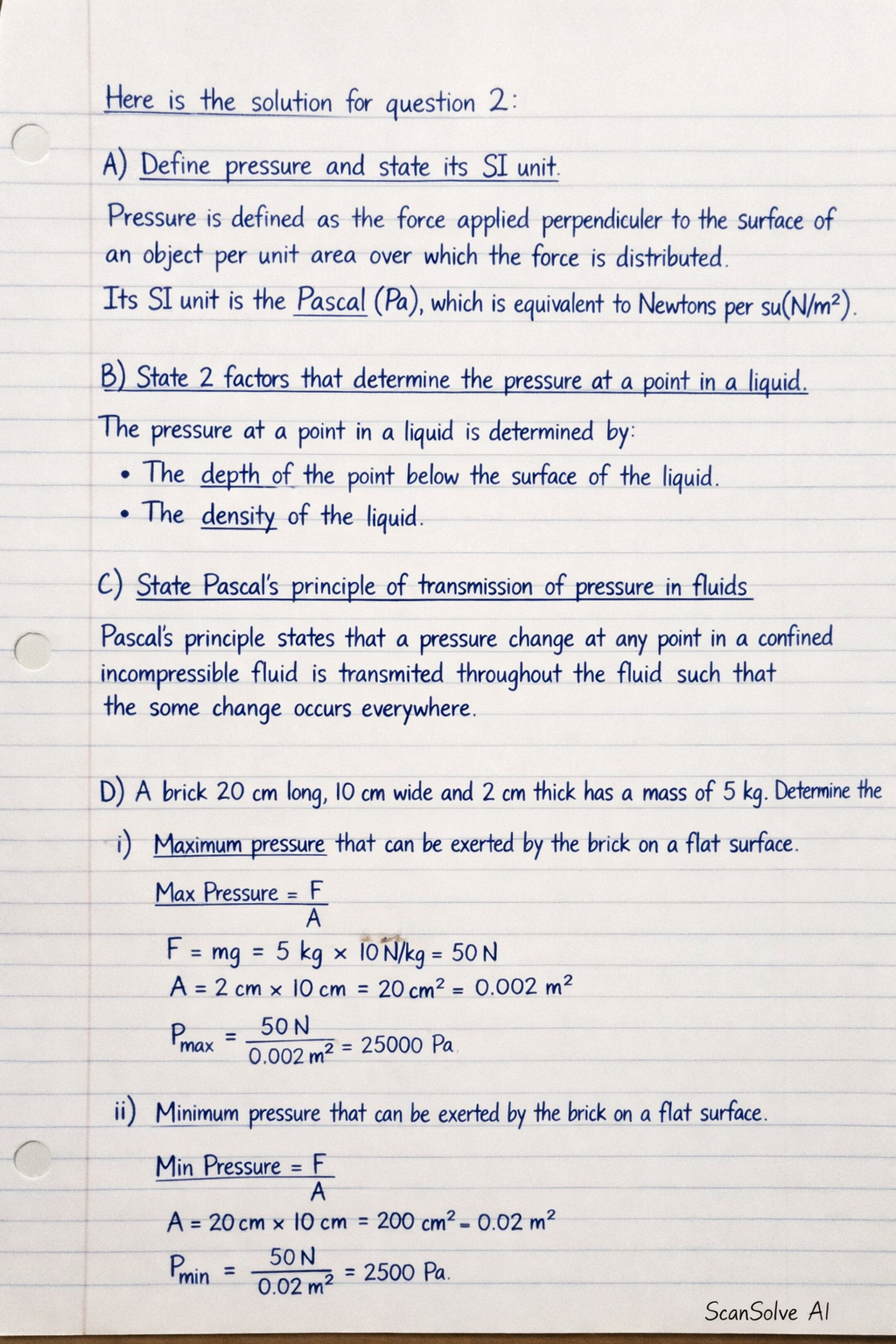
A) Define pressure and state its SI unit.
Pressure is defined as the force applied perpendicular to the surface of an object per unit area over which the force is distributed. Its SI unit is the Pascal (Pa), which is equivalent to Newtons per square meter ().
B) State 2 factors that determine the pressure at a point in a liquid.
The pressure at a point in a liquid is determined by:
- The depth of the point below the surface of the liquid.
- The density of the liquid.
C) State Pascal's principle of transmission of pressure in fluids.
Pascal's principle states that a pressure change at any point in a confined incompressible fluid is transmitted throughout the fluid such that the same change occurs everywhere.
D) A brick 20 cm long, 10 cm wide and 2 cm thick has a mass of 5 kg. Determine the
Part i
Maximum pressure that can be exerted by the brick on a flat surface.
Part ii
Minimum pressure that can be exerted by the brick on a flat surface. (g = 10N/kg)
Calculate the force exerted by the brick (its weight).
Given mass and acceleration due to gravity .
Calculate the areas of the faces of the brick.
Length
Width
ThicknessArea 1 () =
Area 2 () =
Area 3 () =The minimum area () is .
The maximum area () is .Calculate the maximum pressure.
Maximum pressure occurs when the force is applied over the minimum area.
D) i) Maximum pressure:
Calculate the minimum pressure.
Minimum pressure occurs when the force is applied over the maximum area.
D) ii) Minimum pressure:
Try one yourself
A new problem that tests the same skill.
Still stuck on this one?
Ask a follow-up, and the answer starts from this question.
More Physics Questions
Handwritten Step-by-Step Solution
Get this as a handwritten image on WhatsApp — like a tutor wrote it for you.
Try on WhatsApp