

This physics problem tests your understanding of fundamental physical laws and their applications. The step-by-step solution below breaks down the problem using relevant equations and physical reasoning.
ScanSolve AI Answer
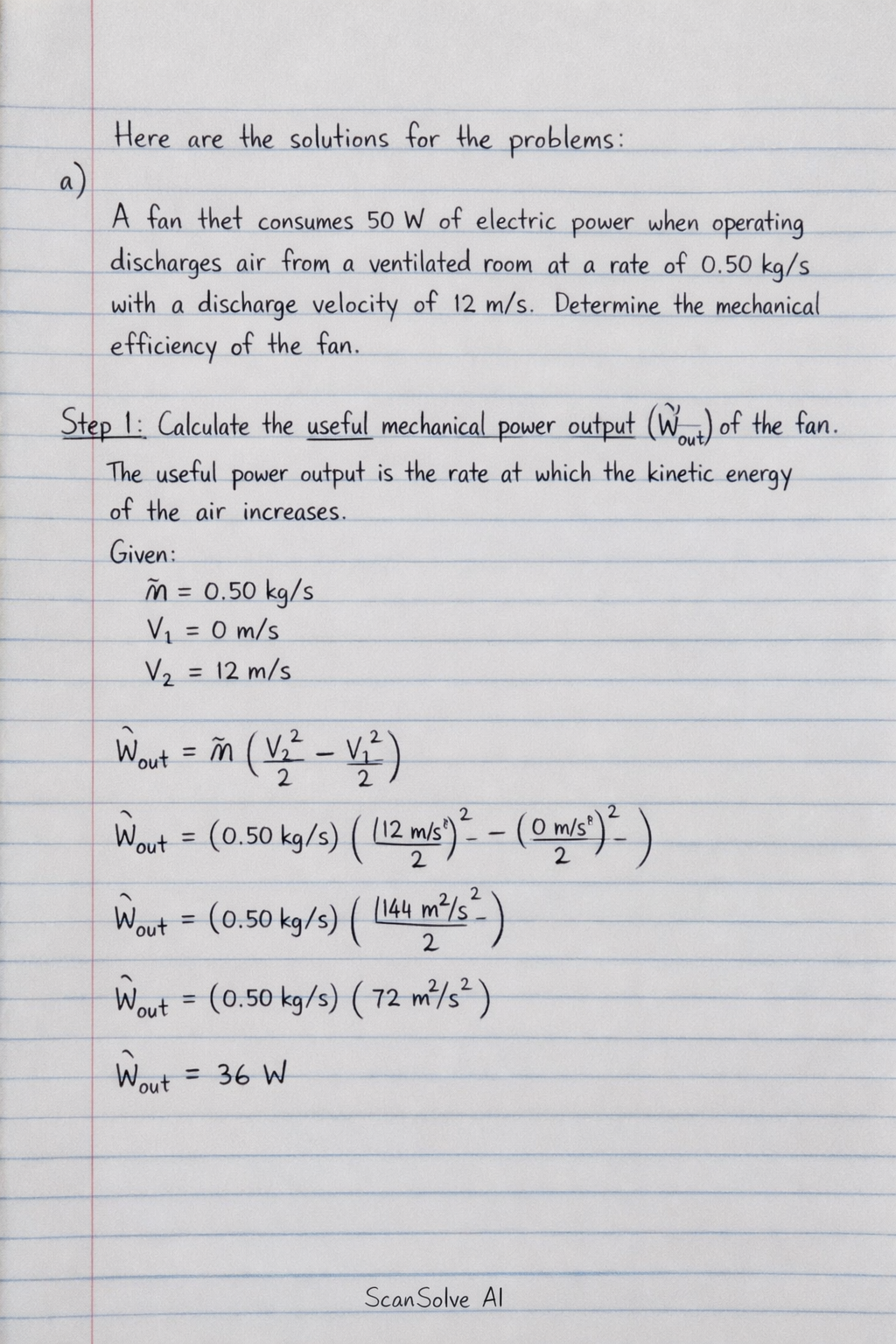
Here are the solutions for the problems: a) A fan that consumes 50 W of electric power when operating discharges air from a ventilated room at a rate of 0.50 kg/s at a discharge velocity of 12 m/s. Determine the mechanical efficiency of the fan. Step 1: Calculate the useful mechanical power output (W_out) of the fan. The useful power output is the rate at which the kinetic energy of the air increases. Given: Mass flow rate (m) = 0.50 kg/s Inlet velocity (V_1) = 0 m/s Discharge velocity (V_2) = 12 m/s W_out = m ( (V_2^2)/(2) - (V_1^2)/(2) ) W_out = (0.50 kg/s) ( (12 m/s)^22 - (0 m/s)^22 ) W_out = (0.50 kg/s) ( 144 m^2/s^22 ) W_out = (0.50 kg/s) (72 m^2/s^2) W_out = 36 W Step 2: Calculate the mechanical efficiency (_mech) of the fan. The mechanical efficiency is the ratio of the useful mechanical power output to the electric power input. Given: Electric power input (P_in) = 50 W Useful mechanical power output (W_out) = 36 W _mech = W_outP_in _mech = 36 W50 W _mech = 0.72 To express as a percentage: _mech = 0.72 × 100\% = 72\% The mechanical efficiency of the fan is 72\%. b) A system undergoes a power cycle while receiving 1000 kJ by heat transfer from a high-temperature reservoir and rejecting 800 kJ by heat transfer to a low-temperature reservoir. Determine the net work done by the system. Step 1: Calculate the net work done by the system. For a power cycle, the net work output (W_net) is the difference between the heat received (Q_in) and the heat rejected (Q_out). Given: Heat received (Q_in) = 1000 kJ Heat rejected (Q_out) = 800 kJ W_net = Q_in - Q_out W_net = 1000 kJ - 800 kJ W_net = 200 kJ The net work done by the system is 200 kJ. Last free one today — make it count tomorrow, or type /upgrade for unlimited.