
We read your photo as:
A force-time graph is given. Calculate the impulse applied to an object and its change in momentum. The graph shows a force of 5 N applied from 0-3s (triangular), 3-5s (rectangular), and 5-8s (triangu
ScanSolve AI Answer
Answer
Step-by-step solution
3 stepsTo solve this problem, we need to use the impulse-momentum theorem, which states that the impulse applied to an object is equal to the change in its momentum. The impulse is the area under the force-time (F-t) graph.
The formula for impulse is:
where is the impulse, is the mass, is the final velocity, and is the initial velocity.
Calculate the total impulse from the F-t graph.
The graph can be divided into three geometric shapes:
- Area 1 (0 s to 3 s): A triangle.
- Area 2 (3 s to 5 s): A rectangle.
- Area 3 (5 s to 8 s): A triangle.
The total impulse is the sum of these areas:
The mass of the particle is given as .
Calculate the final velocity if the particle is initially at rest.
Given .
Using the impulse-momentum theorem:Calculate the final velocity if the particle is initially with a velocity of .
Given .
Using the impulse-momentum theorem:Divide both sides by 5:
The final velocities are when initially at rest, and when initially at .
Comparing these results with the given options, option A matches.
The final answer is .
Try one yourself
A new problem that tests the same skill.
Still stuck on this one?
Ask a follow-up, and the answer starts from this question.
More Physics Questions
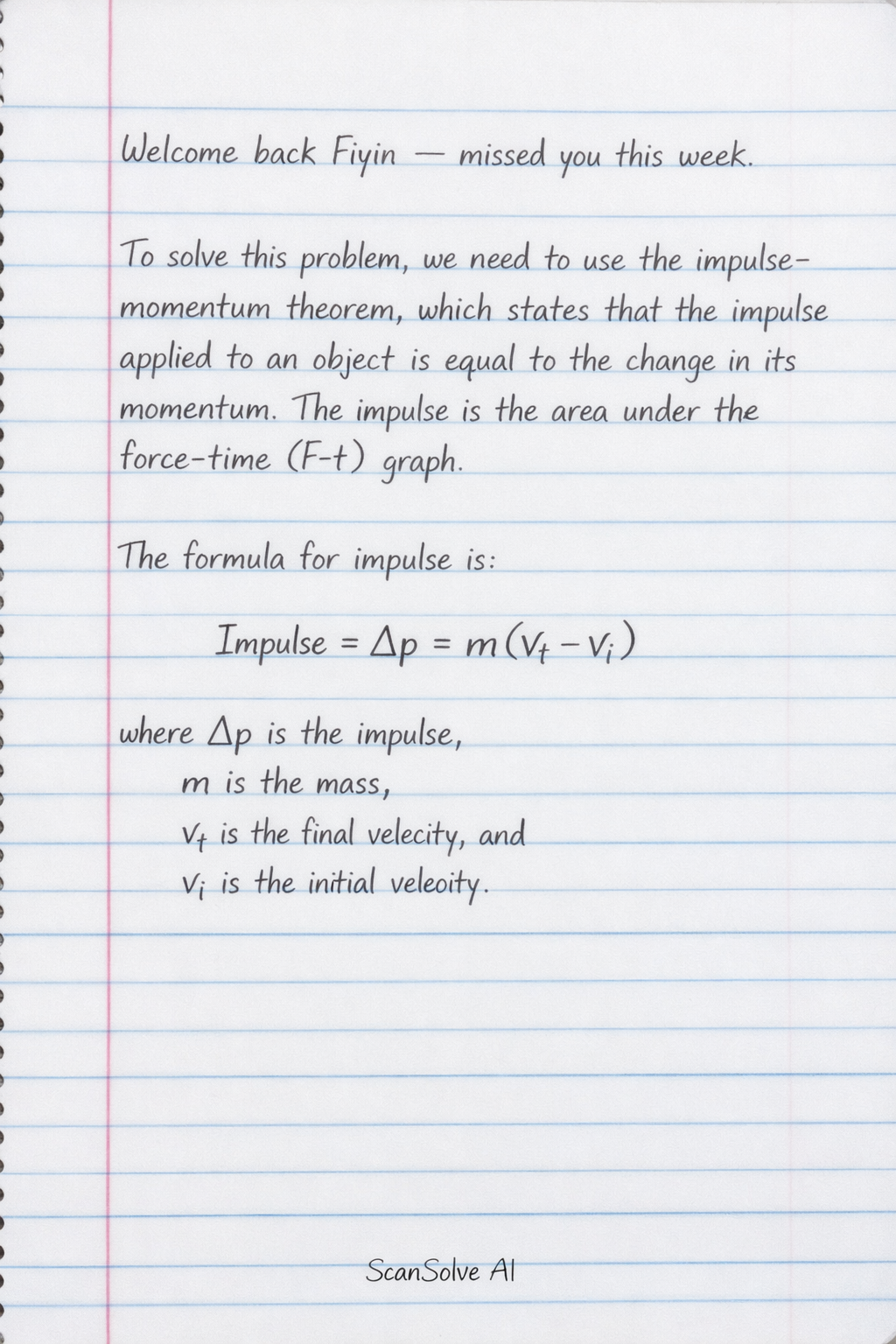
Handwritten Step-by-Step Solution
Get this as a handwritten image on WhatsApp — like a tutor wrote it for you.
Try on WhatsApp