
We read your photo as:
A gas has an initial root-mean-square velocity of 900 m/s. If the pressure of the gas increases by a factor of nine while its density remains constant, what is the new root-mean-square velocity?
ScanSolve AI Answer
Answer
Step-by-step solution
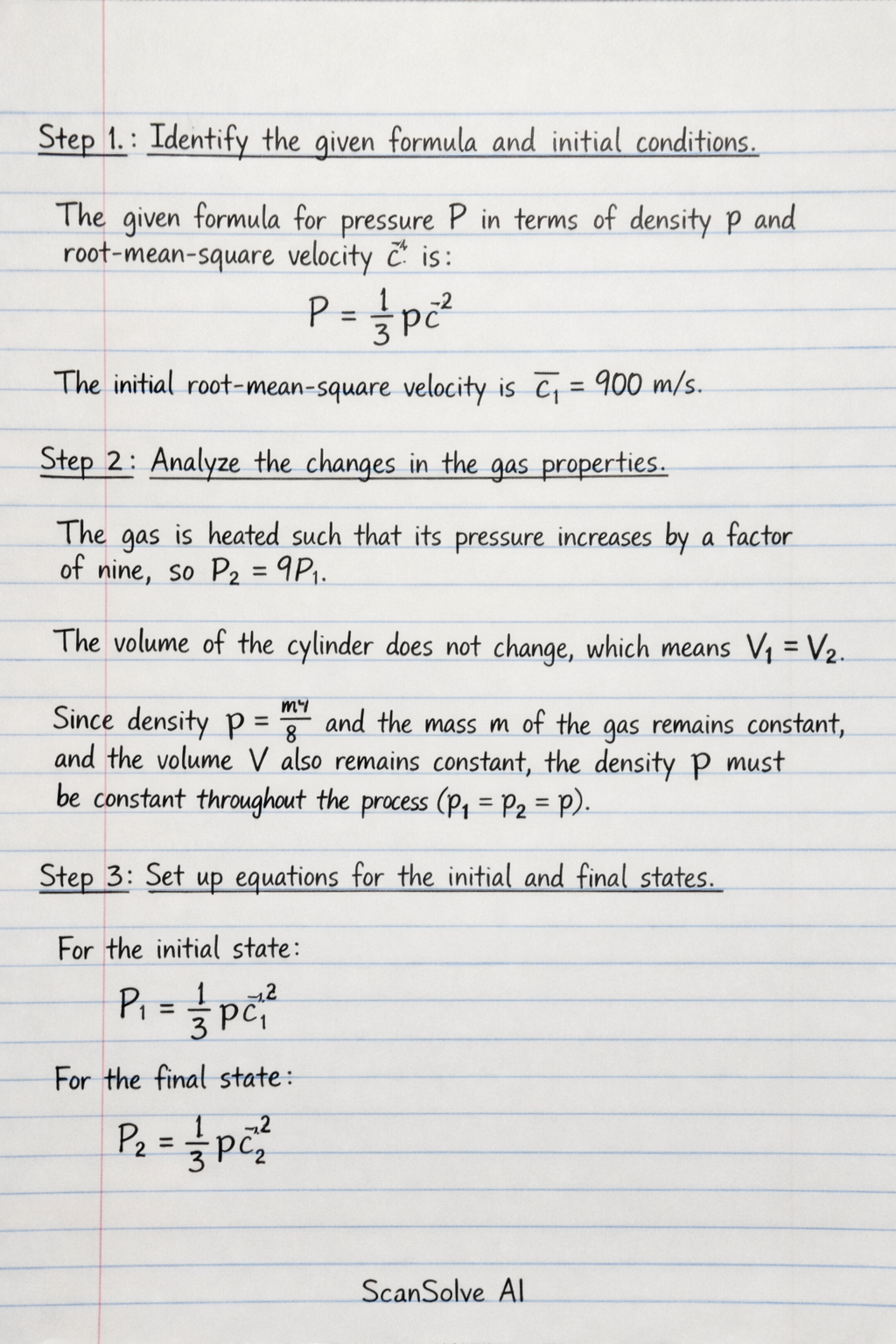
5 stepsIdentify the given formula and initial conditions.
The given formula for pressure in terms of density and root-mean-square velocity is:
The initial root-mean-square velocity is .
Analyze the changes in the gas properties.
The gas is heated such that its pressure increases by a factor of nine, so .
The volume of the cylinder does not change, which means .
Since density and the mass of the gas remains constant, and the volume also remains constant, the density must be constant throughout the process ().Set up equations for the initial and final states.
For the initial state:
For the final state:
Substitute the relationship between and into the equations.
We know . Substitute the expressions for and :
Solve for the new root-mean-square velocity .
Cancel out the common terms and from both sides:
Take the square root of both sides:
Now, substitute the value of :
The new numerical value for the root-mean-square velocity is .
The final answer is .
Try one yourself
A new problem that tests the same skill.
Still stuck on this one?
Ask a follow-up, and the answer starts from this question.
More Physics Questions
Handwritten Step-by-Step Solution
Get this as a handwritten image on WhatsApp — like a tutor wrote it for you.
Try on WhatsApp