We read your photo as:

A gas undergoes a polytropic process (PV1.2 = constant) from an initial state of 3.4 bar and 0.283 m3 to a final pressure of 8.2 bar. If 0.183 kg of gas is involved and 2.2 kJ of heat is transferred f

Physics

ScanSolve AI Answer

Answer

570.00 kJ/kg\text{570.00 kJ/kg}

-2.2 kJ\text{-2.2 kJ}

Step-by-step solution

5 steps
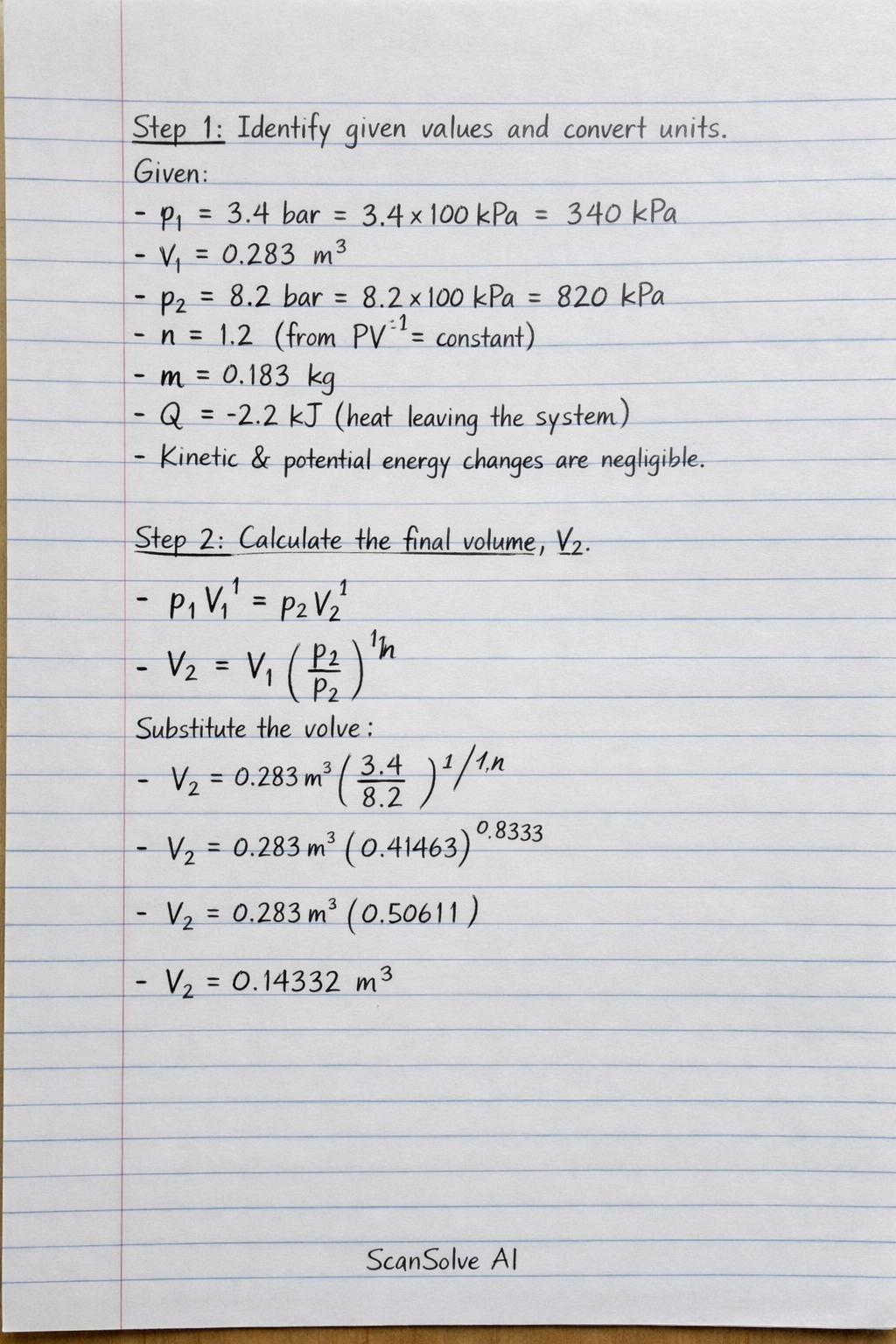
  1. Identify given values and convert units.

    Given:

    • Initial pressure, p1=3.4 bar=3.4×100 kPa=340 kPap_1 = 3.4 \text{ bar} = 3.4 \times 100 \text{ kPa} = 340 \text{ kPa}
    • Initial volume, V1=0.283 m3V_1 = 0.283 \text{ m}^3
    • Final pressure, p2=8.2 bar=8.2×100 kPa=820 kPap_2 = 8.2 \text{ bar} = 8.2 \times 100 \text{ kPa} = 820 \text{ kPa}
    • Polytropic index, n=1.2n = 1.2 (from PV1.2=constantPV^{1.2} = \text{constant})
    • Mass of gas, m=0.183 kgm = 0.183 \text{ kg}
    • Heat transfer from the gas, Q=−2.2 kJQ = -2.2 \text{ kJ} (negative sign indicates heat leaving the system)
    • Changes in kinetic and potential energy are negligible.
  2. Calculate the final volume, V2V_2.

    For a polytropic process, p1V1n=p2V2np_1 V_1^n = p_2 V_2^n.

    V2=V1(p1p2)1/nV_2 = V_1 \left(\frac{p_1}{p_2}\right)^{1/n}

    Substitute the values:

    V2=0.283 m3(3.4 bar8.2 bar)1/1.2V_2 = 0.283 \text{ m}^3 \left(\frac{3.4 \text{ bar}}{8.2 \text{ bar}}\right)^{1/1.2} V2=0.283 m3(3.48.2)0.8333V_2 = 0.283 \text{ m}^3 \left(\frac{3.4}{8.2}\right)^{0.8333} V2=0.283 m3(0.41463)0.8333V_2 = 0.283 \text{ m}^3 (0.41463)^{0.8333} V2=0.283 m3×0.50611V_2 = 0.283 \text{ m}^3 \times 0.50611 V2=0.14332 m3V_2 = 0.14332 \text{ m}^3
  3. Calculate the work done, WW, during the polytropic compression.

    For a polytropic process with n≠1n \neq 1, the work done is given by:

    W=p2V2−p1V11−nW = \frac{p_2 V_2 - p_1 V_1}{1-n}

    Substitute the values:

    W=(820 kPa)(0.14332 m3)−(340 kPa)(0.283 m3)1−1.2W = \frac{(820 \text{ kPa})(0.14332 \text{ m}^3) - (340 \text{ kPa})(0.283 \text{ m}^3)}{1 - 1.2} W=117.5224 kJ−96.22 kJ−0.2W = \frac{117.5224 \text{ kJ} - 96.22 \text{ kJ}}{-0.2} W=21.3024 kJ−0.2W = \frac{21.3024 \text{ kJ}}{-0.2} W=−106.512 kJW = -106.512 \text{ kJ}

    The negative sign indicates that work is done on the gas (compression).

  4. Apply the First Law of Thermodynamics to find the total change in internal energy, ΔU\Delta U.

    The First Law of Thermodynamics for a closed system with negligible changes in kinetic and potential energy is:

    ΔU=Q−W\Delta U = Q - W

    Substitute the values for QQ and WW:

    ΔU=(−2.2 kJ)−(−106.512 kJ)\Delta U = (-2.2 \text{ kJ}) - (-106.512 \text{ kJ}) ΔU=−2.2 kJ+106.512 kJ\Delta U = -2.2 \text{ kJ} + 106.512 \text{ kJ} ΔU=104.312 kJ\Delta U = 104.312 \text{ kJ}
  5. Calculate the specific change in internal energy, Δu\Delta u.

    Specific internal energy is the total internal energy divided by the mass:

    Δu=ΔUm\Delta u = \frac{\Delta U}{m}

    Substitute the values:

    Δu=104.312 kJ0.183 kg\Delta u = \frac{104.312 \text{ kJ}}{0.183 \text{ kg}} Δu=569.99 kJ/kg\Delta u = 569.99 \text{ kJ/kg}

    The heat transfer is given in the problem statement.

    The change in specific internal energy of the gas is 570.00 kJ/kg\boxed{\text{570.00 kJ/kg}}.
    The heat transfer is -2.2 kJ\boxed{\text{-2.2 kJ}}.

Was this helpful?

Try one yourself

A new problem that tests the same skill.

Still stuck on this one?

Ask a follow-up, and the answer starts from this question.

Got a different question?Ask your own question
Handwritten step-by-step solution preview

Handwritten Step-by-Step Solution

Get this as a handwritten image on WhatsApp — like a tutor wrote it for you.

Try on WhatsApp