
We read your photo as:
A. Identify the type of motion. B. Calculate the magnitude of the velocity at point B and the height of point X above the ground.
ScanSolve AI Answer
This answer stops before the end.
It was cut off when it was first written. Ask ScanSolve this question again for the full working.
Here's a step-by-step solution to the problem:
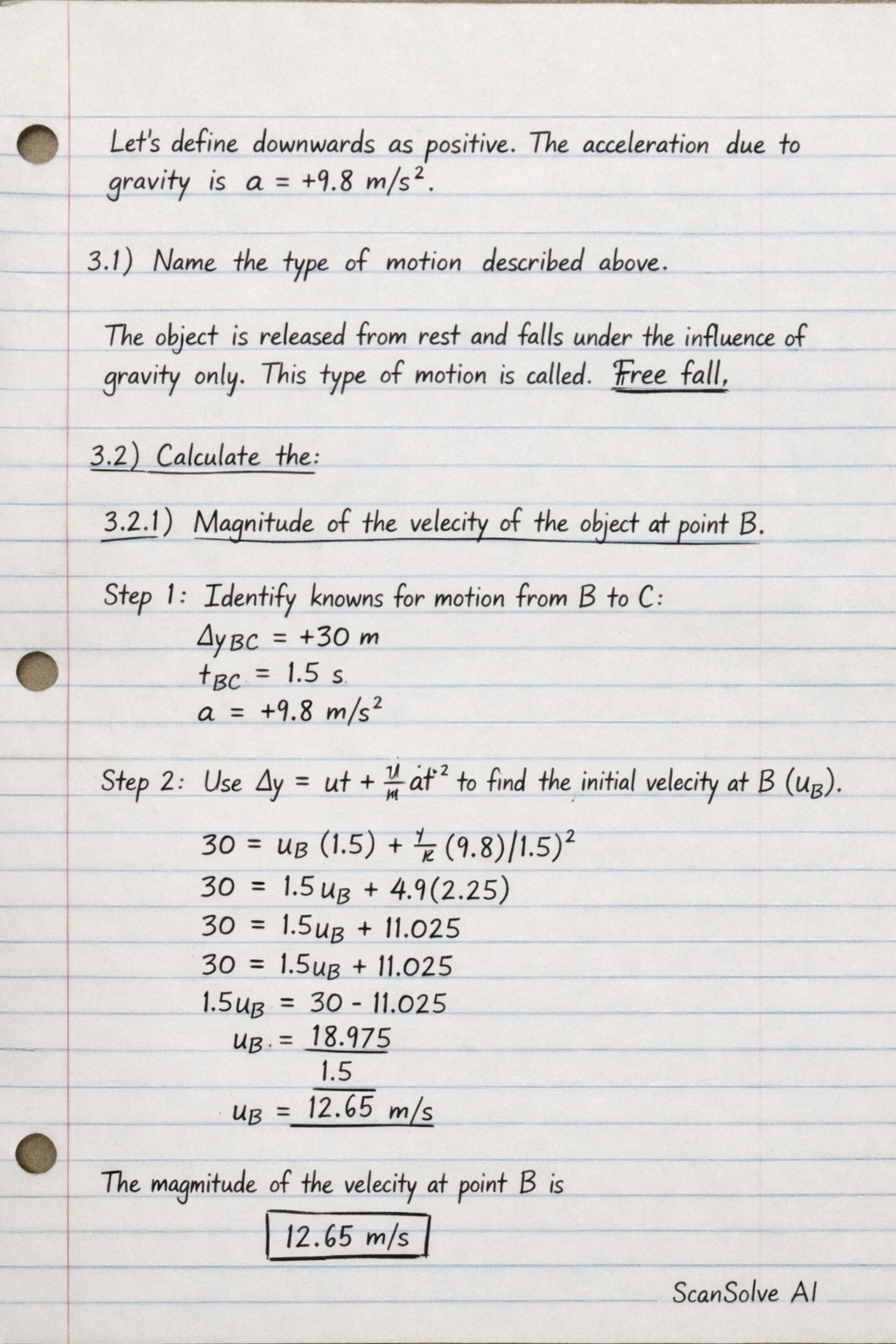
Let's define downwards as the positive direction. The acceleration due to gravity is .
3.1 Name the type of motion described above.
The object is released from rest and falls under the influence of gravity only, with air friction ignored. This type of motion is called free fall.
Answer for 3.1:
Free fall
3.2 Calculate the:
3.2.1 Magnitude of the velocity of the object at point B
Step 1: Identify knowns for the motion from B to C.
- Displacement, (downwards is positive)
- Time,
- Acceleration,
Step 2: Use the kinematic equation to find the initial velocity at B ().
The magnitude of the velocity at point B is .
3.2.2 Height of point X above the ground
Step 1: Identify knowns for the motion from X to B.
- Initial velocity at X, (released from rest)
- Final velocity at B, (from 3.2.1)
- Acceleration,
Step 2: Use the kinematic equation to find the displacement from X to B ().
Step 3: Calculate the total height of point X above the ground.
The total height of point X above the ground is the sum of the displacement from X to B and the displacement from B to C.
Still stuck on this one?
Ask a follow-up, and the answer starts from this question.
More Physics Questions
Handwritten Step-by-Step Solution
Get this as a handwritten image on WhatsApp — like a tutor wrote it for you.
Try on WhatsApp