
We read your photo as:
A man rows a boat across a river at his best speed in still water. The river flows at 4 km/hr, and the man can row at 6 km/hr in still water. If the river is 5 km wide, in what direction must he head
ScanSolve AI Answer
Answer
Step-by-step solution
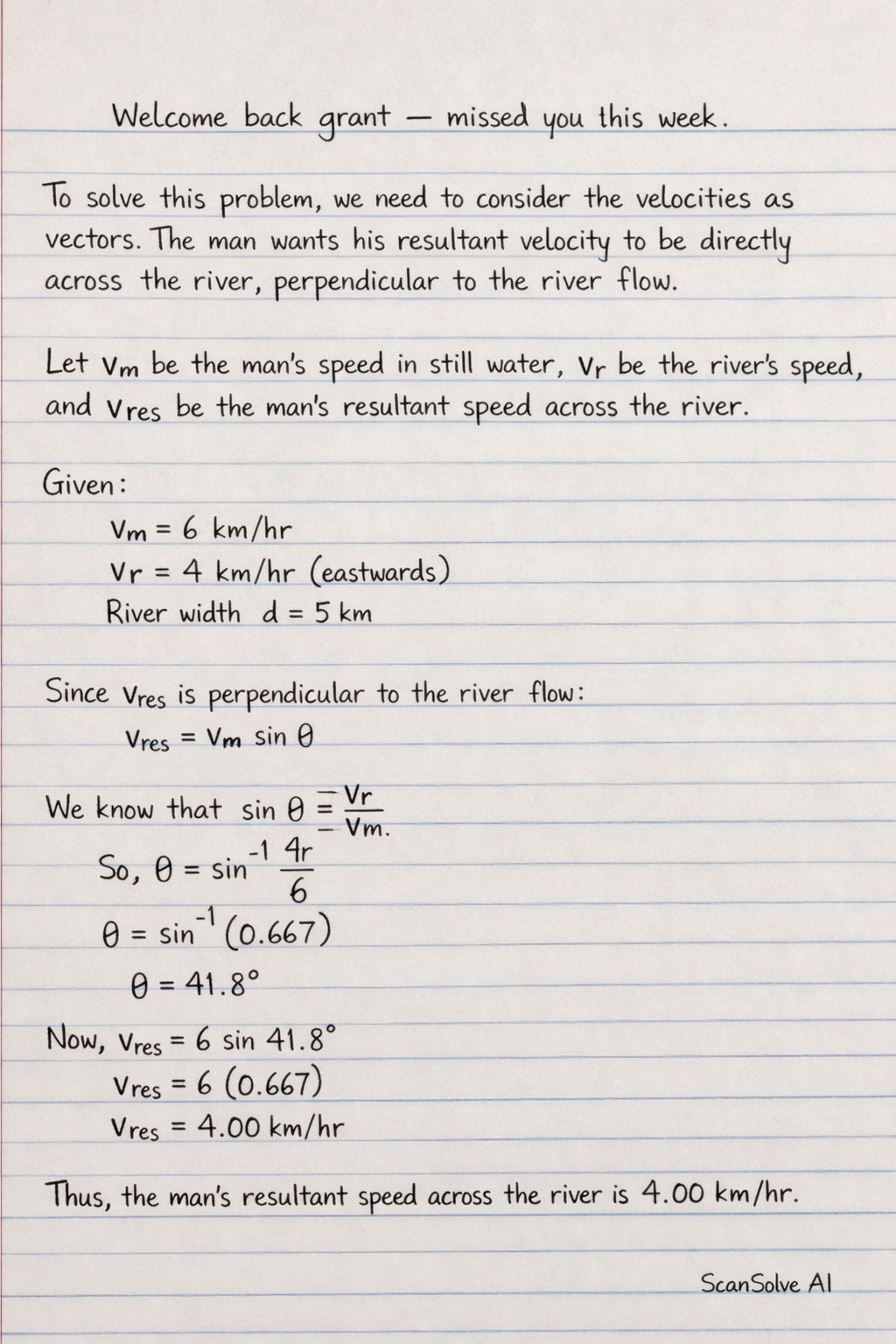
3 stepsTo solve this problem, we need to consider the velocities as vectors. The man wants his resultant velocity to be directly across the river, perpendicular to the river flow.
Let be the man's speed in still water, be the river's speed, and be the man's resultant speed across the river.
Given:
(eastwards)
River width
Determine the direction the man must set off.
To land directly opposite his starting point, the man must row upstream at an angle such that the component of his velocity against the river flow cancels out the river's velocity. This forms a right-angled triangle with as the hypotenuse, as the side opposite the angle of setting off upstream, and as the side adjacent to this angle.
Let be the angle upstream from the direction perpendicular to the river flow.
Using trigonometry:To find the angle :
The man must set off at an angle of upstream from the direction perpendicular to the river flow. If the river flows east, he must row west of north (assuming he wants to cross north).
Calculate the man's effective velocity across the river.
The effective velocity across the river, , is the component of the man's velocity perpendicular to the river flow. Using the Pythagorean theorem or the cosine of the angle:
Calculate the time taken to cross the river.
The time taken is the river width divided by the effective velocity across the river:
To simplify, multiply the numerator and denominator by :
As a decimal:
The direction in which he must set off is .
The time it will take to cross the river is .
Try one yourself
A new problem that tests the same skill.
Still stuck on this one?
Ask a follow-up, and the answer starts from this question.
More Physics Questions
Handwritten Step-by-Step Solution
Get this as a handwritten image on WhatsApp — like a tutor wrote it for you.
Try on WhatsApp