
We read your photo as:
A mass on a spring has an amplitude of 6.0 cm and a period of 2.0 s. If it is released from its maximum displacement at t=0, what are its position and velocity at t=5.2 s?
ScanSolve AI Answer
This answer stops before the end.
It was cut off when it was first written. Ask ScanSolve this question again for the full working.
here's the solution for the spring problem:
Given:
Amplitude,
Period,
Time,
Step 1: Calculate the angular frequency ().
The angular frequency is related to the period by the formula:
Substitute the given period:
Step 2: Compute the position after 5.2 s.
Since the mass is released from its maximum displacement () at , the displacement equation is:
Substitute the values for and :
Now, calculate the position at :
The position after 5.2 s is .
Step 3: Compute the velocity after 5.2 s.
The velocity is the derivative of the displacement with respect to time:
Substitute the values for and :
Now, calculate the velocity at :
The velocity after 5.2 s is .
Step 4: Calculate the maximum velocity.
The maximum velocity () for Simple Harmonic Motion is given by:
Substitute the values for and :
Still stuck on this one?
Ask a follow-up, and the answer starts from this question.
More Physics Questions
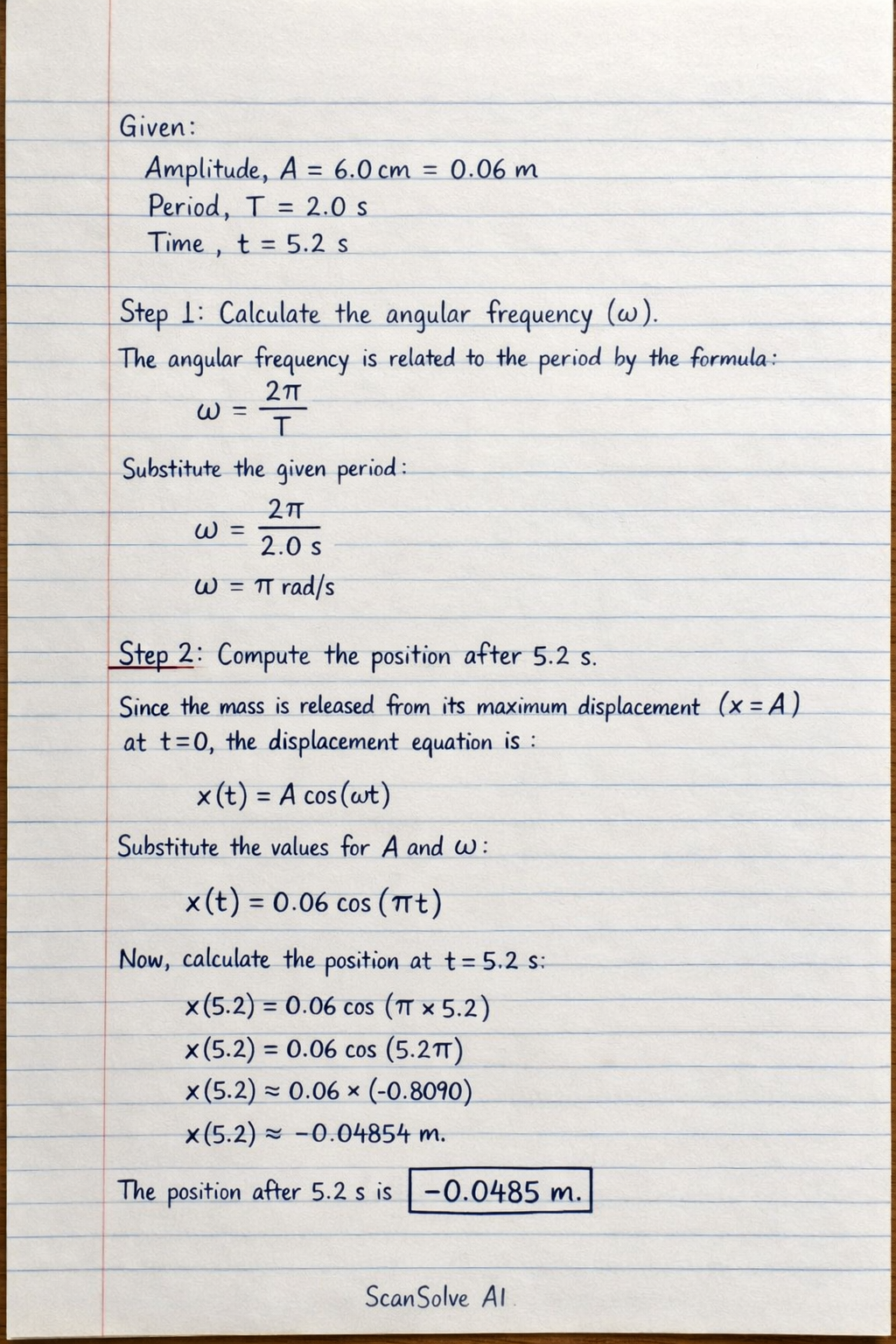
Handwritten Step-by-Step Solution
Get this as a handwritten image on WhatsApp — like a tutor wrote it for you.
Try on WhatsApp