
We read your photo as:
A moving-coil instrument gives a full-scale deflection if 20 mA flows through it. The resistance of the coil is 2 . Calculate:
ScanSolve AI Answer
Answers
2 partsStep-by-step solution
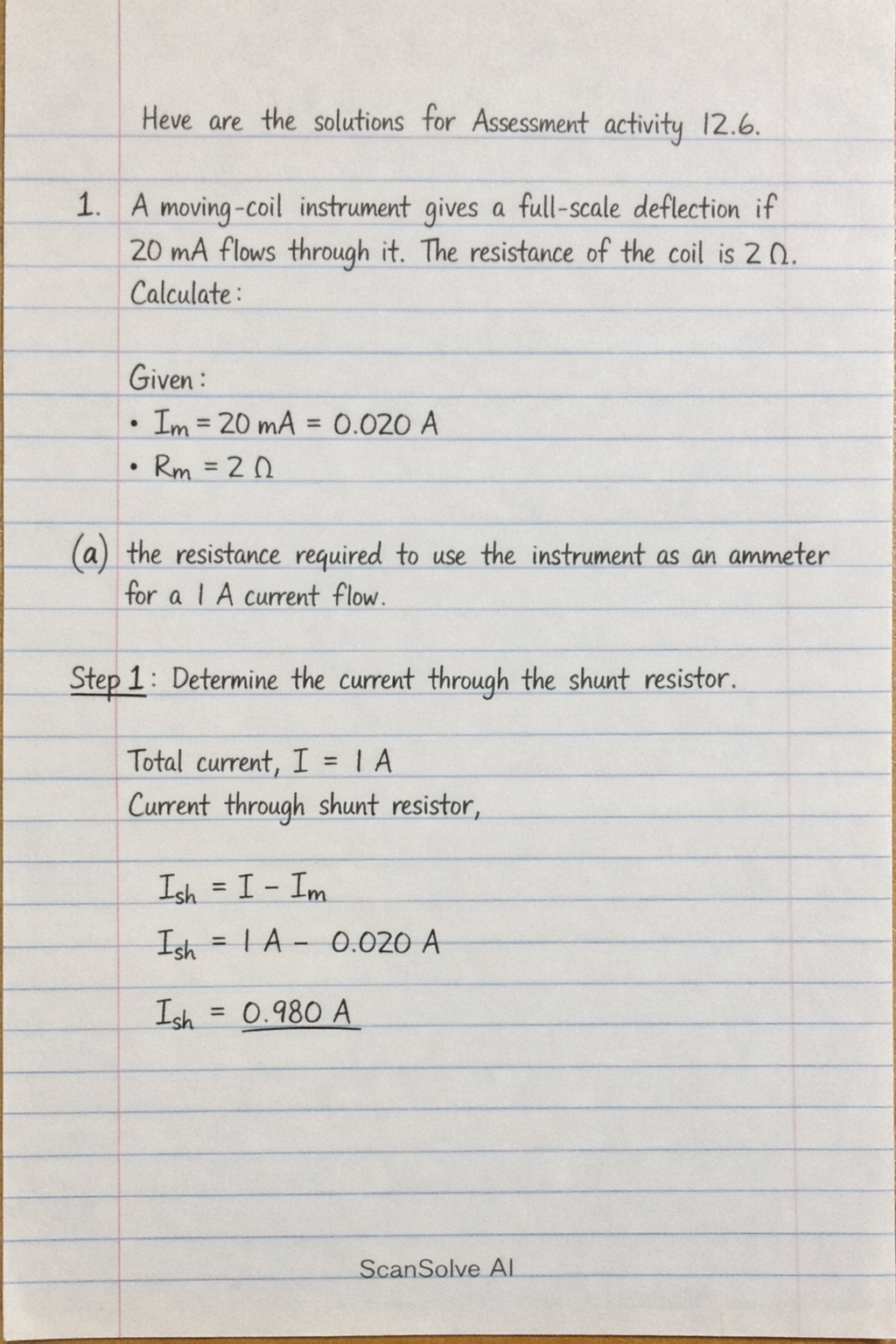
4 stepsHere are the solutions for Assessment activity 12.6.
1. A moving-coil instrument gives a full-scale deflection if 20 mA flows through it. The resistance of the coil is 2 . Calculate:
Given:
- Meter full-scale deflection current,
- Meter coil resistance,
Part a· 2 steps
the resistance required to use the instrument as an ammeter for a 1 A current flow
Determine the current through the shunt resistor.
To use the instrument as an ammeter, a shunt resistor () is connected in parallel with the meter. The total current () is .
The current flowing through the shunt resistor is the total current minus the current flowing through the meter:Calculate the required shunt resistance.
Since the shunt resistor is in parallel with the meter, the voltage across them is the same ().
Substitute the values:
The required shunt resistance is
Part b
the series resistance required to use the instrument as a voltmeter up to 10 V.
Determine the total resistance needed for the voltmeter.
To use the instrument as a voltmeter, a series resistor () is connected in series with the meter. The maximum voltage () to be measured is .
At full-scale deflection, the total resistance () of the voltmeter circuit is given by Ohm's law:Calculate the required series resistance.
The total resistance is the sum of the meter's resistance and the series resistance:
Substitute the values:
The required series resistance is
2. What material are shunt resistors made of? Why?
Shunt resistors are typically made of materials like Manganin or Constantan.
These materials are chosen for shunt resistors primarily because they have a very low temperature coefficient of resistance. This means their resistance changes very little with variations in temperature, ensuring that the ammeter's accuracy is maintained even when the instrument heats up due to current flow. They also have high resistivity and low thermal electromotive force (EMF) against copper.
Try one yourself
A new problem that tests the same skill.
Still stuck on this one?
Ask a follow-up, and the answer starts from this question.
More Physics Questions
Handwritten Step-by-Step Solution
Get this as a handwritten image on WhatsApp — like a tutor wrote it for you.
Try on WhatsApp