
We read your photo as:
For the electron configuration of the transition element chromium (Cr), which has an atomic number of 24. This means a neutral chromium atom has 24 electrons.
ScanSolve AI Answer
Answer
Step-by-step solution
3 stepsBright, let's tackle this electron configuration.
The question asks for the electron configuration of the transition element chromium (), which has an atomic number of 24. This means a neutral chromium atom has 24 electrons.
Write the expected electron configuration based on the Aufbau principle.
For 24 electrons, the standard filling order would be:
Let's count the electrons: .Consider the exception for Chromium.
Chromium is an exception to the Aufbau principle. Atoms tend to achieve greater stability with half-filled or fully-filled d-orbitals. In the case of chromium, promoting one electron from the orbital to the orbital results in a half-filled subshell () and a half-filled subshell (), which is more stable than .
So, the actual electron configuration for chromium is:
Let's count the electrons again: .Compare with the given options.
- (a) (This is the expected configuration, but not the actual stable one for Cr).
- (b) (Incorrect, orbital is missing and electron count is 24, but order is wrong).
- (c) (Incorrect electron count: ).
- (d) (This matches the actual stable configuration for chromium).
The correct option is d).
Try one yourself
A new problem that tests the same skill.
Still stuck on this one?
Ask a follow-up, and the answer starts from this question.
More Physics Questions
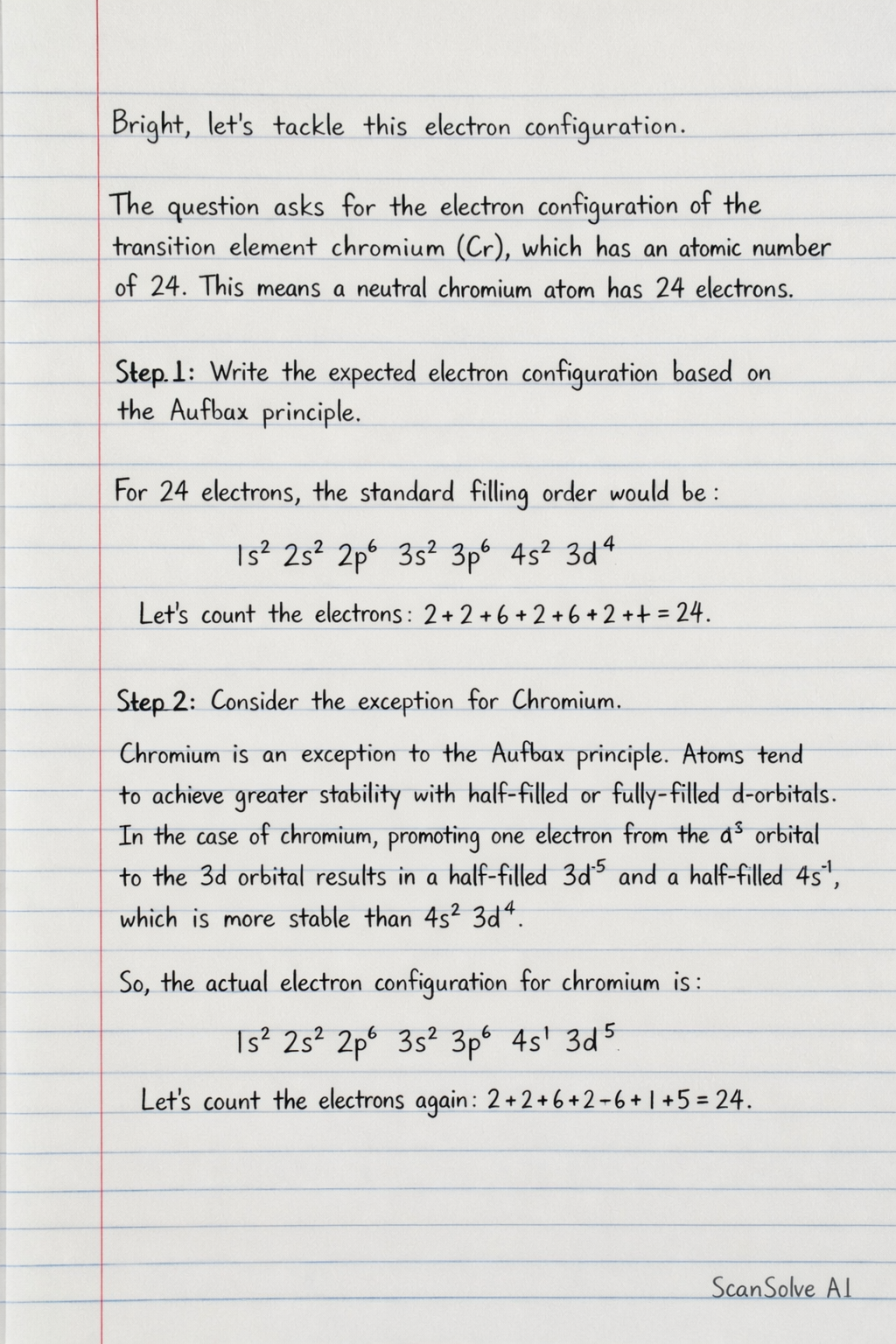
Handwritten Step-by-Step Solution
Get this as a handwritten image on WhatsApp — like a tutor wrote it for you.
Try on WhatsApp