
We read your photo as:
A moving-coil instrument with a resistance of 5 and a full-scale deflection current of 20 mA is to be converted into an ammeter to measure a total current of 3 A. Calculate the required shunt resistan
ScanSolve AI Answer
Answer
Step-by-step solution
5 stepsIdentify the given values.
The resistance of the moving-coil instrument is .
The full-scale deflection current of the instrument is .
The total current to be measured is .Determine the current that must flow through the shunt resistor.
When a shunt resistor is connected in parallel with the instrument, the total current splits between the instrument current and the shunt current .
Therefore, the current through the shunt resistor is:
Calculate the voltage across the instrument.
Since the shunt resistor is in parallel with the instrument, the voltage across both components is the same.
The voltage across the instrument is:Calculate the shunt resistance.
The voltage across the shunt resistor is equal to the voltage across the instrument, .
Using Ohm's Law for the shunt resistor:Round the final answer.
The shunt resistance required is .
Try one yourself
A new problem that tests the same skill.
Still stuck on this one?
Ask a follow-up, and the answer starts from this question.
More Physics Questions
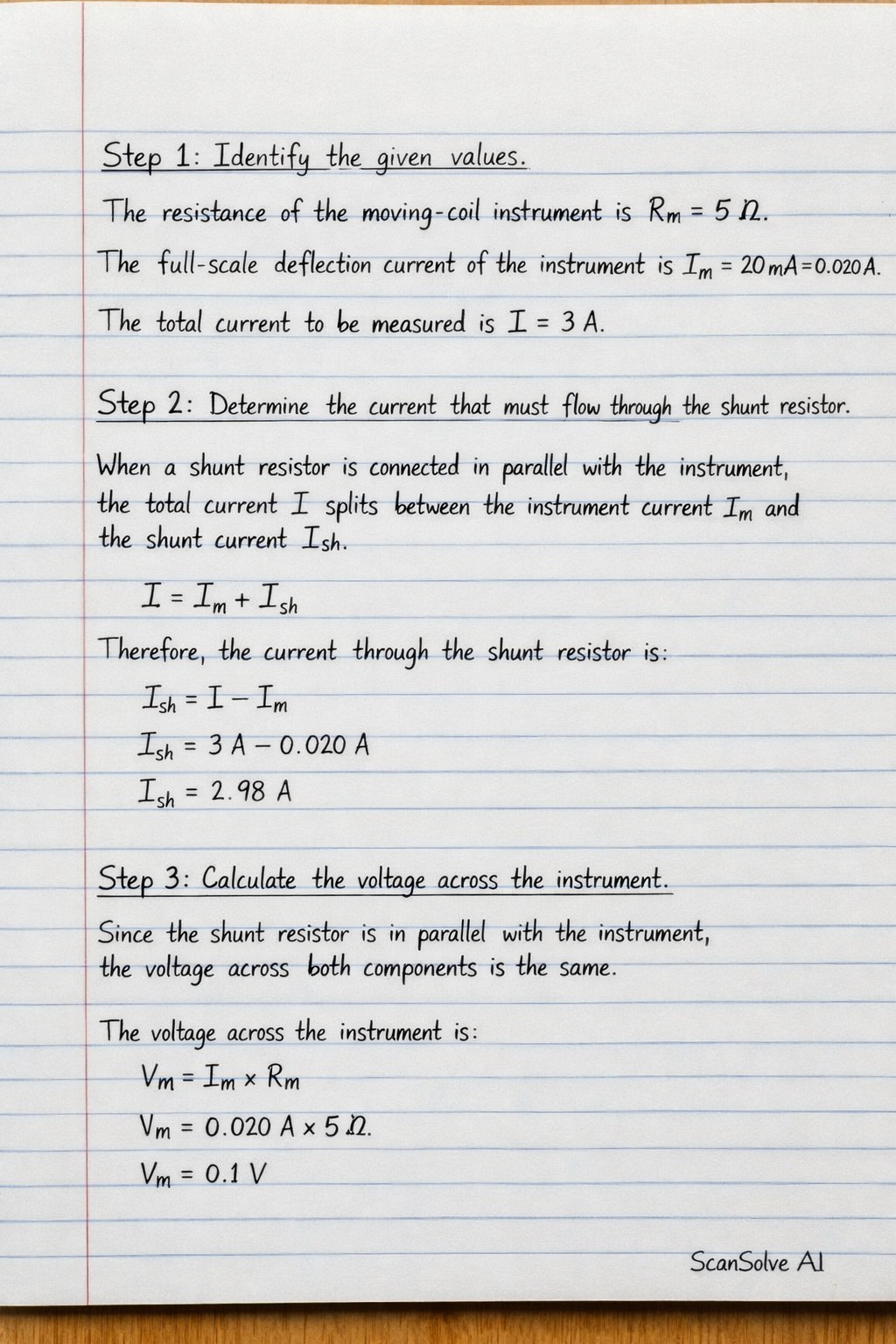
Handwritten Step-by-Step Solution
Get this as a handwritten image on WhatsApp — like a tutor wrote it for you.
Try on WhatsApp