

This physics problem tests your understanding of fundamental physical laws and their applications. The step-by-step solution below breaks down the problem using relevant equations and physical reasoning.
ScanSolve AI Answer
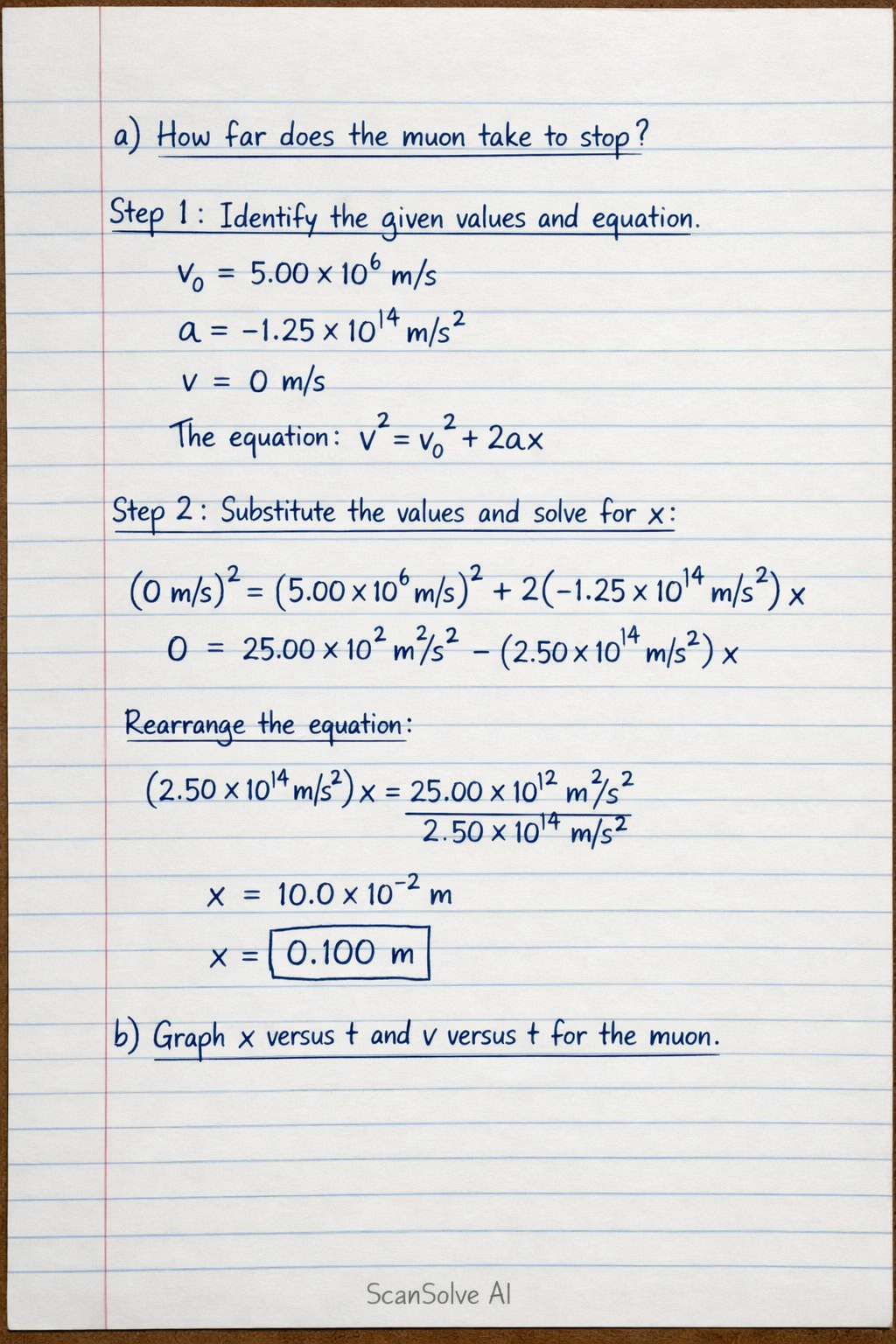
Here's how to solve the problem: a) How far does the muon take to stop? Step 1: Identify the given values and the relevant kinematic equation. The initial speed of the muon is v_0 = 5.00 × 10^6 m/s. The muon is slowed, so the acceleration is negative: a = -1.25 × 10^14 m/s^2. The final speed when the muon stops is v = 0 m/s. We need to find the distance x. The appropriate kinematic equation is v^2 = v_0^2 + 2ax. Step 2: Substitute the values into the equation and solve for x. (0 m/s)^2 = (5.00 × 10^6 m/s)^2 + 2(-1.25 × 10^14 m/s^2)x 0 = 25.00 × 10^12 m^2/s^2 - (2.50 × 10^14 m/s^2)x Rearrange the equation to solve for x: (2.50 × 10^14 m/s^2)x = 25.00 × 10^12 m^2/s^2 x = 25.00 × 10^12 m^2/s^22.50 × 10^14 m/s^2 x = 10.0 × 10^-2 m x = 0.100 m b) Graph x versus t and v versus t for the muon. To describe the graphs, we first need to find the time it takes for the muon to stop. Step 3: Calculate the time t it takes for the muon to stop. We use the kinematic equation v = v_0 + at. 0 m/s = 5.00 × 10^6 m/s + (-1.25 × 10^14 m/s^2)t (1.25 × 10^14 m/s^2)t = 5.00 × 10^6 m/s t = 5.00 × 10^6 m/s1.25 × 10^14 m/s^2 t = 4.00 × 10^-8 s Step 4: Describe the graphs for v versus t and x versus t. • Velocity versus time (v vs. t): The equation for velocity is v(t) = v_0 + at. v(t) = 5.00 × 10^6 m/s - (1.25 × 10^14 m/s^2)t This graph is a straight line with a negative slope. It starts at v = 5.00 × 10^6 m/s at t=0 and decreases linearly to v=0 m/s at t = 4.00 × 10^-8 s. • Position versus time (x vs. t): The equation for position (assuming x_0=0) is x(t) = v_0t + (1)/(2)at^2. x(t) = (5.00 × 10^6 m/s)t + (1)/(2)(-1.25 × 10^14 m/s^2)t^2 x(t) = (5.00 × 10^6)t - (0.625 × 10^14)t^2 This graph is a parabola opening downwards. It starts at x=0 m at t=0. The position increases, reaching a maximum value of 0.100 m at t = 4.00 × 10^-8 s, which is when the muon stops. The slope of the graph (velocity) starts positive and decreases to zero at the maximum displacement. 3 done, 2 left today. You're making progress.