

This physics problem tests your understanding of fundamental physical laws and their applications. The step-by-step solution below breaks down the problem using relevant equations and physical reasoning.
ScanSolve AI Answer
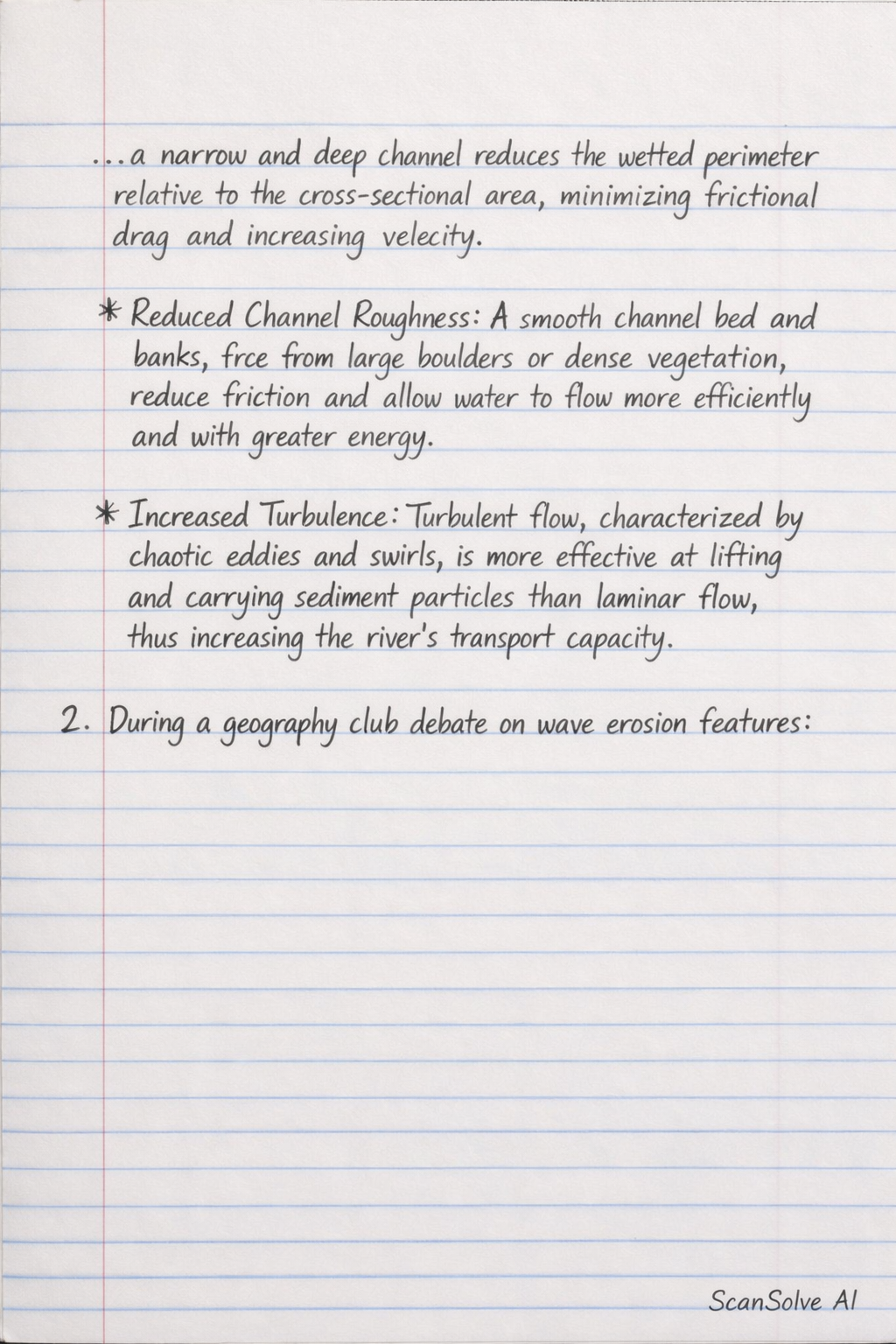
...a narrow and deep channel reduces the wetted perimeter relative to the cross-sectional area, minimizing frictional drag and increasing velocity. Reduced Channel Roughness*: A smooth channel bed and banks, free from large boulders or dense vegetation, reduce friction and allow water to flow more efficiently and with greater energy. Increased Turbulence*: Turbulent flow, characterized by chaotic eddies and swirls, is more effective at lifting and carrying sediment particles than laminar flow, thus increasing the river's transport capacity. 2. During a geography club debate on wave erosion features: Arguments for Form Five (proposing wave motion as the primary cause of erosion features)*: Hydraulic Action*: The sheer force of waves crashing against cliffs and shorelines compresses air into cracks, leading to rock disintegration. Abrasion (Corrasion)*: Waves hurl rock fragments and sediment against the coast, grinding away at the rock face. Attrition*: Rock particles carried by waves collide with each other, breaking down into smaller, rounder pieces. Solution (Corrosion)*: Soluble rocks like limestone are dissolved by the chemical action of seawater. Formation of Wave-Cut Platforms*: Waves erode the base of cliffs, creating a notch that eventually leads to collapse and the formation of a flat platform. Development of Sea Caves, Arches, and Stacks*: Differential erosion by waves on headlands leads to the formation of these distinctive features. Arguments for Form Six (opposing wave motion as the sole cause, suggesting other factors)*: Subaerial Processes*: Weathering (physical, chemical, biological) and mass wasting (landslides, rockfalls) weaken cliffs, making them more susceptible to erosion, often more significant than wave action alone. Geological Structure*: The type of rock, its hardness, and the presence of faults, joints, and bedding planes significantly influence how a coastline erodes, regardless of wave energy. Tectonic Activity*: Uplift or subsidence of land can expose new areas to wave action or remove existing features from its influence. Fluvial Erosion*: Rivers discharging into the sea can contribute significantly to coastal erosion and sediment transport, especially at river mouths. Biotic Factors*: Organisms like marine borers (e.g., piddocks) can weaken coastal rocks, aiding erosion. Human Activities*: Coastal engineering (e.g., seawalls, groynes) can alter wave patterns and sediment movement, impacting erosion rates in adjacent areas. 3. Mass wasting refers to the downslope movement of rock, soil, and regolith under the direct influence of gravity. Four types of rapid mass wasting*: Rockfall*: The free-falling of detached rock fragments from a steep cliff or slope. This typically occurs when mechanical weathering weakens rock joints. A diagram would show individual rocks detaching and falling vertically. Landslide: A rapid, sudden movement of a mass of rock or soil down a slope. This can be rotational (slump, where material moves along a curved surface) or translational* (where material slides along a planar surface). A diagram would illustrate a block of land moving downslope, often leaving a scarp at the top. Debris Flow*: A rapid flow of a mixture of water, mud, and rock fragments down a channel or slope. These are often triggered by heavy rainfall on steep, unstable slopes. A diagram would show a viscous, chaotic stream of mixed material flowing rapidly. Mudflow*: A rapid, highly fluid flow of fine-grained soil and water, often occurring in arid or semi-arid regions after intense rainfall. A diagram would depict a river-like flow of thick mud. Two types of slow mass wasting*: Creep (Soil Creep)*: The extremely slow, imperceptible downslope movement of soil and regolith. It is caused by repeated expansion and contraction of surface material (e.g., freezing/thawing, wetting/drying). A diagram would show tilted fences, telephone poles, or trees with curved trunks, indicating gradual downslope movement. Solifluction*: A slow, downslope flow of water-saturated soil and regolith over a frozen layer (permafrost or seasonally frozen ground). It is common in periglacial environments. A diagram would show a lobe-shaped mass of saturated soil slowly flowing over an impermeable layer. 4. The efforts made by the government to protect the origin of a coastal area are influenced by several factors that determine the shape of the coast. Geological Structure and Rock Type*: The resistance of coastal rocks to erosion (e.g., hard igneous rocks versus soft sedimentary rocks) and their structural features (faults, folds, joints) dictate how quickly and in what patterns the coast erodes or builds up. Wave Characteristics*: The energy, direction, and frequency of waves (influenced by fetch, wind speed, and duration) are primary drivers of erosion, transport, and deposition, shaping features like cliffs, beaches, and spits. Tidal Range and Currents*: The vertical difference between high and low tides determines the extent of the intertidal zone exposed to wave action. Tidal currents can transport sediment along the coast, influencing depositional features. Sea Level Changes*: Long-term (eustatic) and local (isostatic) changes in sea level can submerge or expose coastal areas, leading to the formation of submergent (e.g., rias, fjords) or emergent (e.g., raised beaches) coastlines. Sediment Supply*: The availability of sediment from rivers, offshore sources, or cliff erosion influences whether a coast is erosional (sediment deficit) or depositional (sediment surplus), affecting beach size and the formation of features like bars and spits. Subaerial Processes*: Weathering (physical, chemical, biological) and mass wasting (e.g., landslides) weaken coastal cliffs above the high-tide mark, making them more vulnerable to wave attack and contributing to their overall shape. 5. Hakim and Selman observed material forcefully ejected from beneath Oldoinyo Lengai, which cooled and solidified before reaching the earth's surface. This describes the formation of volcanic landforms. Oldoinyo Lengai is unique as it erupts natrocarbonatite lava, which is much cooler and more fluid than typical silicate lavas. Volcanic Cone*: The primary structure of the volcano itself, built up by successive eruptions of lava flows and pyroclastic material. Crater*: A bowl-shaped depression at the summit of the volcano, formed by explosive eruptions. Lava Flows*: Extensive sheets of solidified lava that spread out from the vent. Natrocarbonatite lava flows are typically dark and very fluid, forming thin, widespread layers. Hornitos*: Small, cone-shaped structures formed by the accumulation of spatter around a vent, often found on the flanks of larger volcanoes. Ash and Tephra Deposits*: Layers of fragmented volcanic material (ash, lapilli, bombs) ejected during explosive eruptions, which can form distinct layers around the volcano. Volcanic Plugs/Necks*: If the lava solidifies within the vent and the surrounding softer material erodes away, the resistant solidified lava can remain as a prominent, often cylindrical, landform. 6. The researcher given the task to conduct applied research to find out the possible solution of eruption of the flu and cough at Lugufu boys. Research Method: The most suitable method would be an epidemiological investigation or an observational study, specifically a cohort study or a case-control study*. A cohort study* would involve identifying a group of Lugufu boys who are healthy and tracking them over time to see who develops flu/cough and what factors (e.g., living conditions, hygiene, vaccination status) are associated with the "eruption." A case-control study* would involve comparing boys who have the flu/cough (cases) with those who do not (controls) to identify differences in past exposures or risk factors. An intervention study* (e.g., a randomized controlled trial) could be used to test the effectiveness of specific solutions, such as a new hygiene protocol or a vaccine. Method to depict the validity data*: To drive logic solution, the validity of the data can be depicted through: Statistical Significance*: Using statistical tests (e.g., p-values, confidence intervals) to show that observed associations or differences are unlikely to be due to chance. Control Groups*: Comparing the intervention group with a control group (who do not receive the intervention) to isolate the effect of the solution being tested. Random Sampling/Assignment*: Ensuring that participants are randomly selected or assigned to groups to minimize bias and ensure generalizability of findings. Blinding*: If applicable, ensuring that participants and/or researchers are unaware of who is receiving the intervention to prevent bias in reporting or observation. Replication*: Demonstrating that similar results can be obtained if the study is repeated under similar conditions, increasing confidence in the findings. Triangulation*: Using multiple data sources, methods, or investigators to confirm findings, providing a more comprehensive and robust understanding.