

This physics problem tests your understanding of fundamental physical laws and their applications. The step-by-step solution below breaks down the problem using relevant equations and physical reasoning.
ScanSolve AI Answer
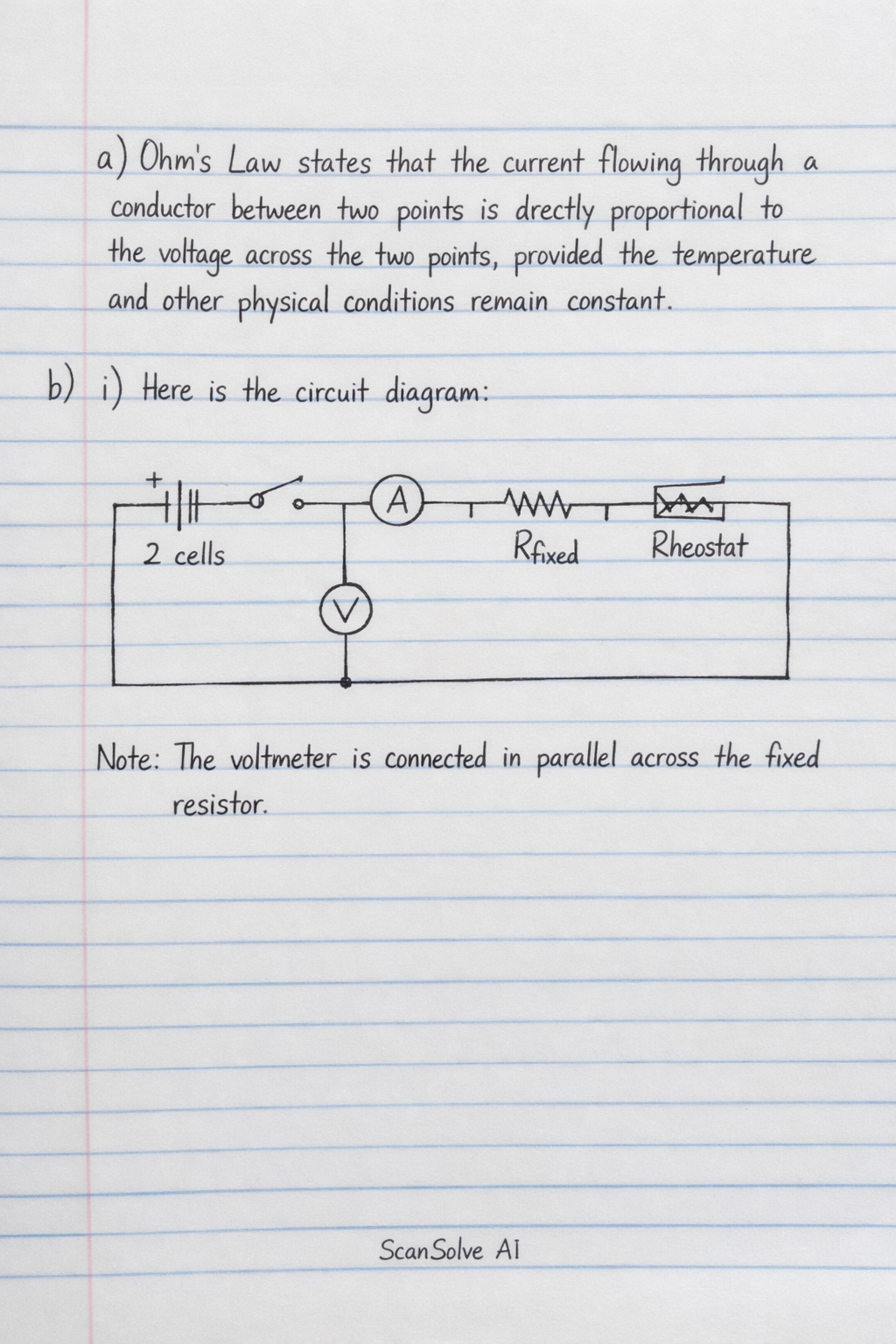
a) Ohm's Law states that the current flowing through a conductor between two points is directly proportional to the voltage across the two points, provided the temperature and other physical conditions remain constant. b) i) Here is the circuit diagram: (0,0) to[battery, l_=2 cells] (0,2) to[switch] (2,2) to[ammeter, l_=A] (4,2) to[R, l_=R_fixed] (6,2) to[variable resistor, l_=Rheostat] (8,2) to (8,0) to (0,0) (4,2) to[open, v_=V] (4,0); Note: The voltmeter is connected in parallel across the fixed resistor. ii) To determine Ohm's law using the setup: 1. Close the switch to complete the circuit. 2. Adjust the rheostat to vary the current flowing through the fixed resistor. 3. For each adjustment of the rheostat, record the reading on the ammeter (I) and the corresponding reading on the voltmeter (V) across the fixed resistor. 4. Repeat this process to obtain several pairs of (V, I) readings. 5. Plot a graph of voltage (V) on the y-axis against current (I) on the x-axis. 6. If the graph is a straight line passing through the origin, it verifies Ohm's law. The gradient of this V-I graph will give the resistance of the fixed resistor. Send me the next one 📸