
We read your photo as:
A parallel-plate capacitor has plates 0.8 mm apart and area 4 cm2. With a potential difference of 100 V, find its capacitance and the charge stored.
ScanSolve AI Answer
Answers
2 partsStep-by-step solution
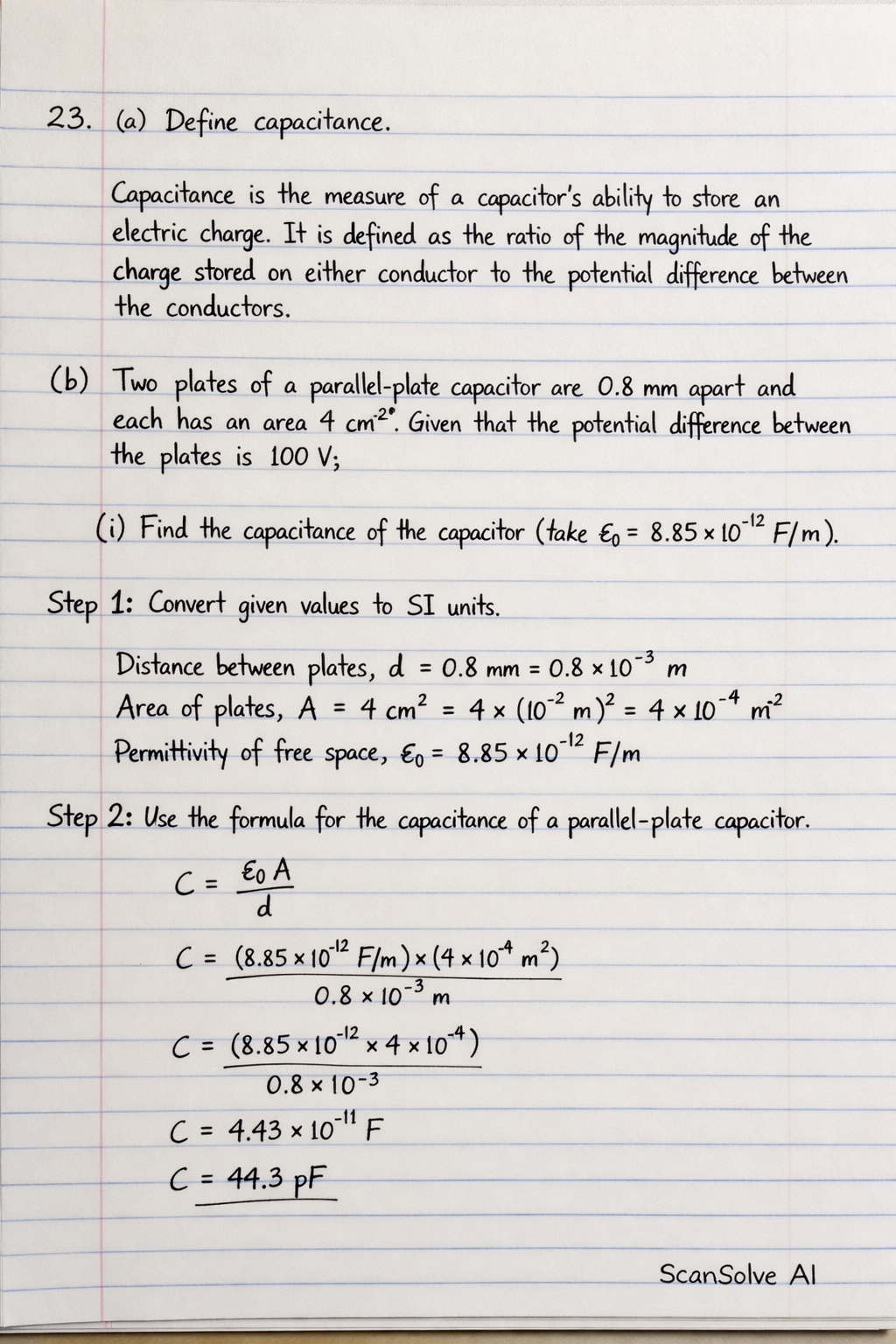
5 steps- (a) Define capacitance. Capacitance is the measure of a capacitor's ability to store an electric charge. It is defined as the ratio of the magnitude of the charge stored on either conductor to the potential difference between the conductors.
Part b(i)· 3 steps
Find the capacitance of the capacitor (take ).
Two plates of a parallel-plate capacitor are apart and each has an area . Given that the potential difference between the plates is ,
Convert given values to SI units.
Distance between plates,
Area of plates,
Permittivity of free space,Use the formula for the capacitance of a parallel-plate capacitor.
Substitute the values and calculate .
The capacitance of the capacitor is .
Part b(ii)
Calculate the charge stored in the capacitor.
Use the formula relating charge, capacitance, and potential difference.
Given potential difference,
Capacitance, (from part b(i))Substitute the values and calculate .
The charge stored in the capacitor is .
Part c
State two applications of a capacitor.
- Capacitors are used for energy storage, such as in camera flashes and defibrillators, where they release a large amount of energy quickly.
- They are used in filtering circuits to smooth out voltage fluctuations in power supplies or to block DC current while allowing AC current to pass.
Try one yourself
A new problem that tests the same skill.
Still stuck on this one?
Ask a follow-up, and the answer starts from this question.
More Physics Questions
Handwritten Step-by-Step Solution
Get this as a handwritten image on WhatsApp — like a tutor wrote it for you.
Try on WhatsApp