
We read your photo as:
A person is stuck to the inside of a large rotating drum of radius r. The coefficient of static friction between the person's clothes and the drum surface is mu. What is the minimum angular velocity o
ScanSolve AI Answer
Answer
Step-by-step solution
4 stepsIdentify the forces acting on the person.
For the person to remain stuck to the wall, the upward static frictional force () must balance the downward gravitational force (weight, ).
The normal force () exerted by the wall on the person provides the centripetal force required for circular motion.
where is the mass, is the angular velocity, and is the radius of the drum.
Apply the condition for static friction.
The maximum static frictional force is given by , where is the coefficient of static friction. For the person not to slide down, the frictional force must be at least equal to the weight:
Substitute the expression for the normal force into the friction inequality.
Substitute into the inequality:
Solve for the minimum angular velocity ().
To find the minimum angular velocity, we set the inequality to an equality:
Divide both sides by :
Solve for :
Take the square root of both sides:
Comparing this with the given options, option (a) matches our result.
The final answer is .
Try one yourself
A new problem that tests the same skill.
Still stuck on this one?
Ask a follow-up, and the answer starts from this question.
More Physics Questions
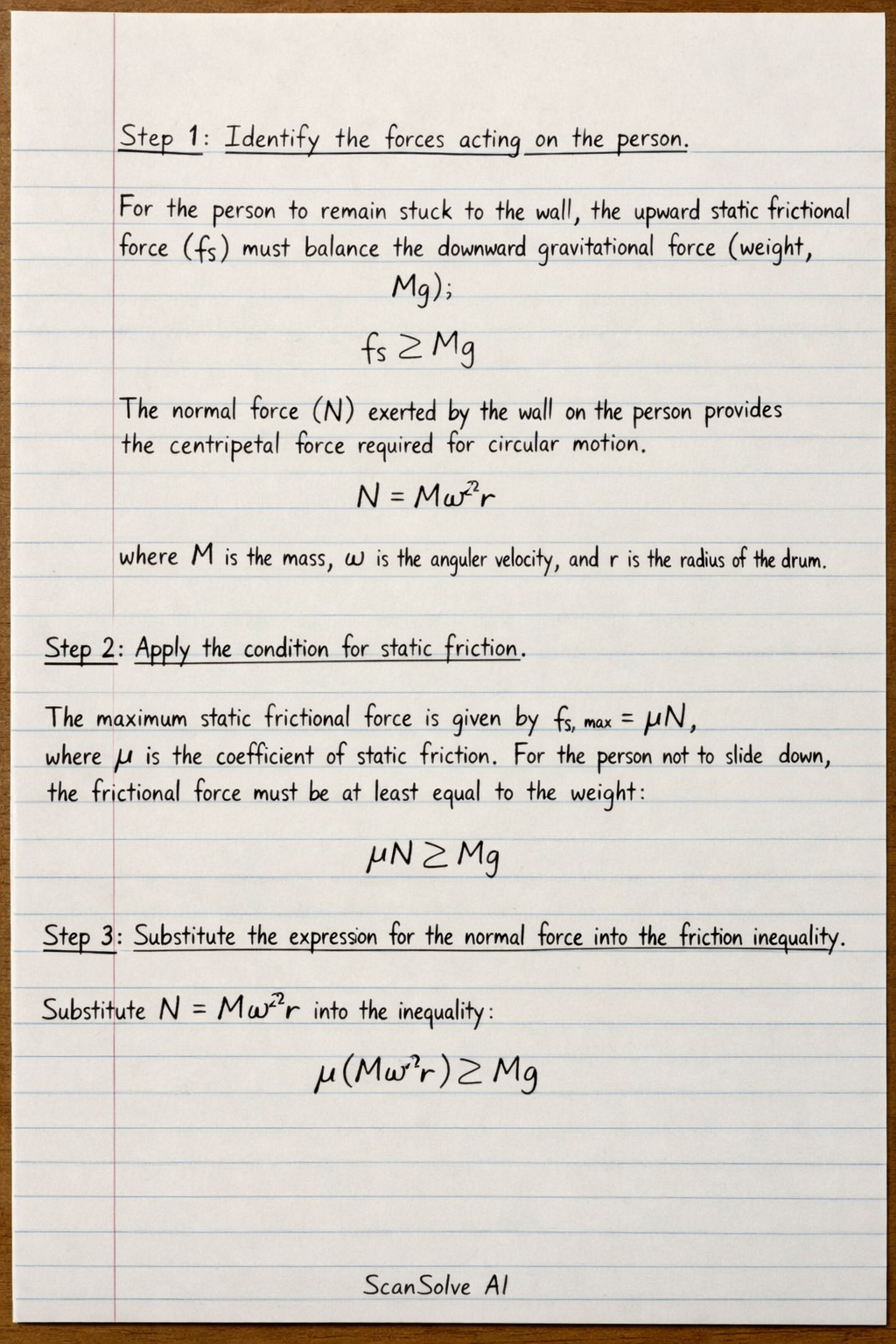
Handwritten Step-by-Step Solution
Get this as a handwritten image on WhatsApp — like a tutor wrote it for you.
Try on WhatsApp